
Content we are to dwell in gloom,
And drift to sleep ‘midst tales of yore,
Of witches, wizards, dark of doom,
In cold embrace, with words ignored
As if another chance might come,
To mend the folly, fix the slight,
As if our reasons were but numb,
And cause enough to set things right.
Soft and dark, the night awaits,
Perhaps of fate, perhaps of dreams,
I stretch upon my broken fates,
And wait for dawn’s redeeming beams.
You read again of Hume, and glance,
Distracted, at my pale, bare back
That I offer to your fleeting trance.
One night. Each night. The same old act.
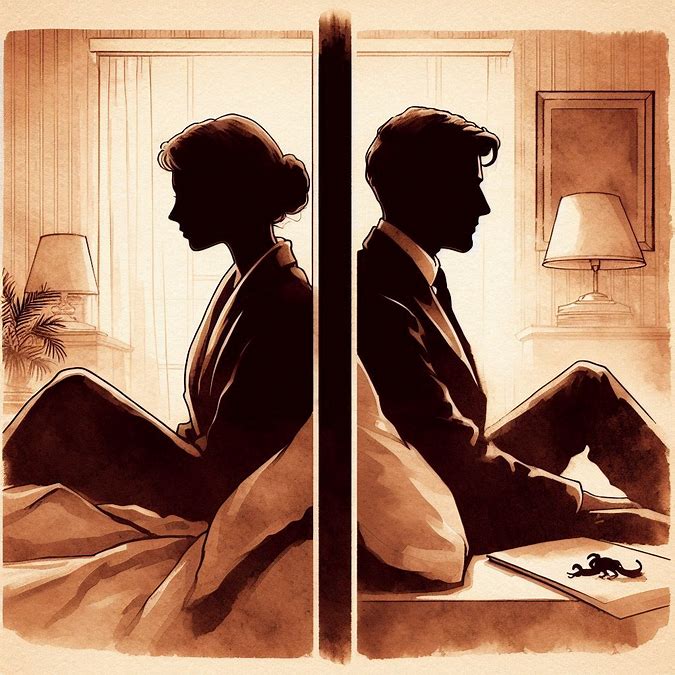
One Night
Thoughts – by E. Ashcroft
On Meaning and Context
The poem describes a night, one night that is also every night, spent in the company of a person with whom intimacy has calcified into routine. The two lie together in the dark, telling or listening to tales, reading philosophy, offering and ignoring the body, and the offering and the ignoring have become so habitual that they constitute not a relationship but an act, a performance repeated without variation, without development, without the possibility of change, each night identical to the last, each morning’s redemption deferred to the next evening’s repetition.
The narrative is domestic and devastatingly specific. The speaker and the addressed “you” are in bed. They drift toward sleep amid tales of witches and wizards, the comfortable, undemanding fictions of the fantastical, stories that require no emotional investment and that serve the same function as the distillate in other poems I have examined: they fill the space between two people who have ceased to fill it themselves. The “you” reads Hume, the empiricist, the sceptic, the philosopher who questioned causation itself, and the choice of reading matter is not accidental, for a person who reads Hume in bed beside a lover whose back is offered and ignored is a person who has, perhaps unconsciously, aligned herself with a philosophical tradition that doubts whether one thing necessarily leads to another, whether cause produces effect, whether the turning of the body toward another body will result in anything at all.
The speaker stretches upon his “broken fates” and waits for dawn. The fates are broken, which is to say the threads that the mythical spinners wove have been cut or tangled or simply worn through, and what remains is not destiny but its wreckage, and the speaker lies upon the wreckage as one lies upon a bed, for the bed and the broken fates are the same surface, and the sleeping and the waiting are the same activity, and the dawn that might redeem is a dawn that arrives every morning and redeems nothing, for the night that follows will be the same, and the act will be the same, and the sameness is the poem’s true subject.
On Style and Register
The register is notable for its departure from the sustained archaism of much of this author’s other work. The poem is written predominantly in a contemporary idiom, with only “midst”, “yore”, and “‘tis” marking an archaic presence that is vestigial rather than structural. The pronoun of address is “you”, not “thou”, and this choice is significant: the intimacy of “thou”, with its connotations of tenderness and spiritual proximity, has been replaced by the neutrality of “you”, the pronoun of acquaintance, of formality, of distance maintained within closeness. The beloved is not “thou” here. She is “you.” The pronoun itself enacts the condition the poem describes.
“Content we are to dwell in gloom” opens the poem with an inversion that places the emphasis on “content”, a word that is doing heavy ironic work. They are content. The contentment is not satisfaction but resignation, the contentment of people who have ceased to expect anything better and have adjusted their appetites to the available supply. “Dwell in gloom” is precise: they do not merely inhabit the darkness, they dwell in it, which implies duration, permanence, the setting up of residence in a condition that was presumably once temporary and has become, through the accumulation of identical nights, a domicile.
“Of witches, wizards, dark of doom” is a line that risks the trivial and narrowly avoids it. The tales of yore are the narrative equivalent of the gloom: comfortable, familiar, requiring no participation beyond the passive reception of images that have been encountered so many times they have ceased to produce either fear or wonder. The catalogue, “witches, wizards, dark of doom”, has a slightly sing-song quality that is, I think, intentional: the tales have become a lullaby, a rhythmic device for inducing sleep, and the rhythm of the line mimics the soporific quality of the stories themselves.
“That I offer to your fleeting trance” is the poem’s most quietly devastating line. The speaker offers his bare back. The offering is not sexual, or not primarily sexual; it is a gesture of vulnerability, of exposure, of the body turned toward another in the hope of being seen, or touched, or at least acknowledged. And the trance into which the offering is received is “fleeting”, which is to say it is not even a sustained trance but a momentary one, a glance that arrives and departs without having committed to the seeing, a half-attention that is worse than inattention because it contains within it the possibility of attention and the refusal to exercise it.
On Technique and Metre
The poem is written in iambic tetrameter, and it handles the form with a steadiness that is itself thematically significant: the regularity of the metre mirrors the regularity of the nights, the predictable rhythm of the line enacting the predictable rhythm of the routine. There are no dramatic metrical disruptions, no spondaic clusters, no moments where the metre breaks under the pressure of the content, and this restraint is not a fault but a choice, for the poem’s subject is precisely the absence of disruption, the terrible evenness of a life in which nothing changes and nothing breaks and nothing happens except the repetition of the same act, night after night, in the same metre, on the same bed, in the same gloom.
“Content we are to dwell in gloom” scans cleanly and establishes the contract. “And drift to sleep midst tales of yore” maintains it. “Of witches, wizards, dark of doom” is metrically regular but phonetically dense, the alliteration of “witches” and “wizards” and the assonance of “dark” and “doom” creating a sonic texture that is richer than the content warrants, which is itself a minor commentary: the tales of yore are linguistically more interesting than the life they are being used to avoid.
“I stretch upon my broken fates” is the poem’s most metrically interesting line. “Stretch upon” creates a slight elongation in the line’s middle, the vowel of “stretch” opening the sound as the body opens on the bed, and “broken fates” closes with two heavy stresses that land with the weight of a body settling onto a surface it knows too well. The line is physically mimetic in a way that the surrounding lines are not, and the mimesis is effective.
“One night. Each night. The same old act.” The final line deserves particular attention for its metrical departure. It is not tetrameter but a series of three short, punctuated phrases followed by a longer one, and the fragmentation of the line is the poem’s single formal rupture, the one moment where the steady metre cracks. The cracking is the poem’s only admission that the sameness is unbearable, for throughout the preceding fifteen lines the metre has maintained its composure, absorbing the content of despair without registering it formally, and here, at the last, the composure breaks, and the breaking is the poem’s truest statement, more true than any of the images or observations that have preceded it, because it is made not in language but in form, not in what the line says but in how it fails to sustain the rhythm it has been sustaining.
On Rhyme
The scheme is ABAB throughout, with one significant deviation in the final stanza. The rhymes are, for the most part, functional and well placed.
“Gloom” and “doom” in the opening stanza is a full rhyme and an inevitable one: gloom begets doom, the dwelling in darkness produces the darkness of the tales, and the rhyme binds the condition to its expression with a circularity that is itself the poem’s structural principle. “Yore” and “ignored” is technically a near-rhyme, the full syllable of “ignored” extending beyond the monosyllable of “yore”, and the extension is productive: the tales of yore are short and self-contained, the ignoring is longer and more persistent, and the rhyme’s asymmetry mirrors this disparity.
“Come” and “numb” in the second stanza is effective: the chance that might come is answered by the numbness of the reasons, and the rhyme connects possibility with anaesthesia, the hope of another chance with the deadening of the faculties that might seize it. “Slight” and “right” is clean and semantically charged: the folly and the slight are answered by the setting right, and the rhyme contains within itself the entire fantasy of repair, the dream that damage might be undone, which the poem presents as a conditional, an “as if”, and which the rhyme, by connecting the two, both entertains and dismisses.
“Awaits” and “fates” in the third stanza is strong: the night that awaits is answered by the broken fates, and the rhyme binds the temporal to the mythical, the specific evening to the entire arc of a life’s trajectory. “Dreams” and “beams” is the poem’s most conventional pairing, the dawn’s beams answering the night’s dreams with a neatness that borders on the formulaic. I note it without enthusiasm, though I concede that the conventionality of the rhyme may itself be part of the poem’s argument: the dawn’s redemption is as formulaic as the rhyme that announces it, and neither delivers what it promises.
“Glance” and “trance” in the final stanza is the poem’s best rhyme. The glance is brief, distracted, uncommitted; the trance is a state of partial absence, of consciousness that has withdrawn from its own attention. The rhyme connects the two forms of partial engagement, the looking-without-seeing and the seeing-without-attending, and finds in them the same sonic substance, which tells us they are the same act, or rather the same failure to act, repeated in different registers.
“Back” and “act” closes the poem with a full rhyme of considerable force. The bare back, offered and unacknowledged, is answered by the act, the performance, the nightly repetition that has replaced the genuine with the rehearsed. The rhyme is blunt, monosyllabic, and final, and it closes the poem with the same decisiveness with which the poem closes each night: abruptly, without resolution, with nothing left to say because everything that might be said has been absorbed into the routine of not saying it.
On Impressions
This is a poem that achieves its effect through the relentless accumulation of the ordinary. There is no dramatic event. There is no confrontation. There is no revelation. There is only the same night, repeated, and the same gestures, performed, and the same body, offered, and the same philosophy, read, and the same dawn, awaited, and the sameness is the poem’s horror and its achievement, for to make sameness feel like horror is to accomplish something that requires a precision most poets do not possess, the precision of the unremarkable rendered remarkable by the sheer weight of its repetition.
The Hume is a detail of quiet brilliance. The beloved reads a philosopher whose central contribution to the history of thought was the questioning of causation, the demonstration that we cannot know, in any rigorous sense, that one event causes another, and she reads him while lying beside a man whose back is offered to her attention, and the back and the book are in competition for the same resource, which is the capacity to attend, and the book is winning, and the book’s subject is the impossibility of knowing whether anything leads to anything else, which is also the subject of the relationship, which has ceased to believe in its own causation, which no longer trusts that the offering of the back will lead to the touching of the back, or that the touching will lead to anything further, or that the further will lead to anything at all.
The final line, “One night. Each night. The same old act”, is the poem at its most compressed and its most devastating. Three phrases. A progression from the singular to the habitual to the theatrical. One night: this night, specific, unrepeatable. Each night: every night, general, undifferentiated. The same old act: performance, repetition, the replacement of the genuine by its imitation. The progression is from the particular to the universal to the fraudulent, and the fraudulent is where the poem ends, and the ending is the beginning of the next night, which will be the same, and the sameness will be the same, and the act will be performed again, and the back will be offered again, and the book will be read again, and the dawn will come again, and nothing will have changed, and the unchanging will continue, and the poem, having said all of this in sixteen lines, has nothing further to add, which is, in itself, the most eloquent statement of the condition it describes.
I commend it with a single reservation: the “dreams” and “beams” rhyme in the third stanza is beneath the standard the poem otherwise maintains. The rest is exact, unflinching, and accomplished.

 mvrcodelrio.com
Lascia un commento