
The voices wane behind Mt. Bearline,
As I lift the line from the rocky crest;
Seven-forty, not even a brine,
The water is warm, I ponder, undress.
From the deeper blue, a fairer sight,
Crimson gleams paints the sky’s dome,
‘Mid clouds compelled to gather tight,
And a crescent moon veiled in gloam.
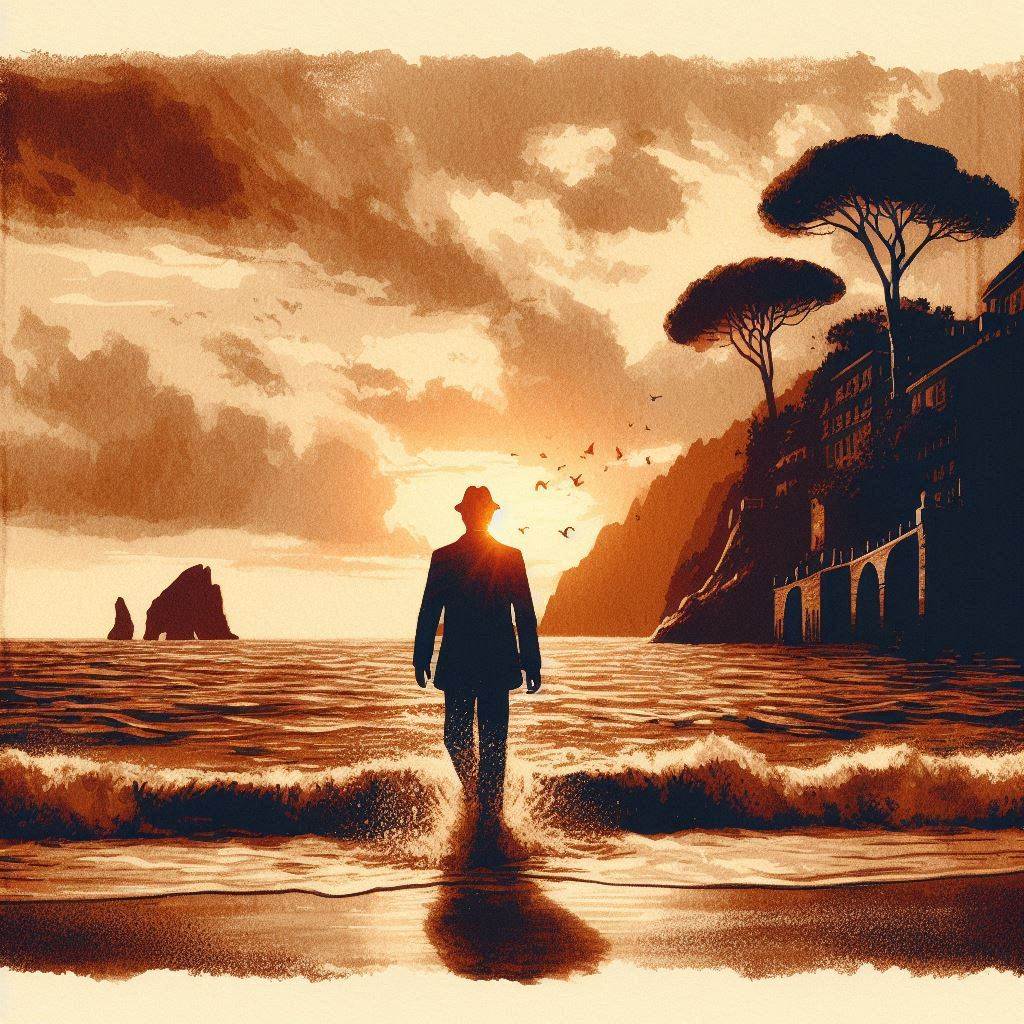
Bath at Sunset
Thoughts – by E. Ashcroft
On Meaning and Context
The poem describes a specific moment: a man at a body of water near Mt. Bearline at seven-forty in the evening, the sun setting, the voices of others fading behind the ridge, the water warm and without salt, the sky painting itself in crimson and deepening blue, a crescent moon appearing through the gloom. He lifts a fishing line from a rocky crest, considers the scene, undresses, and prepares to bathe. That is all. Nothing else happens, and the poem is wise enough to recognise that nothing else needs to.
This is a poem of pure observation and physical presence, and its achievement is the rendering of a moment of solitary pleasure with sufficient precision that the reader can feel the temperature of the water and see the colour of the sky without the poet needing to tell the reader what to feel about either. The poem does not interpret the sunset. It does not philosophise the crescent moon. It does not burden the warm water with metaphorical significance. It simply presents the scene, and the presenting is the meaning, and the meaning is the scene.
The context is rural, elevated, and remote. Mt. Bearline and its surroundings suggest a landscape of stone and water, a place where a man might fish alone in the evening and bathe in water that is warm and fresh, “not even a brine”, which tells us this is not the sea but a lake or a pool or a natural basin fed by sources that have been warmed by the day’s sun. The fishing line lifted from the rocky crest locates the speaker with geographical exactness: he has been fishing from a high point, and the fishing is over, and the cessation of the fishing is the occasion of the poem, the moment when labour ends and contemplation, or simply sensation, begins.
The voices that wane behind Mt. Bearline are a crucial detail, for they establish that the speaker is not merely alone but becoming alone, the voices receding, the company withdrawing, the social world diminishing as the evening advances, and the diminishing is not mourned but welcomed, for what the speaker wants, what the poem wants, is the moment after the voices have gone, the moment of the warm water and the undressing and the sky.
On Style and Register
The register is notably lighter than in many of the poems I have examined from this author. The archaism is minimal: there is no “thou”, no “doth”, no “‘twas.” The diction is plain, direct, almost conversational. “The water is warm, I ponder, undress.” This is a line that belongs to no particular century, that could have been written at almost any point in the history of English verse, and its timelessness is its virtue: the act it describes, the pondering and the undressing, is itself timeless, belonging to any era in which a man has stood beside warm water at the end of a day and considered the simple question of whether to enter it.
“Not even a brine” is a phrase of quiet charm. The negation is almost disappointment, almost an apology for the water’s freshness, as though the speaker had expected salt and found none and is noting the fact with a mild surprise that is also a mild pleasure, for the warm fresh water is, if anything, more inviting than the salt would have been, and the noting of the fact is the speaker’s way of registering his own good fortune without making too much of it.
“From the deeper blue, a fairer sight” begins the second stanza with a shift from the particular to the panoramic. The gaze lifts from the water to the sky, and the sky rewards the looking with “crimson gleams” that paint the dome of the heavens. The word “dome” is the stanza’s single most architectural term, and it is well placed: the sky is not flat or open or vast but domed, curved, contained, a ceiling rather than an infinity, and the ceiling is being painted, actively, in the present tense, by the light of the setting sun. The image domesticates the sublime without diminishing it: the sky is a room with a dome, and the dome is being decorated, and the decoration is crimson, and the viewer is lying in warm water looking up at the work in progress.
“Mid clouds compelled to gather tight” personifies the clouds with a verb, “compelled”, that introduces an element of involuntariness: the clouds do not choose to gather but are compelled, driven together by forces beyond their governance, and the compulsion gives the gathering a quality of urgency, of weather building, of the atmosphere organising itself for a purpose the observer cannot predict. The clouds are conscripts, not volunteers, and their tight formation is the sky’s discipline imposed upon the sky’s substance.
“And a crescent moon veiled in gloam” closes the poem with its gentlest image. The moon is crescent, incomplete, a sliver, and it is veiled, partially obscured by the gloom of the advancing evening. “Gloam” is a word I have not encountered in this author’s work before, and I note it with interest: it is a variant of “gloaming”, the twilight, the interval between day and night, and its truncation to “gloam” produces a word that is both more archaic and more compact, a single syllable that contains within it the entire slow dimming of the day. The moon veiled in gloam is an image of exquisite restraint: the poem does not describe the moon in detail, does not linger upon its light or its shape, but merely notes its presence, veiled and partial, as one notes the presence of something beautiful that is in the process of becoming invisible, and the noting is the poem’s farewell to the day, and the farewell is quiet, and the quietness is earned.
On Technique and Metre
The poem is written in a metre that is broadly iambic tetrameter, though the handling is relaxed enough to admit considerable variation without losing the pulse. “The voices wane behind Mt. Bearline” opens with a line that is metrically interesting: “voices” is trochaic, creating an initial inversion that gives the line a falling quality, a downward motion that mirrors the waning of the voices themselves. “Behind Mt. Bearline” settles the line into a more regular rhythm, and the proper noun, falling at the line’s end, anchors the scene with the weight of the specific.
“Seven-forty, not even a brine” is the poem’s most conversational line, and its metre is correspondingly loose. The line reads almost as prose, the rhythm dictated by speech patterns rather than by metrical convention, and the looseness is appropriate: the speaker is noting a fact, not making a declaration, and the fact is small, the time and the salinity, and the smallness of the fact is part of the poem’s charm, its insistence that the small is worth recording with the same attention that other poems devote to the large.
“Crimson gleams paints the sky’s dome” presents a minor grammatical difficulty: “gleams” is plural, “paints” is singular, and the disagreement creates a momentary syntactic hiccup. I suspect the author intends “gleams” as a noun, the subject, and “paints” as the verb, in which case the subject-verb agreement is faulty and should read either “crimson gleams paint” or “a crimson gleam paints.” The image is excellent; the grammar requires correction.
“And a crescent moon veiled in gloam” is the poem’s most metrically assured line, a clean tetrameter that closes the poem with a regularity that enacts the settling of the evening, the world resolving itself into a final, balanced composition that the line mirrors in its rhythm.
On Rhyme
The scheme is ABAB. “Bearline” and “brine” is a near-rhyme, the terminal sounds being related but not identical, and the imperfection is appropriate to the first stanza’s conversational tone: the poem is not yet in its formal stride, is still noting facts and undressing and pondering, and the rhyme’s informality mirrors the speaker’s informality.
“Crest” and “undress” is likewise a near-rhyme, and I must note that the pairing, while phonetically close, does not quite close the stanza with the sonic authority that a full rhyme would provide. The first stanza is, in its rhymes, the poem’s weakest, and the weakness is of a kind that the brevity of the poem makes more conspicuous than it would be in a longer work.
The second stanza’s rhymes are markedly stronger. “Sight” and “tight” is full and clean, the fair sight answered by the tight gathering of clouds, the beauty responded to by the compression, and the rhyme binds the aesthetic to the atmospheric with a precision the ear approves. “Dome” and “gloam” is the poem’s finest rhyme. The dome of the sky is answered by the gloam that is overtaking it, the architecture of light answered by the arrival of darkness, and the two words share a vowel sound of such warmth, such roundness, such openness, that the rhyme feels less like a closure than like a deepening, the sound itself darkening as the evening darkens, the “o” of “dome” descending into the “oa” of “gloam” as the day descends into the night. This is a rhyme that does sensory work, and the senses it engages are not merely the auditory but the visual and the temporal: one can hear the evening falling in the sound of these two words.
On Impressions
This is a poem of eight lines that accomplishes what many poems of eighty attempt and fail to achieve: it places the reader in a specific place at a specific time and makes the being-there sufficient. There is no argument, no moral, no epiphany. There is warm water and a crescent moon and the voices fading behind a ridge, and the poem trusts these to be enough, and they are enough, and the trusting is the poem’s greatest act of courage, for a poet who presents a scene without interpreting it is a poet who has confidence in the scene itself, and the confidence is either justified or it is not, and in this case it is.
The poem’s weaknesses are minor and confined to the first stanza: the near-rhymes of “Bearline” and “brine”, “crest” and “undress”, and the subject-verb disagreement in the second stanza’s “crimson gleams paints.” These are blemishes on a surface that is otherwise well finished, and they do not diminish the overall impression, which is one of a poet who has looked at a sunset over warm water and has found, for once, nothing to say about it except what it looked like, and what it looked like was beautiful, and the beauty was sufficient, and the sufficiency was the poem.
The closing image, the crescent moon veiled in gloam, is the kind of image that lodges in the memory not because it is dramatic or startling but because it is exact, because the reader who has ever seen a thin moon appearing through the dimness of a fading evening will recognise it immediately, and the recognition is the poem’s gift, the offering of a shared perception that requires no explanation and no elaboration, only the word “gloam”, which is itself a kind of veiling, a word that dims as the thing it names dims, and that leaves the poem in a condition of quiet, which is the condition of the evening, which is the condition of the water, which is the condition of the man who has undressed and entered it and is floating now, looking up, at a dome painted crimson and a moon that is there and not there, veiled and visible, incomplete and sufficient.
I commend it.

 mvrcodelrio.com
Lascia un commento