
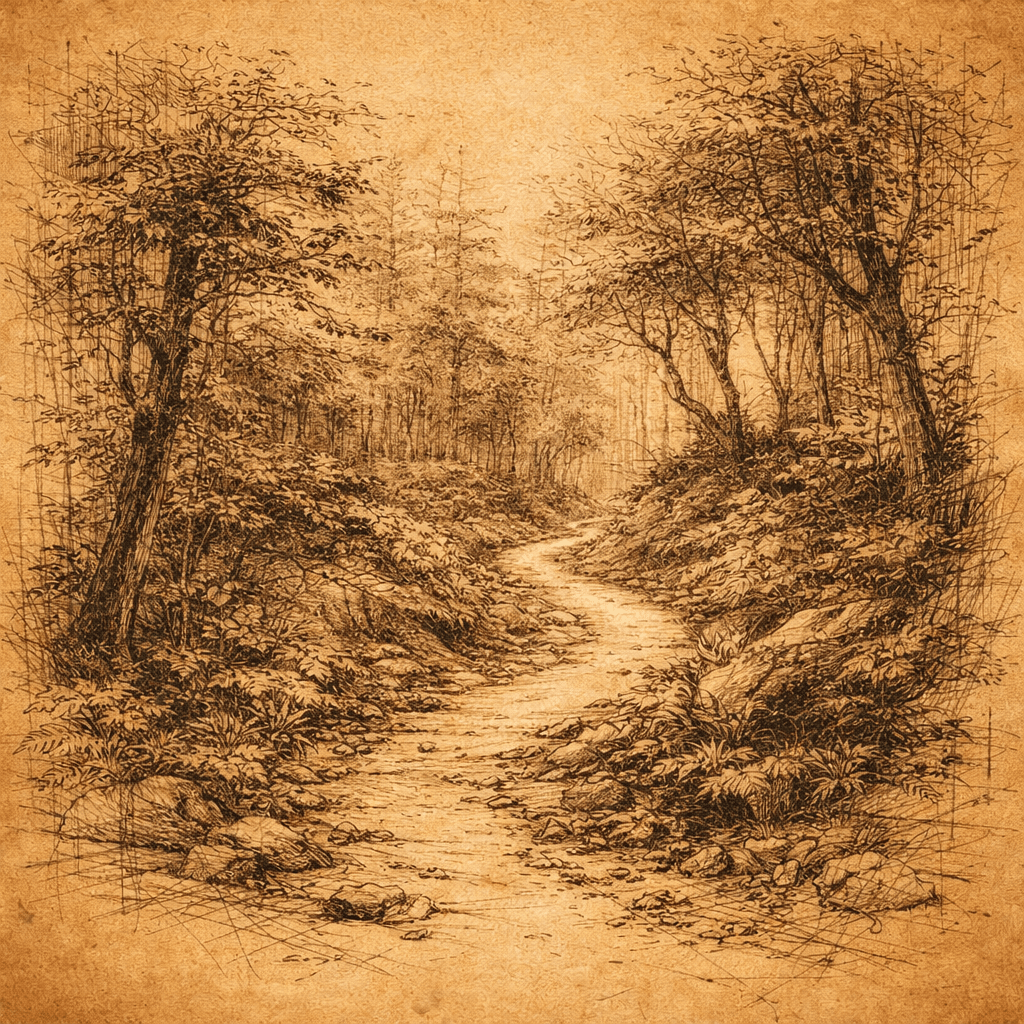
There is a winding passage set ‘fore me
That turneth steep to’rd the rightward side,
And seemeth little moved, nor heedeth me,
By how many have trod it far and wide.
The jutting roots the pathway freely yields,
Do eye me fast with challenge, whispering,
All calm and pleased that such a front it wields,
And show to me the worst that it can bring.
And vaunteth so as though such form were wrought
By millenniums of the study ink’d and learned,
And haply, telling nought, I harbor thought
And muse how praise from silence might be earned.
It waiteth that I come with hasting pace
As many erst have done ‘pon that way,
And haply thinketh I, at turning place,
All frantic, shall from ordered course stray,
That I might bend aside from destined path
And end full straight ‘pon the roadside side,
Where others, well I know, in patient breath
Do bide and linger, do wait and lie.
There is an odor of the chestnut sodden
And the wild fennel, muses unto me,
Who come from pools of mire by travel trodden
And coats of leafage poor that mantle me.
The path beholdeth me with steadfast eyes,
Yet know I well its gaze is cast elsewhere,
As I look not on it in equal guise;
I am one soul that with it travels there.
Thoughts – by E. Ashcroft
On Meaning and Context
The poem describes a walk along a steep, winding path through woodland or rough country, and the walk is, as walks in this author’s work invariably are, both physical and existential. The path is the subject, but the path is also the interlocutor, the adversary, the indifferent host, and the poem’s principal achievement is to sustain the personification of the path across seven stanzas without allowing it to become whimsical or merely decorative. The path is alive. It watches. It vaunts. It waits. It challenges. And the speaker, who is one soul among many that have travelled it, navigates it with an awareness that the path does not care whether he arrives at its end or falls aside, and that the not-caring is not cruelty but simply the condition of paths, which exist to be walked and are indifferent to the walker.
The narrative is the walk itself, and the walk proceeds through several stages. The first stanza establishes the path: winding, steep, rightward-turning, unmoved by the multitude that has trod it. The second introduces the path’s hostility: jutting roots that eye the speaker with challenge, calm and pleased with the difficulty they present. The third stanza shifts to contemplation: the path’s form seems wrought by millennia, and the speaker, telling nought, harbours thought and muses on how praise might be earned from silence. The fourth and fifth stanzas introduce the path’s expectation: it waits for the speaker to hasten and stray, to bend aside and end upon the roadside where others bide and linger. The sixth introduces the senses: the smell of sodden chestnut and wild fennel, the mud, the poor leafage. The seventh and final stanza resolves into a mutual indifference that is also a kind of peace: the path beholds the speaker but looks elsewhere, and the speaker does not look upon it in equal guise, and both proceed together without the pretence of engagement.
This is a poem about the relationship between the individual and the course of a life, figured as a path that is older than any single walker and that will outlast every walker that treads it. The path’s indifference is not hostile but geological: it has been there for millennia, it has seen every variety of traveller, and it has no investment in any particular outcome. The speaker’s response to this indifference is neither defiance nor despair but a quiet, pragmatic acceptance: he is one soul that travels there, neither more nor less, and the path will continue whether he falls aside or not.
On Style and Register
The register is fully archaic and sustained with a consistency that places this poem among the most formally committed of this author’s works. “Seemeth”, “heedeth”, “vaunteth”, “thinketh”, “beholdeth”, “haply”, “‘pon”, “erst”, “to’rd”: the forms are maintained throughout without lapse, and the diction has a quality of unhurried formality that suits the subject, for a path that has existed for millennia deserves to be addressed in a language that is itself old, that carries within its syntax the sediment of centuries, that moves at the pace of the thing it describes.
“The jutting roots the pathway freely yields / do eye me fast with challenge, whispering” is the poem’s most vivid personification. The roots eye the speaker. They whisper. They are “calm and pleased” with the front they wield. The attribution of emotion to roots is a risk, and the poem manages it by making the emotion not human but vegetable: the calmness and the pleasure are not the calmness and pleasure of a person but of a thing that has grown into its position over years and is satisfied with its arrangement, as a root is satisfied when it has found its purchase in the earth and no longer needs to seek. The roots are not malicious. They are established, and their establishment is their challenge.
“All calm and pleased that such a front it wields” is a line I admire for its precision of tone. “Front” is a word that carries the implication of façade, of a presented surface that may or may not correspond to what lies behind it, and the path’s front is its difficulty, its jutting roots and its steep turns, which it wields as one wields a weapon or a shield, with purpose and with confidence. The path is not accidentally difficult. It is deliberately so, or rather its difficulty has, over millennia, become so deeply a part of its character that the distinction between accident and intention has been erased by time.
“There is an odor of the chestnut sodden / and the wild fennel, muses unto me” is the poem’s most sensory passage, and the arrival of smell after six stanzas of sight and thought is well timed: the nose is the most involuntary of the senses, and the odour of sodden chestnut and wild fennel arrives without being sought, as the path’s meanings arrive without being sought, and the “muses unto me” attributes to the smell the quality of contemplation, as though the fennel were doing the thinking and the speaker merely receiving its conclusions. This is a delicate anthropomorphism, and it works because it is presented as the speaker’s fancy rather than as a fact, the “muses unto me” being a construction that locates the musing in the perception of the speaker rather than in the intention of the plant.
On Technique and Metre
The poem is written in iambic pentameter, and it handles the line with a steadiness that mirrors the steadiness of the walk. The pentameter is the natural metre of the measured tread, the pace of a man who is covering ground without haste and without delay, and the poem’s rhythm rarely departs from this gait, which is both its strength and, in moments, its limitation.
“There is a winding passage set ‘fore me” opens with a line that is metrically stable and syntactically plain, establishing the poem’s tone with a directness that is almost prose-like in its simplicity. The line’s virtue is its clarity. The line’s risk is that clarity, at the level of opening, can shade into flatness, and “there is” is, as an opening construction, somewhat inert, a pointing-at rather than a presenting-of. I note this not as a serious fault but as an observation that the poem begins at the level of statement and must therefore build, stanza by stanza, toward something that exceeds statement, and the building is the poem’s structural challenge.
The poem meets this challenge most successfully in the third stanza. “And vaunteth so as though such form were wrought / by millenniums of the study ink’d and learned” is a pair of lines whose enjambment carries the reader from the path’s vaunting to its deep history, and the carrying is effective: the path’s pride is revealed to be not shallow but ancient, the product of geological time, and the enjambment enacts the depth of that time by extending the sentence beyond the boundary of the line, as the millennia extend beyond the boundary of any single walk.
“And haply, telling nought, I harbor thought / and muse how praise from silence might be earned” is the poem’s most intellectually dense couplet. The speaker tells nothing, says nothing, offers no commentary upon the path’s vaunting, and in the silence of the not-telling he harbours thought, and the thought is about how praise might be earned from silence, which is to say how the act of not-speaking, of not-interpreting, of simply walking and observing, might itself constitute a form of recognition that the path would accept. The couplet is a meditation on the poetics of restraint, on the possibility that the most appropriate response to a thing of great age and great indifference is not speech but the quality of one’s silence, and the meditation is compressed into two lines without loss of clarity, which is no small achievement.
“That I might bend aside from destined path / and end full straight ‘pon the roadside side” contains a difficulty. “Roadside side” is a construction that produces a redundancy, “side” appearing twice in close proximity, once as a compound and once as an independent noun, and the repetition creates a phonetic awkwardness that the line does not resolve. The intention appears to be to distinguish the roadside, the margin of the road, as a specific location, a side, but the doubling of the word produces a stammering effect that I do not think is deliberate. This is the poem’s most conspicuous technical blemish.
On Rhyme
The scheme is ABAB throughout, and the rhymes are, in general, adequate to the poem’s purposes, though their quality varies.
“Me” and “wide” in the opening stanza do not rhyme. “Me” is intended to rhyme with the “me” of the third line, while “side” answers “wide”, producing a scheme that is more properly ABAB with “me/me” as the A rhyme. The identical rhyme, “me” with “me”, is a choice I regard with some suspicion, for identical rhyme is not, properly speaking, rhyme at all but repetition, and repetition in the rhyme position produces an effect of stasis rather than of resolution. The speaker is the A rhyme, and the path is the B rhyme, and the speaker’s repetition tells us that he has not moved, that he is still himself, still “me”, while the path has widened and turned. This reading is generous, and I offer it because the poem’s intelligence elsewhere earns the generosity, but I note that a less charitable reader might find the identical rhyme merely lazy.
“Whispering” and “bring” is a near-rhyme that works well enough: the whispering of the roots is answered by the worst the path can bring, and the sonic connection, though imperfect, is sufficient to bind the two halves of the stanza. “Yields” and “wields” is a full rhyme and a good one: the path yields its obstacles and wields its front, and the rhyme connects the offering to the weaponising, the presenting of difficulty to the deliberate deployment of it.
“Wrought” and “thought” is a strong pairing: what millennia have wrought is answered by the thought the speaker harbours, and the rhyme connects the made to the considered, the geological to the intellectual. “Learned” and “earned” is likewise strong: the path’s accumulated learning is answered by the praise the speaker hopes to earn, and the rhyme binds knowledge to recognition.
“Sodden” and “trodden” in the sixth stanza is the poem’s most physically grounded rhyme: the sodden chestnut and the mire trodden by travel are connected by their shared wetness, their shared heaviness, their shared belonging to the earth rather than to the air. “Me” and “me” appears again as the A rhyme, and my reservation about identical rhyme applies here as it did in the opening stanza.
“Eyes” and “guise” in the final stanza is clean and semantically resonant: the path’s steadfast eyes are answered by the unequal guise in which the speaker looks upon it, and the rhyme connects the seeing to the manner of seeing, the gaze to its quality. “Elsewhere” and “there” closes the poem with a pairing that I find quietly effective: the path’s gaze is cast elsewhere, and the speaker is one soul that travels there, and the “elsewhere” and the “there” are different places, and the poem ends on the recognition that the path and the speaker are in the same location but looking in different directions, which is the poem’s final statement on the nature of coexistence, and it is a true one.
On Impressions
This is a poem of considerable ambition that largely, though not entirely, achieves what it sets out to do. The personification of the path is sustained across seven stanzas with an inventiveness that does not flag, and the accumulation of attributes, the path watches, vaunts, waits, expects, beholds, produces a portrait of the non-human that is both vivid and philosophically coherent. The path is not a person. It is a path that has been imagined as having the qualities of a person, and the imagining is conducted with an awareness of its own artifice that prevents the personification from becoming sentimental.
The poem’s greatest strength is its sixth stanza, where the senses finally arrive and the poem becomes, for a moment, fully embodied: the sodden chestnut, the wild fennel, the mud, the poor leafage. After five stanzas of observation and intellection, the nose and the skin are admitted to the proceedings, and their admission is a relief, a grounding of the poem in the physical after a sustained period in the conceptual. The stanza earns its place not by being the most profound but by being the most real, and the real, in a poem of this kind, is the anchor that prevents the conceptual from drifting.
The poem’s greatest weakness is the “roadside side” construction in the fifth stanza, which I have already discussed, and the recurrence of identical rhyme on “me”, which, while defensible, requires a charity from the reader that the poem’s other rhymes do not require. A third, lesser weakness is the poem’s overall pace, which is steady to the point of occasional monotony: the pentameter proceeds without significant variation, stanza after stanza, and while the steadiness is thematically appropriate, it is also, in a poem of seven stanzas, a test of the reader’s patience. A single stanza of metrical disruption, a moment where the path’s difficulty is felt in the rhythm as well as described in the imagery, would have provided the variation the poem needs.
These are, however, reservations rather than objections. The poem is a work of genuine meditation, conducted in a register that is appropriate to its subject and sustained with a discipline that I respect. The final stanza’s recognition, that the path looks elsewhere and the speaker does not look upon it in equal guise, is a conclusion of quiet wisdom: the path and the walker are not partners, not adversaries, not even acquaintances, but merely two things that occupy the same space for a time and then part, the one continuing and the other not, and the not-continuing is not a tragedy but simply the nature of walkers, who are mortal, as the nature of paths is to endure, and the enduring and the not-enduring are both facts, and the poem, in its final line, accepts them both.
I commend it, with the reservations noted.

 mvrcodelrio.com
Lascia un commento