
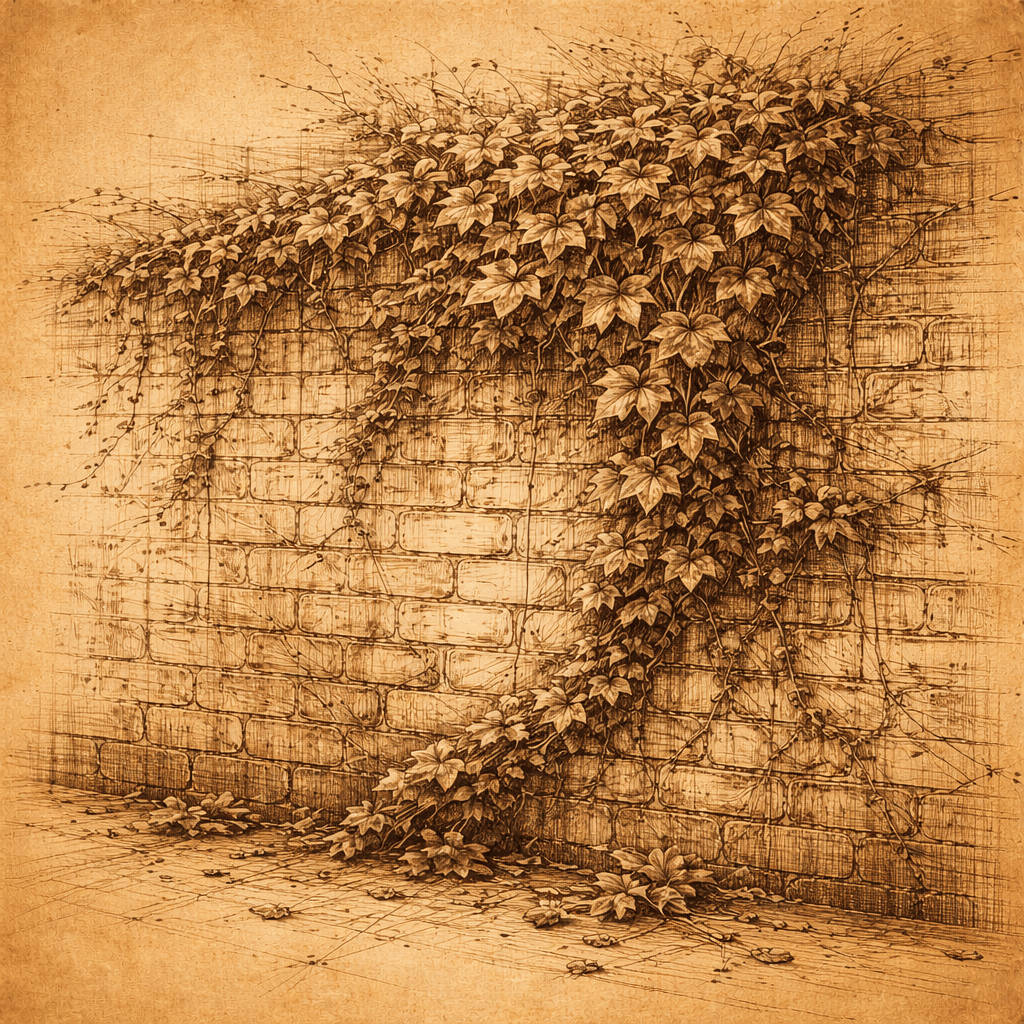
The ivy twisted hard ‘gainst the stone,
As though it had made peace with what was done,
That now the very rock became her own,
A body warped and starv’d, no longer one.
The sun peep’d shyly through the scanty holes,
Left ‘twixt one tangle and the next in place,
And fell without a sound on early scrolls
O’ tales we cut upon the wall’s bare face.
It was but habit, born of options none,
Or none at least that might be call’d as fair,
And that small room, less world than any one,
Did all it could to keep us from elsewhere.
We grasp it only now, how youth did bind,
How much of it was prison in disguise,
And how a circus, fashioned just for mind,
Of light and talk and hunger did arise.
Of thirst as well, too much of all was there,
Yet never quite enough to make us dare
To break the chains that clasp’d our wrist,
And cast away the bonds we never miss’d.
Religious was our rushing to that place,
And opposite the living of it then;
That holy house of ignorance and space
Was more a home than any home for men.
(Im)pertinent detour
The ball struck the wall and came back wrong. It always came back wrong from that particular stretch of wall, the one beneath the window of the vestry where the cement had buckled and swelled into a ridge no wider than a man’s thumb but sufficient, in the precise and unforgiving physics of a leather ball meeting a hard surface at speed, to send it spinning off at an angle that no foot could have predicted and no goalkeeper, had there been a goalkeeper, which there was not, could reasonably have been expected to save.
“That’s in,” said Ercole.
“That is not in,” said the boy they called Piccio, whose real name was Guglielmo and who had been called Piccio since the age of seven for reasons that no one, including Piccio himself, could any longer recall with certainty, though it was generally supposed to have something to do with either his size, which was slight, or his appetite, which was not. “That is the wall. The wall is not in. The wall is the wall.”
“The wall is the post,” said Ercole. “We agreed. The crack is the post.”
“The crack is there,” said Piccio, pointing. “The ball struck here. Here is not there.”
“Here is near there.”
“Near is not in.”
The argument continued in this fashion for some time, as it had continued on many previous occasions and would continue on many occasions to come, for the rules of the game played upon the concrete pitch beside the parish of San Biagio were not rules in any codified or permanent sense but rather a set of provisional understandings, renegotiated at each disputed moment with the passion and the procedural rigour of men debating matters of genuine consequence, which, in the economy of those afternoons, they were.
The pitch was cement. It had been cement for as long as any of them could remember, which is to say for the whole of their lives, which is to say for not very long at all, though it seemed to them, as it seemeth to all boys, that the world had been arranged in its present configuration at the beginning of time and would remain so until the end of it, and that the cracks in the cement and the weeds that grew through the cracks and the iron posts that had once held a net and now held only rust and the memory of a net were features as permanent and as unquestionable as the hills.
The pitch was too small. It was too small for football and too large for anything else, an awkward rectangle bordered on one side by the wall of the parish hall, on another by a chain-link fence through which the brambles of the adjacent lot had long since made their incursion, on a third by the garden, if garden it could be called, a narrow and neglected strip of earth in which a fig tree of great age and uncertain health presided over an undergrowth of nettles and dandelions and the remains of what had once been, in some prior and more optimistic era, a flowerbed. The fourth side was open, giving onto the lane, and it was from this side that they entered, every afternoon, with the regularity and the solemnity of communicants approaching the altar, though what they were approaching was a cement rectangle with weeds in it and a ball that was losing its leather and two iron posts in a condition of advanced despair.
They came because there was nowhere else.
This is the thing that must be understood, before anything else is understood, and it is the thing that is most difficult to explain to anyone who hath not lived it: that the parish of San Biagio, with its cement pitch and its dying fig tree and its vestry window that sent the ball back wrong, was not a choice but an inevitability, the single point in the geography of their afternoons where the various forces that governed their lives, the school, the family, the street, the particular and unspoken hierarchies of a small town, converged and briefly relaxed their grip, and in the space thus opened they could be, if not free, then at least unobserved, which for a boy is nearly the same thing.
The ivy had taken the eastern wall. It had taken it slowly, over years, with the patience of a siege, sending its tendrils into the mortar and prising apart the joints between the stones and establishing, in each crevice so gained, a foothold from which to launch the next advance, until the wall itself had become as much ivy as stone, a thing of two natures, the mineral and the vegetable, fused into a single surface that was neither quite wall nor quite plant but a third thing, a hybrid, a partnership so long established that the partners could no longer be separated without destroying both.
The boys had carved upon the wall. Not on the ivy, which resisted the knife, but on the stretch of bare stone beneath the vestry window where the ivy had not yet arrived, a pale expanse of limestone that received the blade with a willingness that bordered on the complicit, yielding its surface to the pressure of a pocketknife with a soft and chalky acquiescence that produced, with each stroke, a line of white against the grey, bright and conspicuous for the first days and then fading, as all inscriptions fade, into the general texture of the stone, until only those who knew where to look could read what had been written, and even they, after sufficient time, could not be certain whether the marks they were reading were the marks they had made or merely the natural weathering of the surface, the small and random calligraphy of wind and rain and frost.
They carved names. Dates. The occasional word of profanity, placed high upon the wall and executed with care, as though the obscenity were a form of art and the wall its gallery. They carved the results of matches that had been played upon the cement pitch, setting down for posterity the score of a game that no one but themselves had witnessed and that no one but themselves would ever have cause to remember, and the carving was, in its way, the most serious act they performed in that place, more serious than the football, more serious than the arguments about whether a ball that had struck the ridge beneath the vestry window was in or not in, for the carving was the thing that would remain, the only trace of their presence that would outlast the afternoon and the season and the years, and they knew this, though they did not say it, for to say it would have been to admit that the afternoons were finite, and this was a proposition they were not yet prepared to entertain.
“My mother wants me at the shop before six,” said a boy named Dante, who was not named for the poet but for an uncle who had died in circumstances the family did not discuss, and who had inherited from this uncle nothing but the name and a pair of boots that were too large for him and that he wore nonetheless, stuffed with newspaper at the toes, because they were the only boots he had and because the concrete of the pitch was unkind to lesser footwear.
“It is not yet five,” said Ercole.
“It is past five. The bell rang.”
“That was not the bell. That was Ferruccetti’s dog.”
“Ferruccetti’s dog doth not ring.”
“Ferruccetti’s dog maketh a sound that may be mistaken for the bell by one whose ears are less attentive than his feet, which is to say by thee.”
Dante considered this. “My mother,” he said, with the finality of one invoking an authority against which no argument, however ingenious, could prevail, “wants me at the shop before six.” And he departed through the open side of the pitch, into the lane, his uncle’s boots making upon the cement a sound that was too large for his body, a man’s tread from a boy’s legs, and the remaining players watched him go with the particular expression that boys wear when one of their number hath been recalled to the world of mothers and shops and obligations, an expression compounded of pity and relief and the faint, unadmitted satisfaction of being, for the moment, still unclaimed.
The room.
There was a room at the back of the parish, behind the hall and below the vestry, a room of no stated purpose and no official designation, which had served, at various points in its history, as a storeroom for surplus hymnals, as a place where the parish priest kept his wine, as a refuge for a cat of indeterminate age and extraordinary longevity that had lived in the parish for so long that it was spoken of as an institution rather than as an animal, and, most recently and most consequentially, as the place where the boys went when the football was finished or the rain had come or the afternoon had arrived at that particular hour, neither early nor late, when the body is tired and the mind is not and the combination of the two produceth a restlessness that can only be satisfied by sitting in a small room and talking about nothing.
The room was less world than any one. It had a single window, set high in the wall, through which a portion of sky was visible, and a door that did not close properly, and a floor of tiles, some cracked, some missing, that had once been red and were now the colour of dried blood in uncertain light. There was a bench along one wall, donated by a parishioner whose name was recorded on a brass plaque that had been affixed to the backrest with screws that had subsequently rusted, so that the plaque hung at an angle and the name was partly obscured by the green stain of oxidation, rendering the act of donation both permanent and anonymous, which is perhaps the purest form of charity or perhaps merely the consequence of damp.
They sat on the bench. They sat on the floor. Ercole sat on an upturned crate that had once contained bottles of sacramental wine and that still bore, on its side, in stencilled letters of ecclesiastical formality, the words VINO DA MESSA, which Piccio had amended, with a stub of charcoal, to read VINO DA MESSA IN SCENA, a joke that had been funny the first time and that had, through repetition and the slow accretion of familiarity, ceased to be funny and become instead a feature of the room, as fixed and as unremarkable as the cracked tiles and the crooked plaque.
“I am hungry,” said Piccio.
“Thou art always hungry,” said Ercole.
“I am always hungry because I am always here, and there is never anything to eat here, and yet I continue to come here, which is proof either that the company is excellent or that I am a fool. I suspect the latter.”
“The latter,” agreed Ercole.
The light came through the high window in the manner of light that hath been filtered through too many intervening substances, the glass, the dust upon the glass, the ivy that had begun its advance upon this side of the building and had already sent an exploratory tendril across the lower portion of the pane, and arrived at the interior not as light, properly, but as the rumour of light, a secondhand brightness that was sufficient to see by but not sufficient to read by, which was of no consequence, for none of them were reading, nor had any intention of reading, nor could have found in the room anything to read except the hymnals, which were stacked in a corner and which they had, on one memorable and regretted occasion, attempted to use as goalposts, with results that had drawn from the parish priest a rebuke of such magnificent and sustained fury that it had entered the folklore of the group and was quoted, with admiration and with minor embellishments, for years afterward.
“Father Anselmo said,” Piccio would recite, on such occasions as the memory was invoked, “that we were, and I translate from the ecclesiastical, a pestilence upon the house of God, a disgrace to the memory of the saints whose names we bore and did not deserve, and that if we could not distinguish between the instruments of devotion and the equipment of sport then we were no better than the Philistines, whom he identified, for the avoidance of doubt, as a people who had come to a bad end.”
“He did not say Philistines,” said Ercole. “He said barbarians.”
“He said Philistines first and barbarians second. The barbarians were by way of clarification.”
“I remember only the volume,” said a boy called Sandro, who rarely spoke and whose contributions, when they came, had the quality of verdicts. “It was considerable.”
And yet Father Anselmo did not bar them from the room. This is the fact that none of them spoke of and all of them understood, for it was the foundation upon which the whole arrangement rested, the unspoken compact between the priest and the boys, by the terms of which the room was theirs on the condition that the condition was never stated, that the arrangement was never acknowledged, that the permission was never granted because it had never been sought, and that the boys, in their turn, would refrain from acts of such conspicuous desecration as the use of hymnals for goalposts, and would, on Sundays, attend the mass, or at least be seen to attend the mass, which is not the same thing, though Father Anselmo, who was not a fool, understood the distinction and accepted it, as he accepted all the distinctions between the ideal and the actual that the practice of his vocation had, over many years, taught him to accept.
The room was theirs. It was theirs in the way that a thing is most truly owned when it is owned by those who have nothing, for the ownership of those who have nothing is absolute, admitting no comparison and no competition, and the room, with its cracked tiles and its crooked plaque and its high window through which the rumour of light arrived and its bench and its crate and its hymnals in the corner, was everything, because there was nothing else, and the everything-ness of it was not diminished but rather enlarged by the nothing-ness of the alternative, which was the street, which was the school, which was the home that was not a home, or was a home of the kind that maketh a boy prefer a room in the back of a parish with a floor of broken tiles and the smell of old wine and the company of other boys whose homes were, in their various and undiscussed ways, similarly insufficient.
They spoke of what boys speak of. They spoke of football and of food and of the particular injustices that had been visited upon them by teachers and parents and the world at large, and they spoke of these injustices with the fluency and the conviction of those for whom injustice is not a theory but a daily weather, a thing that is endured not because it is understood but because it cannot be avoided, as rain cannot be avoided and cold cannot be avoided and hunger cannot be avoided, though it can, with sufficient ingenuity, be managed, and the management of hunger was a subject to which they returned with a frequency that reflected less the quality of their discourse than the emptiness of their stomachs.
“If I had money,” said Piccio, and this was the customary opening of a speculation that had been conducted many times and that varied only in its particulars, never in its conclusion, “I would buy a bread from Sanfelice’s, the large one, the one with the sesame, and I would eat half of it now and half of it later, except that I would eat all of it now because the later doth not exist when one is hungry, the later is a fiction invented by those who have eaten.”
“If thou hadst money,” said Ercole, “thou wouldst owe it to someone before thou hadst finished counting it.”
“This is true. But I would owe it in a state of satiety, which is a superior form of debt.”
They laughed. The laughter echoed in the small room and was absorbed by the hymnals and the tiles and the walls that were slowly being claimed by the ivy, and the echo died, and the room was quiet again, and the quiet was of that particular kind that belongeth to rooms in which boys have been laughing and have stopped, a quiet that is not silence but the memory of laughter, a warmth that resideth in the air for a moment after the sound hath gone, as the smell of bread resideth in a kitchen after the bread hath been eaten.
The thirst. There was thirst also. There was always thirst, for the pitch was cement and the sun was generous in its attention to cement, and there was no fountain in the parish yard, only a tap at the back of the garden that ran brown for the first three seconds and cold for the next five and then ceased altogether, requiring a wait of some minutes before it could be persuaded to resume, and the boys would queue at this tap with the patience of pilgrims at a shrine, each taking his turn and drinking from the stream with the earnestness of one performing a sacrament, the water entering the body and the body receiving it with a gratitude that had nothing of the intellectual and everything of the animal, the pure and wordless satisfaction of a need met, a hole filled, a fire quenched.
And the chains. They did not know they were chains. This is the thing that time revealeth, as it revealeth all things, slowly and without kindness: that the place they loved was also the place that held them, that the afternoons they ran to were also the afternoons they could not leave, that the football and the room and the talk and the laughter were not only the furnishings of their freedom but also the boundaries of their confinement, for freedom that hath no elsewhere to go is not freedom but merely the most comfortable form of captivity, and the parish of San Biagio, with its cement pitch and its dying fig and its tap that ran brown and its room with the hymnals and the crooked plaque, was the most comfortable thing they had, and they clung to it as one clingeth to a raft, not because the raft is where one wisheth to be but because the water is deep and the shore is nowhere in sight.
They did not break the chains. The chains broke themselves, as chains do, by the slow and ordinary process of growing up, which is to say by the slow and ordinary process of discovering that there are other places and other pitches and other rooms, and that the ball doth not always come back wrong from the wall, and that some walls are smooth, and that some homes are homes, and that the word home, which they had learned to define by the parish of San Biagio, had a meaning they had not known, a meaning that did not include cement or weeds or a tap that ran brown or the smell of old wine in a room where no wine was drunk but whose memory lingered in the tiles and in the wood of the crate and in the particular quality of the air, which was the air of a place that had been, for want of any better word, and in the absence of any better thing, holy.
Holy. Not in the sense the word was used on Sundays, not in the sense Father Anselmo intended when he spoke of it from the pulpit in his vestments and his conviction, but in the other sense, the older and less orderly sense, the sense that belongeth to any place where human beings have gathered not because they were obliged but because they were lost, and have found in one another’s company, if not a remedy, then at least a respite, a pause in the long march of sorrow on the brow, a room in which to sit and be hungry together, which is less terrible than being hungry alone, and to be thirsty together, which is less terrible than being thirsty alone, and to laugh together at jokes that are not funny and have not been funny for years and that continue to be told not because they amuse but because the telling is the thing, the repetition is the prayer, the ritual is the sacrament, and the sacrament is the company, and the company is the room, and the room is the parish, and the parish is the only place on earth where a boy may sit on an upturned wine crate and be, for the space of an afternoon, sufficient.
Religious was our rushing to that place. And opposite the living of it then.
The ivy twisteth still against the stone. The wall still standeth, or stood when last he saw it, which was not recently, for the distance between the man and the boy is not measured in years but in the accumulation of rooms that have intervened, rooms with smooth walls and proper doors and windows that let in the light without apology, rooms that are, by any reasonable measure, superior to the room at the back of the parish of San Biagio, and yet are not, and can never be, and he knoweth this, and the knowing is not sadness but a kind of gratitude, the gratitude of one who hath been sheltered, however poorly, in the season when shelter was most needed, and who hath carried the shelter with him, in the grain of it, in the memory of it, in the particular sound of a ball striking a buckled wall and coming back wrong, which is the sound of his boyhood, which is the sound of a home that was more a home than any home for men.
Thoughts – by E. Ashcroft
I. The Poem
On Meaning and Narrative
The poem describes a place, a room, a parish, that was the centre of a boyhood. The ivy on the wall, the sun through the gaps, the tales carved on stone, the small room that kept its inhabitants from elsewhere: these are the materials of a shared youth, a youth that was not idyllic but confined, not chosen but inevitable, not comfortable but holy, holy in the sense the final stanza articulates, which is not the holiness of the church but the holiness of the only place where a group of young people could be together and be, for the space of an afternoon, unobserved and therefore free, or at least as close to free as their circumstances permitted.
The narrative arc moves from the physical, the ivy, the stone, the sun, through the habitual, “it was but habit, born of options none”, through the retrospective, “we grasp it only now”, to the paradoxical, “more a home than any home for men.” The poem’s intelligence resides in its refusal to sentimentalise. The room was not beautiful. The options were not fair. The habit was born of constraint, not of choice. The youth was binding as well as liberating, prison as well as circus. And yet. The “and yet” is the poem’s entire emotional argument, compressed into the final stanza’s assertion that the place was holy and was home, more home than any subsequent dwelling that has offered better walls and smoother floors and windows that let in the light without apology.
The fifth stanza introduces the most complex note: “of thirst as well, too much of all was there, / yet never quite enough to make us dare / to break the chains that clasp’d our wrist.” The excess and the insufficiency coexisted. There was too much of everything and not enough of anything, and the combination produced not rebellion but acquiescence, not the breaking of chains but the wearing of them, and the chains were not missed when they finally fell away, which is the poem’s most quietly devastating admission, for to say that the bonds were never missed is to say that the freedom that followed was not experienced as freedom, that the departure from the parish was not a liberation but merely a relocation, and that the relocating self carried with it, unknowing, the shape of the chains it no longer wore.
On Style and Register
The register is archaic but tempered, as in several of this author’s more narrative poems, by a conversational directness that prevents the formality from calcifying. “‘Twas the dawn of all” does not appear here; instead the poem offers “‘twas but habit”, which is a more modest and more honest construction, the admission that the central experience of the boyhood was not an epiphany but a routine, not a revelation but a repetition.
“The ivy twisted hard ‘gainst the stone, / as though it had made peace with what was done” is the poem’s opening image and its most structurally important. The ivy has made peace. The stone has been taken. The two have fused into a single organism, and the fusion is presented not as conquest but as accommodation, a mutual acceptance that has been arrived at over time, without negotiation, without consent, by the sheer pressure of proximity. This is also, of course, a description of the boys’ relationship to the place: they have twisted themselves against it, and it against them, until the distinction between the inhabitants and the habitat has been erased, and the removal of either would destroy both.
“Less world than any one” applied to the room is a phrase of considerable compression. The room was less world than any world, smaller, poorer, more confined. But the phrase also carries, in its syntax, the suggestion that the room was less world than any one person in it, that each boy contained more possibility, more vastness, more world than the room could accommodate, and the room’s smallness was therefore not merely a physical constraint but a form of compression, a pressing together of large things into a small space, and the pressing is what produced the heat, the talk, the hunger, the laughter, the holiness.
On Technique and Metre
The poem is written in iambic pentameter, and it handles the form with a steadiness that suits the narrative and retrospective character of the material. The metre does not strain or rupture; it proceeds with the measured pace of recollection, of a man walking back through memory at a speed that allows him to see what he is passing.
“The ivy twisted hard ‘gainst the stone” opens with a trochaic substitution on “twisted” that introduces a physical torque into the line’s rhythm, the stress pattern twisting as the ivy twists, before the line settles into regularity with “‘gainst the stone.” This is effective and unobtrusive, which is the best kind of metrical craft: the kind that does its work without announcing itself.
“We grasp it only now, how youth did bind” is metrically clean and emotionally weighted, the stress on “now” marking the moment of retrospective clarity with a heaviness that the surrounding unstressed syllables amplify by contrast. “How youth did bind” is four syllables that carry the entire weight of the poem’s argument, and the iambic regularity of the phrase gives it the quality of a verdict, a judgement delivered without passion but with finality.
The fifth stanza shifts from ABAB to AABB, a couplet scheme that compresses the stanza’s argument into paired assertions: “too much of all was there” is immediately answered by “yet never quite enough to make us dare”, and the tightening of the rhyme scheme mirrors the tightening of the chains the stanza describes. The shift is well judged, and the return to ABAB in the final stanza releases the pressure with a formal opening that corresponds to the stanza’s thematic expansion, the movement from confinement to holiness, from the chains to the rushing, from the prison to the home.
There is one metrical weakness. “And cast away the bonds we never miss’d” is a line that concludes a stanza of considerable momentum, and “miss’d” in the final position, while metrically correct, carries a phonetic lightness that does not quite match the weight the line requires. The elision preserves the monosyllabic closure, but the word itself, “missed”, is a word of absence, of negation, and the placing of an absence at the stanza’s conclusion produces a slight effect of deflation where the poem might have benefited from a heavier final stress. I note this as a minor observation rather than a serious objection.
On Rhyme
The scheme is ABAB for the first four stanzas, AABB for the fifth, and ABAB for the sixth. The variation in the fifth stanza I have already discussed. The rhymes are, on the whole, well managed.
“Stone” and “one” in the opening stanza is a near-rhyme that I find effective: the stone, hard and singular, is answered by “one”, the unity that has been lost, the body that is “no longer one” but has been warped and fused with the ivy, and the slight imperfection of the rhyme mirrors the imperfection of the fusion, the fact that the stone and the ivy, though joined, are not the same substance and never will be.
“Holes” and “scrolls” is a full rhyme of considerable charm: the gaps in the ivy through which the sun peeps are answered by the scrolls of tales carved on the wall, and the rhyme connects the aperture to the inscription, the light that enters to the marks that remain, the seeing and the recording. “Place” and “face” is clean and semantically sound: the tangles in their place are answered by the wall’s bare face, the grown and the ungrown, the covered and the exposed.
“None” and “one” in the third stanza is a rhyme that operates almost as a pun: the options were none, and the room was less world than any one. The rhyme binds the absence of choice to the singularity of the space, the nothing available to the everything that the nothing produced. “Fair” and “elsewhere” is effective: the options that were not fair are answered by the elsewhere from which the room protected them, and the rhyme connects the injustice to the shelter, the unfairness of the world to the refuge from it.
“Bind” and “mind” is strong: the binding of youth is answered by the circus fashioned for the mind, and the rhyme connects the physical constraint to the mental freedom, the chains to the imagination, the prison to the performance. “Disguise” and “arise” is the stanza’s finest pairing: the prison in disguise is answered by the arising of light and talk and hunger, and the rhyme tells us that the arising was itself the disguise, that the freedom was the costume the prison wore, and that neither could exist without the other.
“Place” and “space” in the final stanza is clean. “Then” and “men” closes the poem with a full rhyme that connects the living of the experience to the category of humanity that might inhabit a home, and the connection is the poem’s final assertion: this was not a home for men in the conventional sense, not a dwelling, not a residence, not a structure designed for habitation, and yet it was more home than any of these, because it was holy, and holiness, the poem insists, is not a function of architecture but of need.
On the Final Stanza
“Religious was our rushing to that place, / and opposite the living of it then.” These two lines require careful attention. The rushing to the place was religious: it had the quality of ritual, of devotion, of the approach to the sacred. But the living of it was “opposite”, which is to say it was not religious, not solemn, not reverential, but the reverse of all these things, which is to say chaotic, profane, loud, hungry, thirsty, argumentative, and alive. The holiness was in the rushing, in the need, in the compulsion that drew them there. The living was the opposite of holy, and the opposition between the rushing and the living is the poem’s final paradox: the sacred and the profane are not merely coexistent but interdependent, the holiness residing not in the behaviour that occurred within the walls but in the fact that the walls were sought, that the rushing occurred, that the feet carried the body to the place as the feet of the devout carry them to the altar, with the same automaticity, the same absence of deliberation, the same surrender to a force that is not understood and does not need to be.
II. The (Im)pertinent Detour
The prose that accompanies this poem is, by a considerable margin, the longest and the most narratively ambitious of the excursions I have examined from this author. It is also, I must say at once, the most joyful, which is a word I have not had occasion to use in any of my previous examinations, and which I use now with the caution appropriate to a critic for whom joy is a condition that requires as much scrutiny as sorrow, if not more, for sorrow is easy to render convincingly in prose, whereas joy is almost impossible, and the almost is where this prose resides.
The prose tells the story of the poem’s place: the parish of San Biagio, the cement pitch, the room at the back, the boys who came there every afternoon because there was nowhere else. It populates the poem’s abstractions with specific bodies, specific voices, specific arguments about whether a ball that struck the ridge beneath the vestry window was in or not in, and the specificity is the prose’s greatest strength, for it is in the specificity that the joy resides, not in the general assertion of fellowship but in the particular sound of Piccio saying “near is not in” and Ercole replying “the wall is the post.”
I must note, parenthetically, that the names in this text, Ercole, Guglielmo, Dante, Sandro, Ferruccetti, Anselmo, and the parish of San Biagio itself, belong to a linguistic tradition that is not the dominant one of the broader region. One might speculate that the text’s setting is one of those smaller communities, not uncommon in the more remote corners of certain territories, where older naming conventions have persisted despite the prevailing anglicisation of the surrounding culture, pockets of linguistic stubbornness that resist the standardisation of the larger map. The author offers no explanation, and I shall not press for one, for the names are right, as names in fiction are right when they sound as though the people who bear them were born into them, and Piccio is Piccio, and no anglicised equivalent would serve.
The opening scene, the disputed goal, is handled with a comic precision that establishes the tone of the entire prose: these boys take the trivial seriously, and the seriousness with which they take the trivial is the measure of the value they place upon the place, for a place where the rules of a football game are debated with the rigour of a legal proceeding is a place where the game matters, and a place where the game matters is a place where being is taken seriously, and the taking-seriously-of-being is, in the final analysis, the definition of holiness that the prose is working toward.
“They came because there was nowhere else.” This sentence is the prose’s thesis, stated with a plainness that refuses elaboration, and the refusal is correct, for elaboration would dilute the force of the statement, which derives its power from the absence of qualification. Not “they came because the place was beautiful” or “because they loved it” or “because they were happy there”, but because there was nowhere else, and the nowhere-else-ness is the foundation of everything that follows, the fellowship, the laughter, the hunger, the holiness. The prose understands, as the poem understands, that the most durable forms of human connection are not those that are chosen from an abundance of options but those that are forged from the absence of them, and the forging is stronger for having been involuntary.
The characterisation of the boys is economical and vivid. Piccio, whose nickname has outlasted its etymology, whose hunger is a philosophical position as much as a physical condition, whose wit operates at the intersection of the absurd and the true. Ercole, the adjudicator, the maker of rules, the voice of an authority that rests upon nothing but the willingness of the others to accept it. Dante, named for an uncle who died in circumstances the family does not discuss, whose boots are too large and whose departure, when it comes, is announced not by decision but by the invocation of a mother, an authority against which no argument can prevail. Sandro, who rarely speaks and whose contributions have the quality of verdicts. Each boy is drawn in a few strokes, and the strokes are sufficient, for the prose is not interested in psychological depth but in the texture of presence, the way a boy occupies a space and a conversation, the particular sound his boots make on the cement.
The passage on the room is where the prose achieves its most sustained descriptive power. The bench with the oxidised plaque, the crate with Piccio’s amended inscription, “VINO DA MESSA IN SCENA”, the hymnals in the corner, the light that arrives “not as light, properly, but as the rumour of light, a secondhand brightness”: every detail is precise and every detail is earned, and together they constitute not merely a description of a room but a phenomenology of poverty experienced as wealth, of confinement experienced as liberty, of insufficient space experienced as everything.
The Father Anselmo passage is the prose’s comic masterpiece. The priest’s rebuke, recounted and embellished over years until it has become folklore, the Philistines offered first and the barbarians by way of clarification, is comedy of the highest domestic order, and the prose handles it with a lightness that does not diminish its seriousness, for the seriousness is this: that Father Anselmo, despite the rebuke, did not bar them from the room, and the not-barring was the compact, and the compact was never spoken, and the unspoken-ness was its strength, for an arrangement that has never been articulated cannot be revoked, and an arrangement that cannot be revoked is the closest thing to permanence that a group of boys with nothing can possess.
“Freedom that hath no elsewhere to go is not freedom but merely the most comfortable form of captivity.” This is the prose’s central insight, and it is delivered with the precision of an aphorism that has been arrived at through experience rather than through thought, the kind of formulation that cannot be produced by intelligence alone but requires the collaboration of intelligence and suffering, and the collaboration is audible in the sentence’s rhythm, which is the rhythm of a man who has thought about this for a very long time and has arrived at the shortest possible way to say it.
The closing passage, on the holiness of the place, is where the prose must risk everything, for to call a cement pitch and a room with cracked tiles holy is to invite the charge of sentimentality, and sentimentality is the one charge from which a prose of this quality cannot recover. The prose avoids the charge by defining its terms: “not in the sense the word was used on Sundays, not in the sense Father Anselmo intended when he spoke of it from the pulpit, but in the other sense, the older and less orderly sense, the sense that belongeth to any place where human beings have gathered not because they were obliged but because they were lost.” The holiness is not ecclesiastical. It is anthropological. It belongs not to the building but to the condition, the condition of being lost and finding in the company of other lost people a form of shelter that the world of found people, the world of homes that are homes, cannot provide.
I have objections. They are, once again, few.
The prose’s length is its most conspicuous liability. At several thousand words, it is considerably longer than any of the previous excursions, and while the length is in many places justified by the richness of the material, there are moments, particularly in the middle sections, where the prose revisits a point it has already made with sufficient force. The passage on the tap that runs brown, while charming, extends the catalogue of the place’s privations beyond the point of diminishing returns. The prose has already established that the parish is poor, that the facilities are inadequate, that the boys have nothing. The tap adds a detail but not a dimension, and a detail without a dimension is, at this length, a cost the prose cannot entirely afford.
The amended inscription on the wine crate, “VINO DA MESSA IN SCENA”, is a joke that the prose itself acknowledges has ceased to be funny and become a feature of the room. The prose’s self-awareness on this point is disarming, and I am therefore inclined to forgive the joke itself, which is, in truth, not very good, but the forgiveness is extended to the prose’s treatment of the joke rather than to the joke itself, and I wish the distinction to be noted.
III. The Relationship Between Poem and Prose
The relationship here is the most democratic of the compound texts. In the previous pairings, the prose served the poem: it dramatised the poem’s composition, or its aftermath, or its domestic setting. Here, the prose does not serve the poem. It accompanies it. The two walk side by side, as the boys walked to the parish, and the walking is itself the relationship.
The poem provides the architecture: the ivy, the stone, the room, the chains, the holiness. The prose provides the inhabitants: Piccio, Ercole, Dante, Sandro, Father Anselmo, the cat of indeterminate age. The poem speaks of “we” without specifying who “we” are. The prose supplies the faces. The poem says “religious was our rushing to that place.” The prose shows the rushing: the ball, the argument, the crate, the hunger, the laughter.
What unites them is the final word of each. The poem ends with “men”: “more a home than any home for men.” The prose ends with “sufficient”: “for the space of an afternoon, sufficient.” The poem asserts the superiority of the parish to any proper home. The prose, more modestly, asserts only that it was enough. The poem’s claim is grand. The prose’s is humble. And the humility is, I think, the more persuasive of the two, for sufficiency, as I have had occasion to observe elsewhere, is not the minimum but the maximum, the most that can be hoped for by those who have learned, through the slow and unkind instruction of experience, that the maximum and the minimum are often the same thing, and that the distance between the two is no greater than the distance between a crack in a cement wall and a leather ball that has come back wrong.
IV. Overall Assessment
The poem is a work of genuine accomplishment, formally assured, emotionally restrained where restraint is needed and expansive where expansion is earned. Its rhymes are strong, its final stanza is amongst the best this author has produced, and its central paradox, that the prison was the home and the home was holy, is delivered without sentimentality and without irony, which is to say with the only tone appropriate to a truth that is both.
The prose is the most ambitious of the excursions and, with the reservation that its length occasionally exceeds its material, the most fully realised as narrative. It achieves something I would not have thought possible in a text of this kind: it makes the reader miss a place the reader has never been, and it does so not by describing the place’s beauty, for the place has none, but by describing, with a precision that borders on the loving, the specific quality of the nothing that was, for those who had nothing else, everything.
Taken together, they constitute the most expansive and the most generous of the compound texts. The author has turned his attention outward, away from the solitary self and toward the community of the insufficient, the fellowship of the hungry, the congregation of the lost, and the turning has produced a text of warmth and intelligence that I find, on the whole, moving, which is a word I do not use often, and which I use now with the full awareness that a critic who confesses to being moved is a critic who has, temporarily, set aside his instruments, and I am content, for once, to stand without them.
I commend it. The parish, I suspect, still stands, though the ivy hath taken the wall, and the ball still cometh back wrong, and the boys are no longer boys, and the room is empty, or not empty, but full of the particular kind of emptiness that is, for all that, sufficient.

 mvrcodelrio.com
Lascia un commento