
Perchance this storm sufficeth, at the last,
Of writings that suffice me never yet,
To leave of me a trace the wind held fast,
That none who tread it may in full forget—
And mayhap foot or shoe, in time to stride,
Might press or ape the rhythm I did chart,
To mend, to praise, or tunefully to bide
That which I ink with the accustomed art,
Which still I set, as done a hundred years,
Or so it seems to me, within this day.
And if it be unworthy of men’s ears,
What shall be left for me to write or say?
Perchance the truth, which, if I reckon true,
Ne’er from the backdrop stepp’d to take a part,
But linger’d pale, in favour of the hue
Wherein the melody conceal’d the heart.
I know not how the truth could aid me now,
The plain, the known, the path of dull lament,
The meagre march of sorrow on the brow,
’Midst speech unsaid and past grown reticent.
Nay, better thus, with rhymèd masks to screen,
With lacquer’d cutouts, and the drifting fume
Of that last cigarette, that still hath seen
Me weak and worn beneath a twilight gloom;
That hath beheld me as I truly seem,
Consumed in seeking what I once possess’d,
Mad with the grief for what I cast from dream,
Glad in my doom, eternally oppress’d.
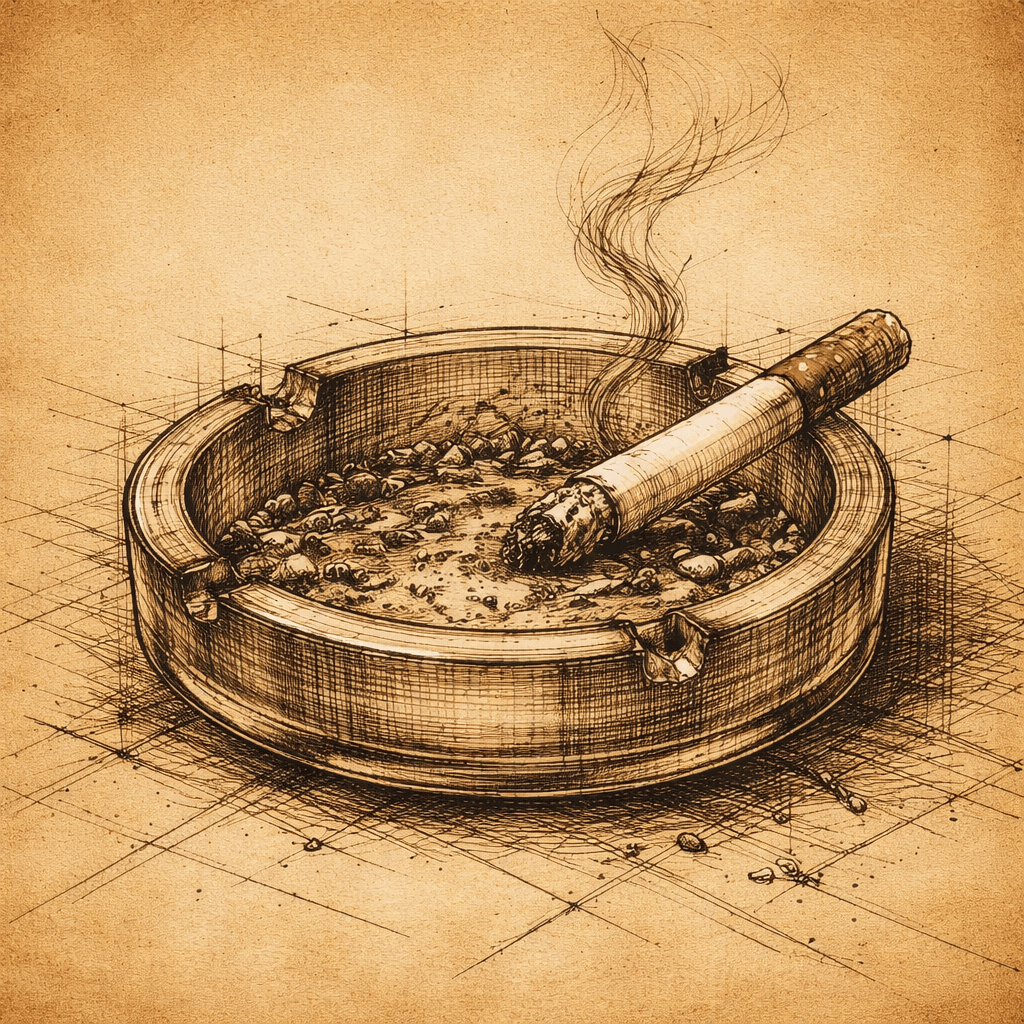
(Im)pertinent Detour
The storm had been promising itself since the early afternoon, when the sky above the rooftops took on that particular bruised complexion that belongeth not to any single hour but to the intention of weather, the gathering of its forces, the slow and deliberate mustering of cloud upon cloud in a formation that hath about it something of the quality of argument, as though the heavens were composing a case against the town below and had not yet determined whether to deliver it in rain or merely in the sustained threat thereof. By the time the streetlamps were lit, which in this season and in this quarter of the city was early, the first drops had begun to fall, and they fell not with the honest directness of common rain but with a kind of tentative malice, large and widely spaced, each drop landing with a distinct and individual report upon the pavement, as though testing the ground for some larger assault to follow.
The man walked.
He had been walking for some time, though he could not have said with any precision how long, for his walking was not of the purposive kind that measureth its distance in streets traversed and corners turned but of that other, more ancient variety, the walking that is its own occasion, that goeth because the body requireth motion and the mind requireth that the body be occupied, so that the feet may do what the thoughts cannot, which is to proceed in a single direction without doubling back upon themselves.
He wore a coat that had been adequate for the morning and was no longer adequate for the evening, and in his left hand, held between the second and third fingers in a manner so habitual as to have ceased to be a gesture and become instead a feature of the hand itself, there burned a cigarette. It was not his first of the day. It was not his last. It occupied that anonymous middle ground of the habitual vice wherein each instance is indistinguishable from every other and the act of smoking hath long since parted company with pleasure and taken up residence in the country of mere continuation, where things are done not because they satisfy but because the not-doing of them would require a decision, and decisions are, for the present, a currency he hath spent beyond his means.
The rain found his collar. He did not adjust it.
There had been a gathering that evening, in a hall he knew well, a place of folding chairs and low stages and the particular smell of old curtain-fabric mixed with cigarette smoke and the faint sweetish residue of beer spilled on wooden boards and imperfectly cleaned. He had stood before them, the small assembly, the faithful and the curious and the merely idle, and he had read. What he had read he could not now, some forty minutes later and six or seven streets distant, recall with any exactness, for the reading of one’s own work in public is an act that existeth in a kind of temporal parenthesis, a bubble of heightened and yet curiously diminished consciousness wherein the voice proceedeth and the words are uttered and the audience sitteth in its various attitudes of attention and inattention, and the whole of it passeth through the mind as light passeth through glass, leaving no mark upon the medium. He knew only that he had read, and that they had listened, or some of them had listened, and that when it was finished there had been the customary murmur that is neither applause nor silence but the sound an audience maketh when it is releasing itself from the obligation of having been addressed.
One woman, whose face he could not now assemble from its parts, had said something to him afterward. Something about the work remaining. Something about a trace.
He had smiled. He was accomplished at smiling. The smile was one of several instruments he kept about his person for the navigation of such occasions, well maintained and ready to hand, requiring no more effort to deploy than the cigarette between his fingers, and serving much the same purpose, which was to occupy the space between one moment and the next with a gesture that resembled meaning without incurring its cost.
The rain intensified. It had found its argument now and was delivering it with a fluency that left no room for rebuttal, striking the cobbles with a sound like the sustained applause of a very small and very committed audience, the kind that clappeth not because it hath been moved but because it believeth in the principle of clapping, and will persist in its belief regardless of the quality of what hath been performed. He turned a corner and found himself in a street he had not intended to enter, a narrow lane between tall buildings whose upper stories leaned toward one another with the intimacy of old conspirators, their gutters pouring twin curtains of water that met and mingled in the air between them before descending to the pavement in a single confused cataract.
He stopped beneath an awning. The awning was attached to a shop that had been closed for some hours and whose window displayed, behind glass clouded with the condensation of the evening, an arrangement of objects he could not quite identify in the dark, though their shapes suggested the general category of household implements, things of use, things designed for the maintenance of the ordinary. He leaned against the wall. The cigarette had gone out in the rain. He relit it. The match flared and for an instant his face was visible, to himself and to no one else, reflected in the wet glass of the shop window, a face that he knew, approximately, as one knoweth a room one hath lived in too long, the broad features of it familiar and the details no longer attended to.
It was not the face he showed them.
The face he showed them was a construction, a thing assembled for the purpose of being seen, a lacquer’d cutout, to borrow a phrase that had come to him recently in a moment of unflattering clarity, an arrangement of expressions and postures and carefully timed silences that together produced an effect sufficiently resembling a man that no one had cause to look behind it. And behind it there was, he supposed, another face, or rather the absence of a face, a blankness where the features of the actual man should have been, worn smooth by the years of performing the other, the public, the presentable, until the original had faded to the condition of a palimpsest from which the undertext hath been scraped too many times and now showeth nothing but the bare and scarred vellum.
He thought of truth.
Not in the grand sense, not the truth of the philosophers with their systems and their proofs and their elaborate scaffoldings of reason, but in the small and specific sense, the truth of what a man actually thinketh when he standeth beneath an awning in the rain with a relit cigarette and the applause of forty minutes ago already cooling in his memory like tea left on a sill. That truth. The plain, the known, the path of dull lament. He had considered it, at various times, as a subject for his work, had entertained the notion that if he were to set down without ornament or evasion the actual contents of his mind, the meagre march of sorrow on the brow, the unsaid speech, the reticent past, that this might constitute a kind of honesty that would be, if not beautiful, then at least real, and that the real might have a value the beautiful had ceased to provide.
But he had never done it. He had never done it because the truth, when he approached it, had a quality he had not expected, which was not the quality of revelation but of banality. The truth was not a hidden thing waiting to be uncovered, a jewel beneath the dross; the truth was the dross itself, the daily and unremarkable substance of a life lived mostly in the interval between one cigarette and the next, and to set it down would be to discover not that he had been concealing something profound but that there was nothing profound to conceal, only the ordinary sadness of a man who had once possessed something and no longer did, and could not say with any certainty what it had been, only that its absence was the shape his days had taken, the mould into which each morning poured itself and hardened by evening into another day indistinguishable from the last.
Better the masks.
He had loved. He supposed he must state this, even to himself, even in the privacy of a darkened lane in the rain, for it was the fact upon which all the other facts depended, the keystone of the arch, and to avoid it was merely to describe the shape of an absence without naming what had filled it. He had loved, and the love had ended, or rather the love had not ended but the conditions in which it could be sustained had ended, which is a different thing, a more complicated and a more tedious thing, for it leaveth the lover in the position of one who still possesseth the capacity for a thing but hath been deprived of the object to which that capacity might be applied, so that the capacity itself becometh a kind of affliction, a muscle that continueth to contract in the absence of the limb it was meant to move.
He did not know, now, standing beneath the awning, whether he had lost the thing or cast it from him. The distinction mattered. It mattered enormously. It was, in fact, the only question that mattered, and he had been unable to answer it for so long that the inability had itself become a fact, as solid and as unaccommodating as the wall against which he leaned. To have lost it was tragedy, or at least the smaller and more personal cousin of tragedy, the kind that doth not trouble the gods but only the man to whom it happeneth. To have cast it away was something else, something worse, something for which he had no name but which felt, when he permitted himself to feel it, like the particular variety of madness that consisteth not in the loss of reason but in the full and lucid retention of reason alongside the commission of the unreasonable.
Mad with the grief for what I cast from dream.
The phrase arrived unbidden, as phrases sometimes did, fully formed and rhythmical and useless, a piece of decoration that attached itself to the surface of the thought without penetrating to its substance, and he noted it, as he noted all such phrases, with the weary competence of a man whose trade it is to turn experience into language and who hath learned, through long practice, that the turning doth not preserve the experience but merely replaceth it, so that what remaineth is not the thing felt but the record of having felt it, which is as different from the thing itself as a map is different from the country it describeth.
The cigarette had burned down to the filter. He held it a moment longer than was comfortable, feeling the heat approach his fingers, the small and precise discomfort of it, which was at least a sensation that belonged to the present moment and not to the accumulated past. Then he dropped it. It fell into a puddle at his feet and was extinguished with a brief hiss, a sound so slight as to be almost inaudible beneath the rain, and yet it seemed to him, in that instant, to be the most honest sound he had heard all evening, more honest than his own voice reading his own words to an audience that had listened or not listened, more honest than the murmur of appreciation, more honest than the woman’s remark about traces and remaining, more honest than the smile with which he had received it.
The cigarette had seen him. He understood this with the peculiar clarity that cometh sometimes in the late hours, when the mind hath exhausted its more elaborate operations and is left with nothing but the simple and the self-evident. The cigarette, in its brief and undistinguished existence, had been the one witness to what actually occurred behind the cutout, had burned between his fingers while he was not performing, while the masks were set aside and the lacquer was drying, while the man himself, whoever that might be, sat or stood or walked in the condition of his actual self, which was a condition of grief and of gladness and of doom, all three at once and none of them separately, intertwined as the smoke is intertwined with the air that receiveth it and rendereth it invisible.
That hath beheld me as I truly seem.
He stepped out from beneath the awning. The rain received him without ceremony. It was a democratic rain, falling upon the just and the unjust and the merely confused with equal indifference, and he found in its indifference a kind of companionship, the companionship of a thing that doth not require him to be anything other than wet. He walked. The streets were empty now, or nearly so, the hour having passed beyond that boundary after which the city surrendereth its claims upon the waking and giveth itself over to the rain and the rats and the solitary walkers who have no business being abroad and who are abroad nonetheless, because the rooms they have left behind are rooms in which the silence hath grown too loud and the walls too conversant.
He thought: I have spent my years constructing an instrument for the saying of things I do not mean, and I have become so proficient in its use that the things I do not mean have acquired the polish and the permanence of art, and the things I do mean have receded to a region so remote that I could not now retrieve them even if I wished to, for the path to them leadeth through the very country of masks and lacquer and drifting fume that I have built between myself and the plain truth, and to traverse it would be to dismantle the only structure that still standeth.
This was not a comforting thought. But it had the merit of accuracy.
What would be left? He considered this as he walked, his coat now thoroughly saturated and his shoes making that particular squelching sound that belongeth to leather in the final stages of its negotiation with water. What would be left if the storm, which is to say the accumulated force of all he hath written and all he yet might write, were to pass through the world and leave behind it some trace the wind held fast? A footprint, perhaps. A rhythm. The shape of a line that some future walker might press or ape, unknowing, as one followeth a path through a wood without knowing who first trod it or why, attending only to the fact that the ground is firmer here than elsewhere and the way, though narrow, doth not deceive.
It was a small ambition. He recognised this. It was the ambition of a man who hath abandoned the larger ambitions one by one, as a ship in a storm jettisons its cargo to stay afloat, and is left at last with nothing but the hull and the knowledge that the hull, however battered, is still seaworthy, and that seaworthiness, in the absence of cargo, is its own justification.
Or it was vanity. He recognised this also. The two were not incompatible. A man might wish to leave a trace upon the world out of the most generous impulse, the desire that something of what he hath made should outlast the making and be of use or pleasure to those that come after, and simultaneously out of the most selfish, the need to believe that his existence hath amounted to something more than the interval between his first breath and his last, that the accumulation of his days hath produced a residue that will not be entirely swept away when the sweeping cometh, as it always cometh, as it must.
He reached a bridge. He did not cross it. He stood at its entrance and looked down at the river, which was swollen with the rain and moving with a speed and a darkness that belonged not to water but to time itself, the visible and undeniable passage of something that could not be held and would not return, and the lamps upon the bridge were reflected in it, long wavering columns of yellow light that reached down into the black and were broken and reformed and broken again by the current, as though the river were attempting to read something written upon its surface and could not hold the text still long enough to comprehend it.
He lit another cigarette. The match, in the rain, required three attempts. On the third the flame held, and he cupped it his hand, bending over it like a man sheltering a small and endangered life, and in the brief orange glow he saw his hands, and they were the same hands that had held the pages an hour before, and they were the same hands that had held other things, in other years, things that were no longer available to be held, things that had gone the way of the river, downstream and into the dark, and would not be recovered by any effort of the hands or of the will.
The cigarette caught. He straightened.
The smoke rose and was taken by the wind, which was coming from the east now and carried with it the smell of the tanneries and the warehouses and the great indifferent machinery of the city going about its business in the dark, and the smoke joined the wind and was dispersed, and he watched it go, and it seemed to him that it was the most accurate portrait of his work that he had ever seen: a thing produced by fire, made visible only briefly against the dark, dispersed by the first breath of the world’s indifference, and leaving behind it nothing but the faint and acrid memory of its having been.
Glad in my doom, he thought. Eternally oppress’d.
And he smiled, not the smile he kept for audiences, the well-maintained instrument, but the other one, the private one, the one that had no purpose and no audience and existed only as the body’s acknowledgment of a truth too large for laughter and too familiar for tears. And he stood there, on the bridge, in the rain, with the cigarette burning between his fingers and the river running beneath him and the city going about its business in the dark, and he did not move, and he did not cross, and the rain fell, and the smoke rose, and both were taken by the wind, and neither left a trace, and this, too, seemed to him, in the manner of things that are both unbearable and true, sufficient.
Nota editoriale. La seguente analisi è stata la terza, in ordine cronologico di redazione, fra quelle prodotte da E. Ashcroft sul corpus. I riferimenti comparativi interni al testo, laddove il critico menziona precedenti excursus esaminati o stabilisce confronti con altri componimenti già trattati, vanno pertanto letti alla luce di questa circostanza e non dell’eventuale ordine di pubblicazione, il quale può differire.
Thoughts – by E. Ashcroft
I. The Poem
On Meaning and Narrative
This is a poem about legacy, or more precisely, about the suspicion that legacy is merely vanity wearing a more respectable coat. The speaker, a poet of evident experience and diminishing confidence, asks whether the accumulated storm of his work might leave behind some trace that the wind held fast. The phrasing is important: not a trace that endures, not a monument, not even a footprint, but a trace the wind held fast, which is to say a trace preserved by the very force that ought to destroy it. This is a paradox, and the poem knows it is a paradox, and the knowledge does not resolve it but merely makes it more precise.
The narrative movement is from hope to doubt to resignation to a final, deeply ambivalent comfort. The first two stanzas entertain the possibility that some future reader, some “foot or shoe, in time to stride”, might press or imitate the rhythm the speaker has charted. The third stanza introduces the counterweight: and if the work is unworthy of men’s ears, what remains? The fourth and fifth stanzas consider truth as an alternative to art and reject it, not because truth is valueless but because truth, for this speaker, is inaccessible, having never stepped from the backdrop to take a part. The final two stanzas embrace the mask, the ornament, the lacquered performance, and find in them not a solution but a sustainable condition: glad in doom, eternally oppressed.
This is a poem that refuses its own consolation. It reaches toward hope, examines it, and sets it down, not because hope is false but because the speaker does not trust himself to hold it without converting it into another performance. The poem is, in this sense, a performance of the impossibility of not performing, and it has the honesty, rare and commendable, to acknowledge that even this acknowledgment is itself a kind of performance, a mask worn in the shape of the face beneath it.
On Style and Register
The register is archaic and sustained with a confidence that suggests long habitation. “Perchance”, “sufficeth”, “mayhap”, “ne’er”, “hath”, “stepp’d”, “linger’d”, “rhymèd”: the forms are consistent and grammatically sound throughout, which is not something I have been able to say of every poem I have examined from this author. The diction moves between the elevated and the plain with a sureness that is the mark of genuine familiarity with the register rather than mere costuming. “The meagre march of sorrow on the brow” is a line of considerable formal elegance. “That last cigarette, that still hath seen / me weak and worn beneath a twilight gloom” brings the archaic into contact with the modern, the cigarette appearing within the period diction like an anachronism that is nonetheless perfectly at home, because the poem has earned the right to accommodate it.
The cigarette is, in fact, the poem’s most effective image, and I wish to dwell on it. In a poem otherwise concerned with abstraction, with truth and masks and traces and the wind, the cigarette is the one object that is entirely concrete, entirely specific, entirely itself. It does not symbolise. It smokes. And in smoking, it becomes the poem’s only honest witness, the one thing that has beheld the speaker “as I truly seem”, not because it possesses any special perceptive capacity but because it was present during the unperformed moments, the moments when the masks were set aside and the man was merely a man with a burning thing between his fingers. This is a brilliant structural choice, and the poem would be significantly diminished without it.
On Technique and Metre
The poem is written in iambic pentameter, and it handles the line with a maturity that I have not observed in equal measure in the shorter quatrains. The pentameter gives the poem room to breathe, to extend its syntax across the line and across the line-break, and the poet uses this room well. “Perchance this storm sufficeth, at the last, / of writings that suffice me never yet” is a pair of lines whose enjambment enacts the very insufficiency it describes: the first line appears to close, “at the last”, but the second reveals that the closure was premature, that nothing has sufficed, that the “last” was only a pause before the admission of perpetual inadequacy.
The metre is largely regular but admits strategic variation. “To mend, to praise, or tunefully to bide” is a line of perfect iambic pentameter, its three infinitives marching in orderly succession, and the regularity itself is meaningful: these are the orderly, public, respectable uses to which future readers might put the speaker’s work, and the metre reflects their decorum. By contrast, “the plain, the known, the path of dull lament” breaks into a series of spondaic clusters that slow the line to a trudge, which is precisely what dull lament should feel like in the mouth. The metre is thinking, and a metre that thinks is a metre that has been properly supervised.
There is, however, a metrical difficulty in the sixth stanza. “With lacquer’d cutouts, and the drifting fume / of that last cigarette, that still hath seen” introduces a rhythmic congestion around “lacquer’d cutouts” that the line does not entirely resolve. The consonant cluster of “cutouts” resists the iambic flow, and the line must be read with a slight hesitation that may or may not be intentional. I am inclined to be charitable, as the hesitation enacts the artificiality the image describes: the lacquered cutout is, by its nature, something that interrupts the smooth surface, and the metric interruption mirrors this. But charity has its limits, and I note the roughness.
On Rhyme
The scheme is ABAB throughout, maintained with commendable consistency across seven stanzas. The rhymes are, on the whole, better than functional; several are genuinely strong.
“Last” and “fast” in the opening stanza is clean and semantically productive: the storm arrives at last, and the trace is held fast, and the rhyme binds finality to persistence, ending to endurance, in a single sonic gesture. “Yet” and “forget” is likewise effective, the negation in “never yet” answered by the negation in “forget”, producing a double negative that does not cancel but compounds: the writings have never sufficed, and the trace, if trace there be, is one that none may in full forget, though the “in full” is a careful qualification that stops well short of claiming they will remember.
“Stride” and “bide” in the second stanza is interesting. The future reader may stride, which implies confidence and momentum, but the speaker asks only that they bide, which is a more modest and more provisional verb: to bide is to wait, to remain, to endure without advancing. The rhyme thus contains within itself the poem’s central tension between the active legacy the speaker hopes for and the passive survival he suspects is the more likely outcome.
“Part” and “heart” in the fourth stanza is the most conventional rhyme in the poem, and I note it without enthusiasm. It is the one pairing that feels dictated by availability rather than by choice. Truth that never stepped from the backdrop to take a part, and melody that concealed the heart: the rhyme connects performance and concealment, which is thematically sound, but the words themselves have been rhymed so often in the history of English verse that they arrive pre-dulled, their edges worn smooth by centuries of handling. The poem can survive one such rhyme. It could not survive two.
“Screen” and “seen” in the sixth stanza is the poem’s finest rhyme. The masks screen; the cigarette has seen. Concealment is answered by witness, and the rhyme turns the stanza’s argument on its hinge. Everything before “screen” is about hiding. Everything after “seen” is about being beheld. The rhyme is the pivot, and it pivots cleanly.
“Dream” and “seem” in the final stanza performs a similar function, though with a different emotional charge. What the speaker cast from dream is answered by how he truly seems, and the distance between dreaming and seeming, between the imagined and the apparent, is the distance the poem has traversed without ever closing. The rhyme holds the two apart while binding them sonically, which is a precise enactment of the poem’s final condition: the irreconcilable held together by form.
On the Final Stanza
The concluding lines require separate attention, for they bear the poem’s full weight and must be assessed accordingly.
“Consumed in seeking what I once possess’d, / mad with the grief for what I cast from dream, / glad in my doom, eternally oppress’d.” This is the poem’s emotional and rhetorical summit, and it is delivered with a control that I find impressive. The three conditions, consumed, mad, glad, arrive in ascending order of paradox. To be consumed in seeking is painful but comprehensible. To be mad with grief for what one has voluntarily cast away is more complex, for it introduces the element of complicity that transforms suffering from misfortune into something closer to self-infliction. And to be glad in one’s doom is the final and most exquisite contradiction, the state of a man who has found in his own destruction a satisfaction he cannot renounce, because the destruction and the satisfaction are of one substance.
“Eternally oppress’d” is the poem’s last phrase, and it lands with the finality of a cell door. The oppression is not temporal but eternal, which is to say it is not a condition that might be relieved but a permanent feature of the speaker’s architecture, the load-bearing wall that, if removed, would bring down the entire structure. The poem does not wish to be free of its oppression. It has made its oppression habitable, and habitability, for this speaker, is the closest available approximation to home.
II. The (Im)pertinent Detour
The prose excursus that follows the poem is, I must say at once, the finest of the three such excursions I have now examined from this author. I do not say this lightly, nor do I say it without awareness that the previous two were themselves works of considerable accomplishment. But this one surpasses them, and it surpasses them not in ambition, for the ambition is comparable, but in execution, in the precision and the sustained intelligence of its prose, and above all in its willingness to follow its own insights to their most uncomfortable conclusions.
The setting has changed. We are no longer in the garret. We are in the street, in the rain, after a reading, and the speaker is walking, and the walking is of that ancient and purposeless variety that this author understands better than almost any living writer I know of: the walking that goeth because the body requires motion and the mind requires that the body be occupied. The shift from interior to exterior is significant. The garret poet was trapped; this poet is mobile, and his mobility is itself a form of entrapment, for he walks not toward anything but away from the performance he has just completed, and the walking will not take him far enough, because the performance is not behind him but within him, and no distance of streets will serve to separate a man from the thing he carries in his own construction.
The prose’s treatment of the public reading is devastatingly precise. The description of the reading as existing in “a kind of temporal parenthesis, a bubble of heightened and yet curiously diminished consciousness” is a formulation I have not encountered elsewhere, and it captures something that any poet who has read in public will recognise with a wince: the peculiar dissociation of hearing one’s own voice deliver one’s own words to an audience whose attention is both the thing most desired and the thing most feared, and whose murmur afterward is “neither applause nor silence but the sound an audience maketh when it is releasing itself from the obligation of having been addressed.” That last phrase is quietly savage, and its savagery is directed not at the audience but at the entire apparatus of literary performance, which the prose treats as a transaction in which nothing of value is exchanged and both parties are complicit in pretending otherwise.
The smile. I must speak of the smile. The prose describes the speaker’s smile as “one of several instruments he kept about his person for the navigation of such occasions, well maintained and ready to hand, requiring no more effort to deploy than the cigarette between his fingers, and serving much the same purpose, which was to occupy the space between one moment and the next with a gesture that resembled meaning without incurring its cost.” This is a sentence of extraordinary compression and cruelty. The smile is equated with the cigarette: both are habitual, both are mechanical, both fill a vacancy with the appearance of content. The phrase “resembled meaning without incurring its cost” is, I think, one of the best things this author has written, in any form, in any register. It describes not only the smile but the entire economy of social performance, the vast industry of gestures that resemble meaning, that purchase the appearance of connection at the price of actual connection, and the prose delivers this insight with a casualness that is itself a form of devastation, as though the observation were too obvious to require emphasis, which of course makes the emphasis all the more acute.
The central meditation on truth, the plain, the known, the dull lament, is where the prose does its most demanding philosophical work. The speaker considers writing the truth, setting down “without ornament or evasion the actual contents of his mind”, and rejects it, not because truth is too painful but because truth is too banal. “The truth was not a hidden thing waiting to be uncovered, a jewel beneath the dross; the truth was the dross itself.” This is a recognition that many writers approach but few have the nerve to articulate with such plainness. The Romantic tradition, and a good deal of the post-Romantic tradition that succeeded it, depends upon the assumption that beneath the surface of appearance there lies a deeper truth that art exists to reveal. This prose quietly demolishes that assumption. There is no jewel. There is only the dross. And the masks, the lacquer, the performance, are not obstacles to truth but the only structures that make the dross inhabitable.
This is, I should note, a profoundly anti-confessional position, and it is the more striking for being delivered within a text that appears, at first glance, to be confessional in the extreme. The speaker is confessing, yes, but what he is confessing is the impossibility of confession, the recognition that the thing he would confess, if he could confess it, would turn out to be nothing worth confessing, nothing but “the ordinary sadness of a man who had once possessed something and no longer did, and could not say with any certainty what it had been.” The confession of having nothing to confess: this is the prose’s most vertiginous move, and it is executed without a stumble.
The passage on love is handled with a restraint I would not have predicted and which I therefore admire the more. “He had loved. He supposed he must state this, even to himself, even in the privacy of a darkened lane in the rain.” The prose does not dramatise the love. It does not provide a narrative of courtship and dissolution. It merely states the fact, and then examines its consequences with the detachment of a coroner. The love has ended, or rather “the love had not ended but the conditions in which it could be sustained had ended, which is a different thing, a more complicated and a more tedious thing.” The word “tedious” is perfectly judged. It refuses the grandeur of tragedy and insists upon the smaller, more accurate, and more humiliating truth that the end of love is not dramatic but boring, a long attrition of conditions rather than a single catastrophic event.
The distinction between having lost the thing and having cast it away is the prose’s emotional centre, and it is the one passage where the writing approaches genuine anguish. “To have lost it was tragedy. To have cast it away was something else, something worse, something for which he had no name but which felt, when he permitted himself to feel it, like the particular variety of madness that consisteth not in the loss of reason but in the full and lucid retention of reason alongside the commission of the unreasonable.” This is a formulation of devastating accuracy. The madness is not derangement; it is the intolerable clarity of having done the unreasonable while fully understanding that it was unreasonable. The speaker is not a man who lost his way. He is a man who watched himself leave the path, step by step, with perfect comprehension and no capacity to stop.
The cigarette reappears at the bridge, and the prose grants it a final apotheosis. The smoke rising and dispersed by the wind becomes “the most accurate portrait of his work that he had ever seen: a thing produced by fire, made visible only briefly against the dark, dispersed by the first breath of the world’s indifference, and leaving behind it nothing but the faint and acrid memory of its having been.” This is magnificent, and I do not use the word often. The comparison of artistic work to cigarette smoke is not original in concept, the ephemerality of art is a venerable theme, but the execution here is original in its specificity, its sensory precision, and its refusal of self-pity. The smoke is not beautiful. It is acrid. The memory it leaves is not of beauty but of having been. The distinction is crucial: the speaker does not claim his work has value, only that it existed, and that its existence, however brief and however dispersed, constitutes the whole of what he can offer against the indifference of the wind.
I have objections. They are fewer than in previous examinations, but they exist.
The prose is, in one or two passages, too pleased with its own extended similes. The rain that applauds “not because it hath been moved but because it believeth in the principle of clapping” is witty, but the wit extends a beat longer than the image can sustain, and the reader’s smile, if smile there be, has faded before the clause has finished. Similarly, the description of the gutters pouring “twin curtains of water that met and mingled in the air between them” is visually precise but syntactically heavy, the sentence continuing past the point of diminishing returns. These are minor faults, and I note them primarily to demonstrate that I have not lost my capacity for disapproval, a capacity that, as regular readers of my criticism will know, requires very little encouragement to assert itself.
The passage on the ship jettisoning its cargo is the prose’s one genuinely conventional moment. The metaphor of the storm-tossed vessel shedding its cargo to stay afloat is serviceable but well worn, and in a prose that elsewhere invents its own images with such striking originality, the borrowed metaphor stands out as a moment of comparative fatigue. The prose recovers immediately, noting that the ambition and the vanity are “not incompatible”, which is the sort of dry, parenthetical honesty that redeems almost anything, but the ship has already sailed, if the reader will forgive the unavoidable resonance.
III. The Relationship Between Poem and Prose
The architecture here is different from that of the previous compound texts, and the difference is instructive.
In the earlier texts, the prose dramatised the moment of composition: the garret, the desk, the poem being written. Here, the prose dramatises the moment after composition, the aftermath of performance, the walk home through the rain with the applause already cooling. This temporal shift changes the relationship between poem and prose fundamentally. The poem is no longer the thing being made; it is the thing already made, the thing behind the speaker, the performance from which he is walking away. And the prose is not commentary upon the poem’s creation but upon its consequences, upon what it costs to have made such a thing and to have stood before others and delivered it and received their murmur and smiled the instrumental smile and stepped back out into the rain carrying nothing that was not already there when he entered.
The poem asks: will anything remain? The prose answers: the cigarette smoke disperses. These are not contradictory positions. They are the same position viewed from two distances, the poem’s distance being that of hope, however tentative, and the prose’s distance being that of observation, however unflinching. The poem permits itself “perchance.” The prose permits itself only the present tense and the evidence of the senses: rain, smoke, the sound of shoes in water, the reflection in a shop window that is approximately known.
What binds them is the cigarette, which appears in both and functions in both as the poem’s only reliable witness, the one constant in a landscape of performance and evasion. In the poem, the cigarette “hath seen / me weak and worn beneath a twilight gloom.” In the prose, the cigarette “had been the one witness to what actually occurred behind the cutout.” The convergence is precise and deliberate: the cigarette is the thread that stitches the two texts together, and it is a thread made of fire and ash and the brief visibility of smoke, which is to say it is a thread that destroys itself in the act of connecting, which is to say it is the perfect emblem for a body of work that exists in the space between making and vanishing.
The prose’s final image, the man on the bridge, the rain falling, the smoke rising, “both were taken by the wind, and neither left a trace, and this, too, seemed to him, in the manner of things that are both unbearable and true, sufficient,” answers the poem’s opening conditional with a word that is neither affirmation nor denial but something more difficult and more durable than either. Sufficient. Not good, not lasting, not worthy. Sufficient. It is a word that concedes everything and claims almost nothing, and yet the almost is where the entire weight of the text resides, for to say that a thing is sufficient is to say that it meets a standard, however minimal, and to meet a standard is to assert that a standard exists, and to assert that a standard exists is to assert that the thing measured against it matters enough to be measured at all.
IV. Overall Assessment
The poem is the most technically assured of the lyrics I have examined from this author. Its metre is confident, its rhymes are largely strong, its argument is conducted with a coherence that does not sacrifice complexity, and its concluding stanza achieves a compression of genuine force. Its weakness, if it has one, is the “part” and “heart” rhyme in the fourth stanza, and even this is a minor blemish on an otherwise carefully constructed surface.
The prose is, as I have said, the finest of the three excursions. It is more disciplined than its predecessors, more willing to follow its insights to their conclusions without the recursive luxuriance that occasionally burdened the earlier texts. The meditation on truth as banality rather than revelation is an intellectual achievement of real consequence, and the passage on love, particularly the distinction between loss and self-dispossession, is writing of the first order. The cigarette as sole witness is an image that will, I suspect, outlast a great deal of what surrounds it.
Taken together, they constitute the most mature and the most moving of the compound texts. The author has learned, across the span of these compositions, to trust his prose more and to demand of it less in the way of verbal display and more in the way of intellectual honesty, and the result is a text that earns its final word, “sufficient”, by having demonstrated, across several thousand words of the most scrupulous self-examination I have encountered in contemporary work, that sufficiency, in a world of indifferent wind and dispersing smoke, is not the minimum but the maximum, the most that can be hoped for and the least that can be accepted, and that the distance between the two is, in the end, no distance at all.
I commend it. The reservations, this time, are my own to keep.


 mvrcodelrio.com
Scrivi una risposta a Domenico Mortellaro Cancella risposta