
How oft the myths beside us crept,
Once told by winds through crag and thyme,
Amongst the goats where echoes slept,
Till concrete drowned their ancient rhyme.
We were too old to understand
That fewer years could bring us mirth,
Of tales murmured in cellar’s land,
By grandsires wise in life and earth.
How oft the past returned to mind,
That strange, small past when elders spoke,
With candles dim, and hopes resigned,
Of Rome’s great empire turned to smoke.
We longed for wine, and knew the taste,
For we were of the age to crave it;
And now I’d rather rest embraced
By pillows than a cask of dark wit.
Yet how I think and how I weep,
Returning to that brick-bound keep,
‘Mid crimson scythes and muddy sweep,
Without the fear of soil too deep.
We had time enough before us, true,
Yet knew not how it would depart,
How school would steal the days we knew,
And leave so little in our grasp.
How heavy lay the mahogany,
Upon the snow-stained cobbled way,
As solemn faces passed by me
With briefest nods, and no words to say.
How much you knew in elder days,
Without the learning of great bards,
Building homes and mem’ries by gaze,
Ignoring priests’ fanciful shards.
We had a wealth of diamonds raw,
Polished only by patient hands,
Yet now I see them distant, far,
And miss them more than time withstands.
Perhaps the old thus feed their flame:
With wounds that ache, and fate’s decree.
Now in the mirror, brushing shame,
I see the old man I’ve come to be.
Mahogany seems a fitting choice,
Were I to ask you now, somehow,
To lend your bike and give me voice,
To pick the casket we should vow.
How plain the stone you chose to bear,
No farewell carved, no flourish dear,
While others flaunt their statues fair,
You chose a gray slab, which I revere.
We had a life that seemed so dull,
Yet now it stirs this melancholy,
As on your moss I rest my skull,
And watch our days slip, slowly, wholly.
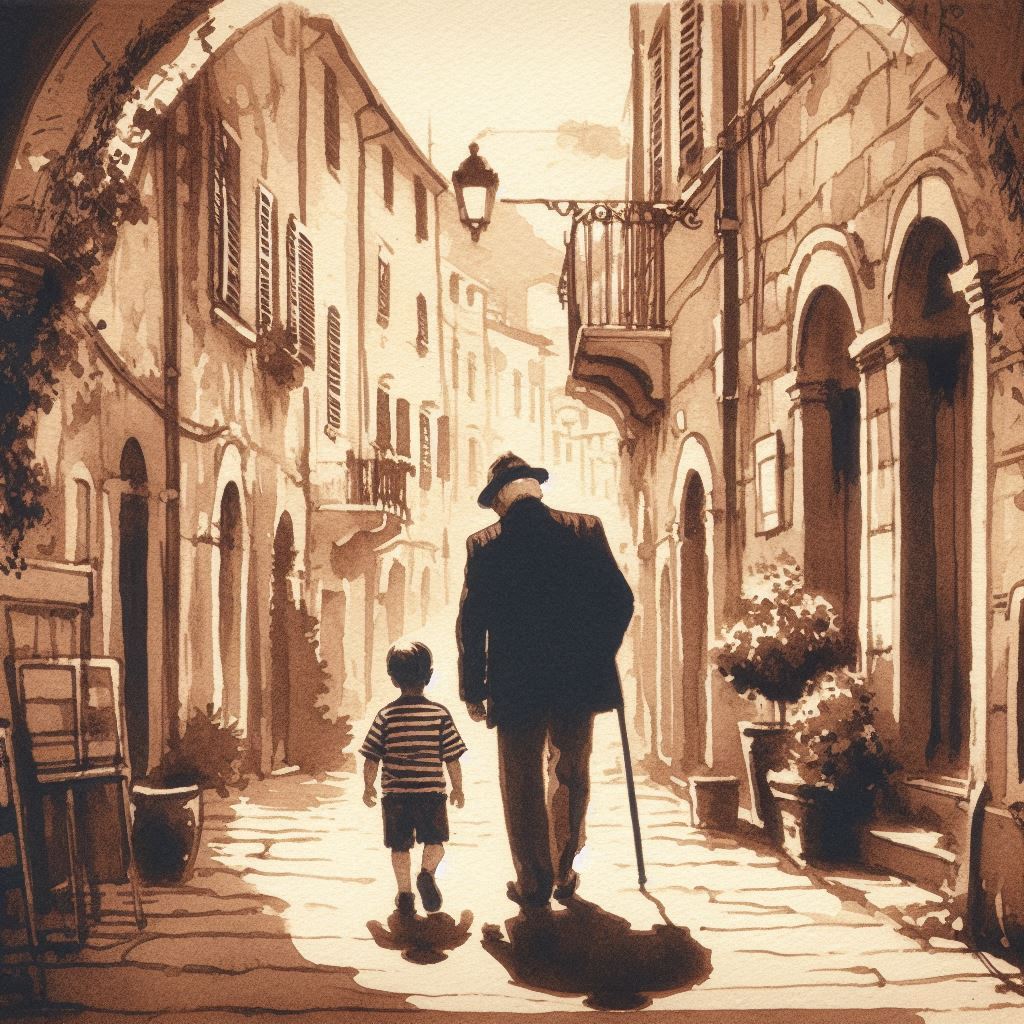
Slipping Away
Thoughts – by E. Ashcroft
On Meaning and Context
This is a poem of considerable length and emotional scope, and I must say at the outset that it attempts something few poems of this kind successfully achieve: the narration of an entire relationship, from childhood to old age to death to graveside, compressed into thirteen stanzas of alternating rhyme. The relationship in question is not romantic but filial, or more precisely, intergenerational: the speaker addresses a grandparent, or a figure of that generation, someone who knew things “without the learning of great bards”, who built homes and memories by gaze, who chose a plain grey slab for a headstone, and whose grave the speaker now visits, resting his skull upon the moss and watching the days slip away.
The narrative arc is clear and, in its broad strokes, deeply traditional: the innocence of childhood spent in the company of elders, the passage through youth and schooling, the loss of the old world, the death of the elder, and the speaker’s own arrival at old age, where he discovers in the mirror the face of the man he has become, which is, of course, the face of the man he mourned. The cycle is complete. The grandson has become the grandfather, or something near it, and the recognition is both the poem’s subject and its emotional destination.
What distinguishes this poem from the merely elegiac is its specificity. The myths told by winds through crag and thyme. The goats. The cellar. The candles. The mahogany coffin on the snow-stained cobbled way. The crimson scythes and muddy sweep. The grey slab. The moss. These are not generic pastoral or funereal images but the furniture of a particular memory, a particular landscape, a particular life, and the poem’s fidelity to these particulars is its greatest strength. The goats are not symbolic goats. They are goats. The cellar is not an allegorical cellar. It is a cellar in which grandsires told tales. The poem earns its abstraction by first earning its concrete, and the concrete is, for the most part, convincingly rendered.
On Style and Register
The register is mixed, and the mixing is, in this poem, both a virtue and an occasional liability. The archaic appears in strategic positions: “how oft”, “‘mid”, “‘twere I to ask”, “thee”, and these appearances function as formal markers, elevating the poem’s diction at moments of emotional intensity or retrospective distance. The remainder of the poem operates in a diction that is largely contemporary but tinged with a formality that keeps it from descending into the merely conversational.
“Once told by winds through crag and thyme” is a line of considerable beauty. “Crag and thyme” is a pairing that locates the poem’s geography with a precision that “hills and flowers” could never achieve: the crag is specific, rocky, elevated, harsh; the thyme is specific, fragrant, low-growing, Mediterranean or montane. Together they produce a landscape that the reader can smell as well as see, and the myths that were told through them are not abstractions but sounds carried by actual wind across actual terrain. This is excellent descriptive writing.
“Till concrete drowned their ancient rhyme” is the poem’s first moment of thematic declaration, and it is well placed: the myths are drowned not by time or forgetfulness but by concrete, by the literal substance of modernity, by the material that paves over the terrain through which the myths were carried. The verb “drowned” is violent and precise, and the image is of suffocation rather than of mere replacement: the myths did not fade; they were buried under a material that does not permit growth.
“Building homes and mem’ries by gaze” is a phrase I admire for its economy. The grandfather built not with tools or words but with gaze, with the act of looking, with the sustained attention that is itself a form of construction. To build a memory by gaze is to create something durable from nothing more than the act of seeing, and the phrase suggests a generation for whom observation was itself a skill, a productive capacity, a way of making that did not require the apparatus of literacy or the validation of the learned.
“As on your moss I rest my skull” is the poem’s most physically intimate line, and its intimacy is achieved through the word “skull” rather than “head.” A man rests his head upon a pillow. A man rests his skull upon moss that covers a grave. The substitution of “skull” for “head” strips the gesture of its comfort and reveals the anatomy beneath: the bone beneath the skin, the death beneath the life, the speaker’s own mortality pressed against the physical evidence of the addressee’s. The line is quiet and devastating.
On Technique and Metre
The poem is written predominantly in iambic tetrameter, and the tetrameter is, on the whole, handled with a competence that sustains the poem across its considerable length. The shorter line suits the subject: tetrameter has a quality of the ballad, of the folk tale, of the story told aloud, and this poem is, at its core, a story told aloud, a memory narrated at a graveside with the rhythm of common speech rather than the grandeur of the ode.
The opening stanza is metrically clean and sets the contract with clarity: “How oft the myths beside us crept, / once told by winds through crag and thyme.” The iambs are regular, the line-breaks are natural, and the reader settles into the rhythm without effort. The second stanza maintains this, though “that fewer years could bring us mirth” introduces a slight ambiguity of stress on “fewer” that the ear resolves without difficulty.
The poem’s metrical difficulties begin in the middle stanzas. “And now I’d rather rest embraced / by pillows than a cask of dark wit” is a couplet in which the second line is markedly longer than the first, and the additional syllables of “a cask of dark wit” create a metrical overhang that the tetrameter cannot comfortably accommodate. “Dark wit” as a phrase is also somewhat opaque: is it the wit of the wine, the dark humour of the cellar, the wisdom of the elders recast as something fermented? The image is suggestive but not sufficiently resolved, and the metrical strain exacerbates the semantic uncertainty.
“How heavy lay the mahogany” is a line of remarkable weight, and the weight is mimeticof the object: the mahogany coffin is heavy, and the line is heavy, the three polysyllabic words, “heavy”, “mahogany”, creating a rhythmic slowness that enacts the physical effort of the pallbearers. This is good metrical craft. The stanza that follows it, describing the solemn faces and briefest nods, maintains the gravity without overplaying it, and the transition from the weight of the coffin to the brevity of the nods is managed with a restraint I commend.
The fifth stanza, the central stanza of the poem in terms of its emotional architecture, presents a metrical anomaly. “Returning to that brick-bound keep, / ‘mid crimson scythes and muddy sweep, / without the fear of soil too deep” is a triple rhyme on “keep”, “sweep”, “deep” that creates a monorhyme effect within the AABB scheme. The effect is incantatory, almost hypnotic, and it serves the passage well: the speaker is returning to the cemetery, and the return has a ritual quality that the repeated sound reinforces. The “crimson scythes” are presumably poppies or similar flowers seen in silhouette, their curved petals resembling the blade of a scythe, and the image is both visually precise and symbolically loaded, the scythe being the traditional instrument of death made manifest in the flora of the graveyard. “Without the fear of soil too deep” is the stanza’s best line: the speaker walks among the graves without fearing the depth of the soil, which is to say without fearing his own death, which is to say with the familiarity of one who has visited so often that the cemetery has ceased to be a place of dread and become instead a place of habitation, a keep to which one returns.
On Rhyme
The scheme alternates between ABAB and AABB across the poem’s thirteen stanzas, and this variation is itself worth noting: the poem does not commit to a single scheme but shifts between the two as the emotional register shifts, the cross-rhyme serving the more reflective passages and the couplet rhyme serving the more immediate or declarative ones. This is either a deliberate structural choice or an inconsistency, and I am, on balance, persuaded that it is the former, though the poem would benefit from a slightly more visible logic governing the alternation.
Among the stronger rhymes: “crept” and “slept” in the opening stanza is clean and semantically productive, the myths that crept beside the speaker answered by the echoes that slept among the goats, the active and the dormant held in balance. “Thyme” and “rhyme” is a pairing of particular elegance, the herb and the verse bound by a homophony that suggests they are, in the landscape of memory, the same substance: the thyme grows where the rhyme was spoken, and the rhyme carries the scent of the thyme.
“Taste” and “embraced” in the fourth stanza is a near-rhyme that works well enough in context: the taste of wine that was craved in youth is answered by the embrace of pillows that is preferred in age, and the distance between the two words mirrors the distance between the two conditions.
“Me” and “say” in the seventh stanza does not rhyme at all, and this is the poem’s most conspicuous formal lapse. The stanza appears to intend an ABAB scheme with “mahogany” and “me” as the A rhymes and “way” and “say” as the B rhymes. “Way” and “say” is functional. “Mahogany” and “me” share a terminal vowel sound but not a terminal syllable, and the distance between the two is too great for the ear to bridge without effort. The stanza is otherwise well constructed, and the lapse is the more visible for the quality of the surrounding work.
“Flame” and “shame” in the penultimate stanza is strong. “Decree” and “be” is functional but uninspired. “Choice” and “voice” in the following stanza is clean and effective: the mahogany that is a fitting choice is answered by the voice the speaker asks to borrow, and the rhyme connects the material, the coffin, with the immaterial, the speech, the request, the act of asking for something that cannot be given.
“Bear” and “fair” and “dear” and “revere” in the penultimate stanza constitute a rhyme scheme of unusual richness, and the accumulation of sounds in “-ear” and “-air” creates a sonic density that suits the subject: the plain stone, the absent farewell, the statues others flaunt, the reverence the speaker feels. The rhymes here are doing genuine work, binding plainness to ostentation, absence to presence, the uncarved to the adorned, and the binding is tight.
“Dull” and “skull” in the final stanza is the poem’s finest rhyme. The life that seemed so dull is answered by the skull that rests upon the moss, and the rhyme tells us that the dullness was not emptiness but the ordinary substance of a life that has become, in retrospect, the most valuable thing the speaker possesses, and the skull is the organ that contains the memory of it, and the memory is all that remains, and the remaining is the poem’s final subject. “Melancholy” and “wholly” is a full rhyme that closes the poem with a word that means entirely, completely, without remainder, and the word is a quiet devastation: the days slip wholly, which is to say without leaving anything behind, which is to say the slipping is total and the loss is complete and the speaker knows it and watches it and does not prevent it, because the watching is the only thing left, and the watching is itself a form of love.
On Impressions
This is a poem that attempts a great deal and accomplishes most of it. Its ambition is to contain an entire life, from the myths of childhood through the discoveries of youth to the losses of old age and the final reckoning at the graveside, within a form that is both musical and narratively coherent, and the ambition is, for the most part, fulfilled. The poem is at its strongest in its opening and closing stanzas, where the imagery is most concrete and the emotion most restrained, and at its weakest in certain middle stanzas where the abstraction exceeds the image’s capacity to support it.
The poem’s greatest achievement is its graveside passage, from the fifth stanza onward. The crimson scythes, the mahogany on the cobbles, the solemn faces, the plain stone, the moss: these images constitute a sequence of such specific and unsentimental beauty that they elevate the poem from the merely elegiac to the genuinely commemorative. The speaker does not mourn the dead man; he visits him, rests upon his grave, and reports on the condition of living, which is the condition of having become, without intending to, the thing one mourned. “I see the old man I’ve come to be” is a line of perfect plainness that arrives with the force of a door opening onto a room one has been avoiding, and the room contains a mirror, and the mirror contains a face, and the face is both one’s own and the face of the dead.
The poem’s weakness is its occasional tendency toward the sententious. “We had time enough before us, true, / yet knew not how it would depart” is a statement that, while accurate, does not possess the imagistic force of the poem’s better passages. It tells the reader what the poem elsewhere shows, and the telling is less persuasive than the showing, as telling always is. Similarly, “we had a wealth of diamonds raw, / polished only by patient hands” is a metaphor that is adequate but not original, and in a poem that elsewhere achieves considerable originality of image, the diamonds stand out as a moment of conventional figuration.
The shift to the intimate “you” in the later stanzas, departing from the archaic “thou” of the opening, is a choice I find structurally interesting. The archaism of the opening establishes the distance of memory, the formality of retrospection, and the shift to “you” in the stanzas concerning the death and the graveside reflects a collapsing of that distance, a movement from the remembered to the present, from the mythic past to the actual grave. The grandfather was “thou” when he was alive in memory. He is “you” now that the speaker stands before his stone. The shift is not, I think, accidental, and it does quiet but effective work.
The final image, resting one’s skull upon the moss and watching the days slip slowly, wholly, is an image of such tenderness and finality that it redeems the poem’s occasional missteps and leaves the reader in a condition of silence, which is the appropriate condition in which to be left by a poem about the dead. The silence is not empty. It is full. It is full of the moss and the skull and the slipping and the watching, and the watching is love, and the love is grief, and the grief is the poem, and the poem is sufficient.
I commend it, with the reservations I have noted, and with the observation that a poem which begins with goats among the crags and ends with a skull upon the moss has traversed a distance that few poems of any length successfully traverse, and that the traversal, however uneven in places, arrives at a destination that is both earned and true.

 mvrcodelrio.com
Lascia un commento