
The March sun rests on tufts of brown
Of the mimosa that none will claim,
And fades away on drunkards drowned,
Clinging to benches, lost in shame.
It sings its song on weekend’s eve,
O’er gleaming fruits in Martyrs’ Way,
Where my alien form doth weave,
Watched by those who sweat and sway.
Yet the wind that dances ‘round these parts,
Fears not the rhymes of scorn I chew,
As it combs through locks in fits and starts
Resettling strands that the gusts renew.
The sun here wanes, both shy and frail,
O’er branches that grasp at the empty air,
And on a tangerine, pale and stale,
That hangs indifferent to the ground’s despair.
The chatter of lives yet to be sown,
Upon a noble path of bricks,
And scents of those whose dreams have grown
To grasp the sense these songs affix.
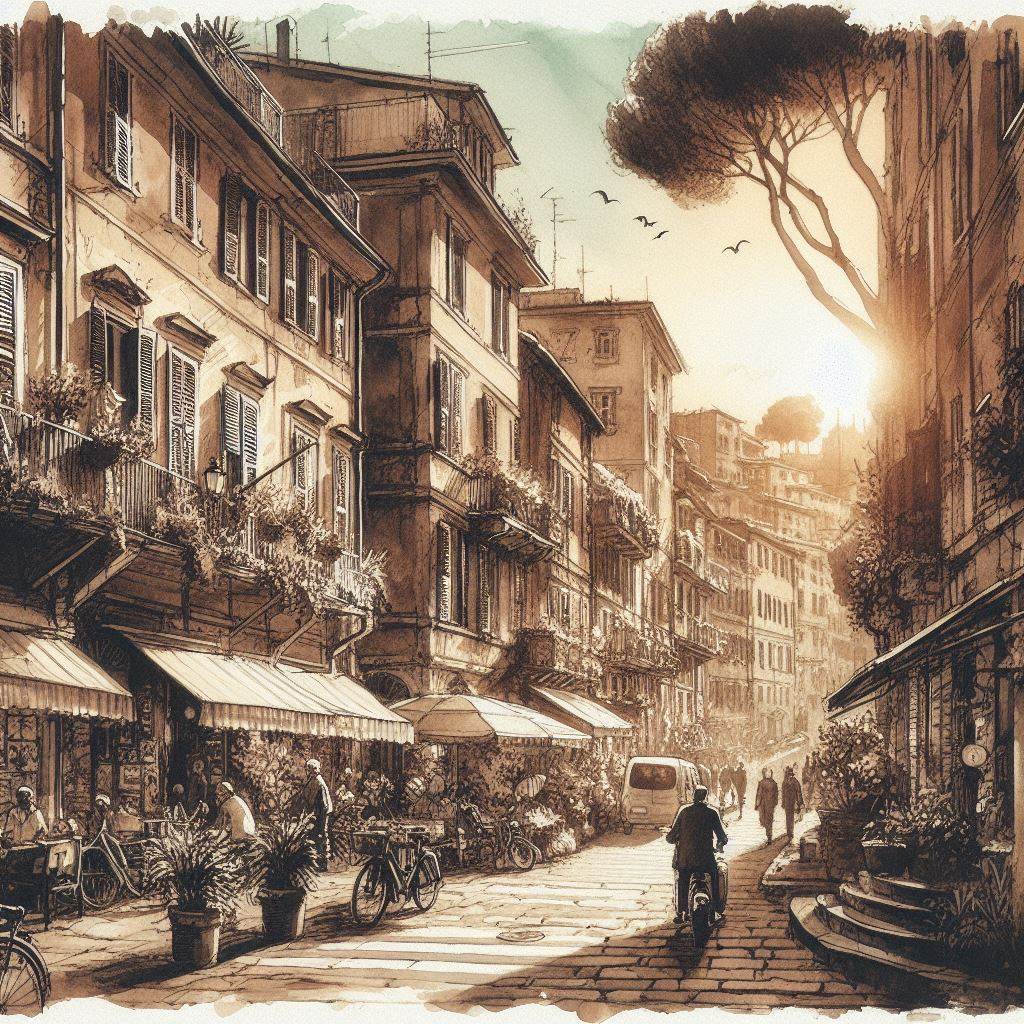
March
Thoughts – by E. Ashcroft
On Meaning and Context
The poem describes a walk through a specific street on an afternoon in March. The sun is low, the season is transitional, the mimosa is in bloom but unclaimed, and the speaker moves through the scene as a self-described “alien form”, observed by market workers, accompanied by wind, surrounded by the small commerce of fruit and brick and the chatter of lives not yet begun. It is a poem of observation rather than of argument, and its virtue, when it achieves it, is the precision of the looking rather than the profundity of the thought.
The narrative is slight by design. The speaker walks through Martyrs’ Way on a weekend eve, notes the sun, the mimosa, the drunkards on benches, the gleaming fruits, the wind in his hair, a tangerine hanging indifferent on its branch, and the chatter of passers-by. Nothing happens. The poem does not build toward a revelation or a crisis. It accumulates sensory impressions and then, in its final stanza, gestures toward a meaning that remains deliberately unresolved: “the sense these songs affix.” What sense? The poem does not say, and I suspect it does not know, and I am not certain that the not-knowing is, in this instance, a strength. But I shall return to this.
What does interest me is the speaker’s self-positioning. He is an “alien form” weaving through a scene of ordinary commerce. He is watched by those who “sweat and sway.” He chews “rhymes of scorn.” He is, in other words, the poet among the workers, the observer among the observed, and he is aware of his own incongruity, his own foreignness to the scene he inhabits. This is not an uncommon posture for a poet, but the poem handles it with a lightness that avoids the worst excesses of the type. The speaker does not condescend to the drunkards or the fruit-sellers. He notes them, places himself among them, and acknowledges that the wind, which is the scene’s most democratic element, “fears not the rhymes of scorn I chew.” The wind does not care about his poetry. The wind combs through hair without regard for the owner’s vocation. There is a humility in this that the poem does not advertise but that I note with approval.
On Style and Register
The register is mixed, and the mixing is, I think, the poem’s most interesting stylistic feature. The archaic appears sparingly: “doth weave”, “o’er”, “‘round.” The rest is contemporary or near-contemporary: “weekend’s eve”, “drunkards drowned”, “clinging to benches”, “pale and stale.” This is not the fully sustained archaism of the longer works but a lighter touch, a selective deployment that reserves the archaic for moments of formal elevation while permitting the descriptive passages to breathe in a more modern idiom. The effect is of a poet who is writing in his own century but who carries, as a residual habit, certain formal tics from a register he has inhabited more fully elsewhere.
“My alien form doth weave” is the poem’s most deliberately archaic line, and it earns its archaism through the strangeness of the image: the speaker’s body is alien to the scene, and the formal diction mirrors the alienation, setting the speaker apart linguistically as he is set apart physically. “Doth weave” is a better choice than “weaves” would have been, not because it is more beautiful but because it is more foreign, more conspicuously out of place, and the conspicuousness is the point.
The mimosa that “none will claim” is an image of quiet force. The mimosa blooms in March with an exuberance that is, in this context, slightly absurd: its yellow tufts are vivid and cheerful, and no one is paying them any attention. The unclaimed mimosa is a minor emblem of beauty that exists without an audience, which is, of course, a condition the poet recognises from his own experience, though the poem is tactful enough not to draw the comparison explicitly.
“A tangerine, pale and stale, / that hangs indifferent to the ground’s despair” is the poem’s best single image. The tangerine is not fresh. It is not ripe. It is past its moment, and it knows it, or rather it does not know it, which is worse, for its indifference is not a posture but a condition, the condition of a thing that has ceased to participate in the economy of ripeness and decay and now simply hangs, neither falling nor flourishing, occupying its branch with the passive stubbornness of something that has outlasted its relevance. The personification of the ground as despairing is the poem’s most extravagant gesture, and it works because the tangerine’s indifference requires an audience, and the ground, which would receive the tangerine if it fell, is the only audience available, and the tangerine declines to perform even the minimal act of falling. The ground waits. The tangerine refuses. The impasse is at once comic and melancholy, which is the poem’s tonal range at its most effective.
On Technique and Metre
The poem is written in iambic tetrameter, and it handles the form with a competence that is, in the main, reliable. “The March sun rests on tufts of brown” scans cleanly and establishes the rhythmic contract with an economy that the opening line of a poem should possess. The tetrameter suits the subject: it is a walking metre, a metre of steady pace and moderate speed, and the poem is a walk, and the walking should be felt in the line.
There are, however, moments where the metre is not so much varied as simply miscounted. “Where my alien form doth weave” is a line of four stresses that sits comfortably within the tetrameter. “Watched by those who sweat and sway” is likewise stable. But “As it combs through locks in fits and starts” introduces a rhythmic congestion that the tetrameter cannot entirely accommodate: “combs through locks” is three consecutive stresses, a spondaic cluster that stalls the line’s forward motion. The effect may be intentional, the combing through hair in fits and starts being itself an interrupted motion, and the metric interruption mirroring it. I am prepared to grant this reading, but I note that the line requires the reader’s active collaboration to scan, which is a cost the poem should be aware of incurring.
“Resettling strands that the gusts renew” is metrically clean and contains, in “resettling”, a word whose trochaic character creates a brief countercurrent against the iambic flow that is both pleasant and appropriate: the strands are being resettled, put back into order, and the metric settling of the line enacts the physical settling of the hair. This is good craft.
The final stanza presents the greatest metrical difficulty. “The chatter of lives yet to be sown” is pentameter rather than tetrameter, and the shift in line length is perceptible. “Upon a noble path of bricks” returns to tetrameter. “And scents of those whose dreams have grown” is tetrameter. “To grasp the sense these songs affix” is tetrameter. The first line of the stanza is therefore an anomaly, a pentameter in a tetrameter poem, and the anomaly draws attention to itself without justifying itself through any corresponding semantic expansion. The line would be stronger trimmed to fit its contract.
On Rhyme
The scheme is ABAB throughout, and the rhymes are, on the whole, functional, with several that merit individual comment.
“Brown” and “drowned” is an effective opening pairing: the tufts of brown, the dry and fading mimosa, are answered by the drunkards drowned, the human equivalent of the unclaimed bloom, equally past their moment and equally unregarded. The rhyme connects the vegetable and the human through their shared condition of decline, and the connection is made without commentary, which is the correct way to make it.
“Claim” and “shame” is clean and semantically productive: the mimosa that none will claim is answered by the drunkards lost in shame, and the rhyme binds the unclaimed to the ashamed, the unowned to the self-despising, in a single sonic gesture. This is a rhyme that works.
“Eve” and “weave” is full and well placed. “Way” and “sway” is functional. “Parts” and “starts” is clean. “Chew” and “renew” is an interesting pairing: the scornful rhymes that the speaker chews are answered by the gusts that renew the strands of hair, and the rhyme connects the destructive (chewing, which is a form of consumption and dissolution) with the restorative (renewal), suggesting that the wind undoes and remakes with equal indifference, which is, as I noted earlier, the poem’s most democratic observation.
“Frail” and “stale” is the poem’s most compressed pairing and its most resonant: the sun is frail, the tangerine is stale, and the rhyme binds the cosmic and the domestic, the astronomical and the botanical, in a single sound. Both are diminished. Both are past their moment. The rhyme does not explain the connection; it simply asserts it, and the assertion is convincing.
“Sown” and “grown” in the final stanza is adequate but unremarkable. “Bricks” and “affix” is the poem’s weakest rhyme: “affix” is a word that carries a mechanical, adhesive quality that sits uneasily in a stanza that is attempting to gesture toward the numinous. One affixes a stamp or a label. One does not typically affix a sense. The word has been chosen, I suspect, for its rhyme with “bricks” rather than for its intrinsic rightness, and the suspicion is damaging, for a reader who suspects the rhyme has dictated the word is a reader who has ceased to trust the poem, and a poem that has lost the reader’s trust in its final line has squandered the goodwill accumulated by the preceding nineteen.
On Impressions
This is a poem of modest ambition executed with, for the most part, considerable skill. It does not attempt the emotional depth of the longer works nor the philosophical density of the more introspective quatrains. It attempts, instead, something that is in its own way equally difficult: the rendering of a specific place at a specific time with sufficient precision that the reader feels the sun and smells the fruit and hears the chatter, without the rendering being merely descriptive, merely photographic, merely a catalogue of impressions without organising intelligence.
The poem largely succeeds in this. The opening three stanzas are well managed, the sun and the mimosa and the drunkards and the market and the wind combining into a scene that is vivid without being overloaded. The fourth stanza, with the tangerine, is the poem’s high point, an image of genuine originality and tonal sophistication. The third stanza, with the wind combing through locks, is the poem’s most relaxed passage, and the relaxation suits it: the poet allows himself a moment of physical pleasure, the wind in his hair, that counterbalances the alienation he has established.
The fifth and final stanza is the poem’s weakest. “The chatter of lives yet to be sown” is a promising image, the voices of the young or the not-yet-arrived figured as seeds, but the stanza does not develop it with sufficient specificity. “Upon a noble path of bricks” is a detail that grounds the stanza in the physical, but “noble” is an adjective that asks the reader to take the street’s distinction on faith without providing evidence for it. “And scents of those whose dreams have grown” introduces a new sensory element, smell, that arrives too late in the poem to be fully integrated. And “to grasp the sense these songs affix” is a line that reaches for a closing statement and does not quite grasp it, the verb “affix” being, as I have noted, mechanically inappropriate and the “sense” being too vaguely specified to function as a destination.
The poem needed, in its final stanza, either a return to the concrete, a specific image as strong as the tangerine, or a closing gesture as restrained as the wind in the third stanza. What it provides instead is an abstraction, “the sense these songs affix”, that the preceding stanzas have not prepared the reader to receive, and the result is a poem that walks steadily and observantly for four stanzas and then, in the fifth, attempts to fly, and the wings are not yet strong enough.
I commend the first four stanzas without reservation. The fifth I commend with the suggestion that the author return to it with the pruning shears he has demonstrated, in other poems, that he knows how to wield.

 mvrcodelrio.com
Lascia un commento