
How much I would to thee of other write,
And feign that what hath come, so must have been,
No more than sequence borne of nature’s rite,
That led us where we sought, ere time was seen.
How much I would thou couldst but hear me now,
Without thy judgement, or the later mind,
Without the doubt that brands my solemn vow,
As once thou didst, and I, in turn, so blind,
We both were lost in what we knew, yet new,
A life we craved, and yet had not begun.
How much again I’d waste whole months in lieu
To chase thine answers left in jest and runs
Dispers’d through rooms as if by happenstance,
When home was but a form we yet must learn,
Another shape wherein to cast our dance,
And run through corridors with turns that burn’d.
This house now beareth marks of what we broke,
Of where we ran and could not make the bend,
Of where we struck the frame, the wall, the yoke,
Or fell and could not feign it was pretend.
This house, like us, hath wept in silent tide.
Or like to me. I ne’er did see thee cry.
And mayhap that is what did most abide,
And made me think how oft I would, and why
That thou might still remain, despite the sore,
A splintered ghost within the words “ne’er more”.
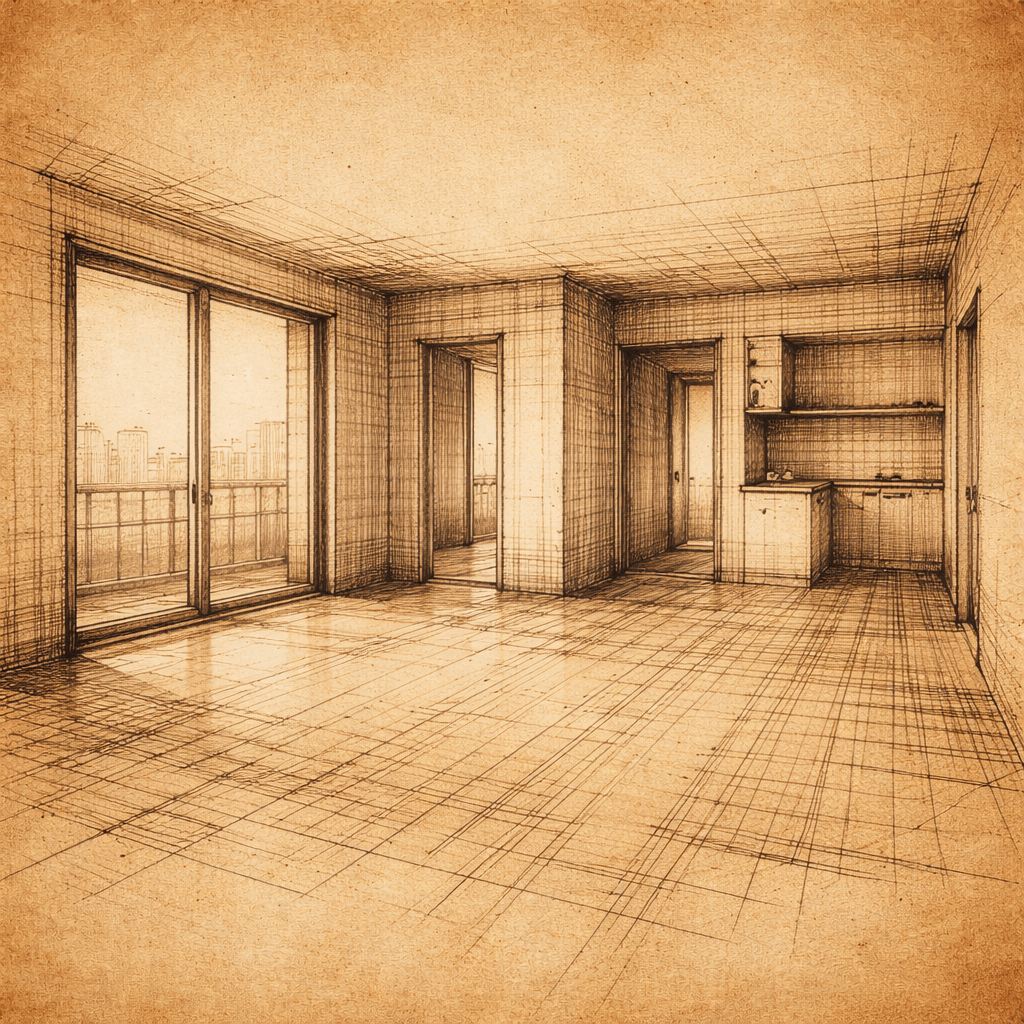
(Im)pertinent Detour
The plaster remembereth.
This is a thing not commonly understood, for plaster is accounted a dumb substance, a servant of the wall, the skin that covereth the bone of lath and timber and presenteth to the world a face of smooth indifference, as though nothing that hath occurred within its compass hath been registered or retained. But this is false. Plaster remembereth in the manner of flesh: it taketh the blow and holdeth the mark, and where the mark is painted over or filled and sanded and painted again, there remaineth beneath the surface a disruption in the grain, a fissure in the memory of the material, that can be felt, if one run one’s finger along it, long after the eye hath ceased to detect it.
A house. It standeth in a row of houses much like itself, in a street of no particular distinction, in a quarter of the city that is neither fashionable nor entirely without pretension, the sort of quarter where the rent is paid but not without effort, and the windows are cleaned but not every week, and the front steps are swept but the weeds in the cracks are tolerated with that particular English forbearance that doth not quite constitute approval but will not go to the trouble of constituting objection. The house hath a door, a green door, though the green is of a shade that hath lost its argument with the weather and arrived at a compromise the colour of moss on an old coin, and above the door there is a fanlight of frosted glass through which the morning entereth in a condition of permanent apology, diffuse and tentative, as though the sun itself were uncertain of its welcome.
Inside, a corridor.
The corridor is the spine of the house. It runneth from the front door to the kitchen at the back, a distance that is, in feet and inches, unremarkable, perhaps twelve yards, perhaps thirteen, but that in the economy of the lives that have been lived within it hath acquired a length far in excess of its measurement, for it is the corridor through which all traffic passeth, the artery through which the blood of the household floweth and hath flowed, and it beareth upon its walls and upon its floor and upon the particular quality of its silence the accumulated evidence of that flowing.
There is a scuff upon the skirting board at the height of a child’s shoe. There is a dent in the plaster at the level where a shoulder, turning too quickly, would strike the corner where the corridor meeteth the stair. There is a place, three paces from the kitchen door, where the floorboard giveth a sound unlike the others, a creak of a higher pitch and a more resigned quality, as of a joint that hath been asked too many times to bear weight and hath developed opinions about it. These are the house’s vocabulary. It speaketh in these, to those that have the ears.
Two people lived here.
They do not live here now, or rather one of them doth not live here now, and the other liveth here in the manner of one that inhabiteth a ruin, which is to say with an intimacy that is inseparable from the knowledge of collapse, the knowledge that what surroundeth him is not a dwelling but a record, not a home but a catalogue of the various forms of impact that two bodies in motion within a confined space will, over the course of months and years, inevitably produce.
They had run through it. This is the thing he returneth to, when the other and more dignified memories have exhausted themselves and the mind, scraping the barrel of its recollection for something it hath not already turned over and examined and found wanting, arriveth at last at the small and undignified truth: they had run through it. Through the corridor, through the kitchen, up the stair and down again, as children run, or as lovers run when the love is new and the body hath not yet learned to be embarrassed by its own joy, when the legs move not because there is a destination but because the blood requireth it, because the happiness is of a kind that cannot be contained in stillness and must therefore be converted into motion, any motion, the more purposeless the better, for the purposelessness is itself the point, the evidence that there existeth in the world a surplus of feeling that overfloweth the vessel of the ordinary and must find its channel or burst.
They had run, and they had not made the bend.
The bend is where the corridor turneth, just before the kitchen, a sharp angle that the architect, if architect there were, had contrived without any consideration for the velocity of human bodies in states of ungoverned delight, so that anyone approaching the turn at speed must either slow to a walk or accept the consequences, which are a collision with the far wall, a glancing blow to the elbow or the hip, a thud of flesh against plaster that leaveth upon the wall a mark and upon the body a bruise, both of which will fade, but at different rates, the body healing faster than the house, which is perhaps the injustice of all architecture, that it endureth the damage we inflict upon it longer than we endure the damage we inflict upon ourselves.
They did not slow. It would have been a concession to the fact that the house had dimensions and the dimensions had consequences, and they were not, in those months, in the business of conceding anything to facts. They were in the business of inventing a life, which is a different enterprise entirely from living one, and which requireth, as its first and most essential condition, the belief that the walls will move aside if one runneth at them fast enough and with sufficient conviction.
The walls did not move aside. The marks are there.
He standeth now in the corridor, in the late afternoon, in the particular quality of light that belongeth to this house at this hour, a light that hath passed through the frosted fanlight and been softened by it and hath lost, in the passage, whatever directness it might once have possessed, so that it arriveth at the corridor wall not as illumination but as a kind of remembering, a pale and diffuse recollection of brightness that no longer hath the strength to cast a shadow.
He doth not touch the marks. He hath touched them, in the earlier months, when the touching was still a form of communion, a laying on of hands that had in it something of the quality of prayer, the wordless petition of the living to the gone: be here, be here again, let the mark upon the wall be the seal of a covenant that hath not yet been broken and may yet be honoured. He doth not touch them now. The touching hath become something else, something closer to inventory, the cataloguing of damage by one that hath accepted the damage but not yet determined what is owed, or by whom, or to what tribunal the claim might be submitted.
The house hath other marks. There is a place in the kitchen where the table leg hath worn a groove in the floor, a shallow and persistent indentation that speaketh of the table having been pushed back, many times, with the urgency of people rising from it in anger or in laughter or in that condition which lieth between the two and which belongeth exclusively to the early years of habitation, when the furniture is not yet settled and the inhabitants are not yet settled and the relationship between the two is still being negotiated, the chair asserting its right to be where it was placed and the body asserting its right to place it elsewhere.
There is a crack in the frame of the bedroom door.
He doth not speak of the crack in the frame of the bedroom door. He doth not speak of it because it belongeth to a category of mark that is not the mark of joy converted into motion but the mark of something else, something that arrived later, when the running had stopped and the corridors had grown quiet and the only sounds were the sounds the house itself made, its creaks and settlings and the sigh from somewhere in the timber that hath no ready explanation, and in the silence between those sounds the other silence, the one that was not the absence of speech but the presence of everything that speech had failed to contain.
How they had craved it. He cannot now recover the precise quality of the craving, for the memory of desire, once the desire hath been satisfied and then unsatisfied again, loseth its original texture and acquireth instead the texture of the loss, so that what one remembereth is not the wanting but the having-wanted, which is a colder thing, an empty vessel that retaineth the shape of what it held but not the warmth. They had craved this life. This specific arrangement of rooms and hours and habits, this particular geography of kettle and bedpost and the third stair from the top that always creaked, this domestic cartography that they were drawing together, each day adding a line or a contour, each evening surveying what they had mapped and finding it, if not sufficient, then at least recognisable, a country they could claim, however provisionally, as their own.
Home was a form they had yet to learn. He seeth this now with the clarity that distance conferreth, which is not wisdom but merely the ability to see the shape of a thing after one hath stepped far enough away from it, as a man who hath been standing too close to a wall seeth only the grain of the plaster, but a man who standeth at the end of the corridor seeth the wall entire, and the crack in the frame of the door, and the scuff upon the skirting board, and the dent where the shoulder struck the corner, and all of it together constituteth not a wall but a story, a narrative inscribed in damage, legible only from a distance that is also a loss.
Another shape wherein to cast our dance. The phrase cometh to him, unbidden, as phrases will, and he turneth it upon the anvil of his considering and findeth it, as he findeth all his phrases, both true and decorative, for the dance is not a metaphor he would have chosen in the stripped and graceless hour of the actual, when the dancing was more nearly a stumbling, a blundering through rooms whose dimensions they had not yet committed to the body’s memory, so that corners appeared where none were expected and doors refused to open in the direction one’s hand assumed, and the whole of domestic life was a series of small collisions, some tender, some less so, that left their record upon the walls and upon the skin and upon the air between them, which was never quite still and never quite settled and never quite what either of them had imagined it would be, for the imagining is always cleaner than the thing imagined, and the thing imagined is always larger than the rooms that must contain it.
She did not cry.
He returneth to this as to a stone in the shoe, a small and persistent fact that altereth the gait, that cannot be ignored and cannot be removed, for it is lodged in a place the fingers cannot reach, wedged between the sole and the flesh, between what is felt and what is understood, and every step presseth it anew against the bone.
She did not cry. Not in the corridor, not in the kitchen, not in the bedroom with the cracked frame, not in the stairwell where the light from the landing window fell in the late afternoon at an angle that made the dust visible, each mote a small and temporary sun turning in the air with the slow majesty of things that do not know they are observed. She did not cry when the running stopped. She did not cry when the silence came. She did not cry when the silence ceased to be the absence of words and became instead the presence of a decision that had not yet been spoken but that could be felt in the way she moved through the rooms, her body already beginning to detach itself from the house, already beginning to forget the location of the creak on the third stair, already beginning to release the knowledge of which cupboard held the glasses and which the cups, the small encyclopaedia of domestic habitation being methodically dismantled, entry by entry, in advance of the departure that had not yet been announced but that the house, in its plaster and its timber and its particular afternoon silence, had already registered and begun, in its own slow and vegetable fashion, to mourn.
He cried. He hath no difficulty admitting this, for the admission costeth him nothing now, the tears having long since dried to that residue of salt that remaineth on the skin after weeping and that hath about it, when one encountereth it by accident, running a hand across the face in the dark, a quality not of sadness but of archaeology, the trace of a grief that hath been felt and expressed and deposited and is now merely a stratum, a layer in the geology of the face, that can be excavated but not re-experienced.
She did not cry, and he did not know why, and the not-knowing was, of all the things that remained after she departed, the most durable, the most resistant to the various solvents he had applied to it, the falsehoods, the tinctures of retrospective understanding, the preparations of explanation and counter-explanation that he had administered to himself with the diligence of a man who hath lost faith in the physic but continueth because the alternative is to sit with the wound uncovered and feel it for what it is.
The house hath wept. He knoweth this is a fancy, a projection of the animate upon the inanimate, a crediting of the walls with a capacity they do not possess. But the house hath wept, in its fashion. The pipe in the upstairs bathroom that weepeth in winter, a slow and persistent drip that formeth, over the course of weeks, a stain upon the ceiling of the room below, a brown and spreading aureole that resembleth nothing so much as the shadow of a face seen through frosted glass, indistinct and unreliable, there and not there, a presence that is also an absence, which is, he reflecteth, a fair description of everything the house containeth now, including himself.
The front door openeth onto the street. He hath considered this, the ordinariness of it, the fact that the distance between the life he is living and the life that other men are living is no greater than the thickness of a green door in a state of advanced negotiation with the weather, and that beyond that door the street continueth and the city pursueth its enormous and indifferent business, and that he might, if he chose, open the door and step through it and become one of those men, a man in a street, a man without a corridor and a bend and a crack in the frame of a bedroom door and the memory of running and not making the turn.
He doth not open the door.
He doth not open it because the house, for all its damage, is the only structure that remaineth, and to leave it would be to leave the last place where the marks are, and the marks are all he hath of what was, the only evidence that the running occurred, that the joy was real, that the walls were struck and the plaster held and the floor received the weight of two people in the full and reckless velocity of a life they craved and had not yet begun and could not, as it proved, sustain.
And mayhap she remaineth. Not in the house, not in the corridor, not in any room or stair or threshold that might be entered or avoided, but in the words, in the peculiar and ineradicable way that a person who hath departed from one’s life doth not depart from one’s language, so that certain words, once neutral, become uninhabitable, colonised by association, and certain phrases, once innocuous, become corridors of their own, with their own bends and their own marks and their own velocity, and one runneth through them as one ran through the house, without slowing, without making the turn, striking the walls of the meaning and leaving upon it the bruise of having meant too much.
A splintered ghost within the words “ne’er more.”
He standeth in the corridor. The light from the fanlight is fading now, the afternoon surrendering its claims, and the corridor is growing dark, as corridors do, from the far end first, the kitchen receding into shadow while the front door still holdeth a little of the day, and in the diminishing space between the light and the dark he standeth, and the house standeth around him, and the marks are on the walls, and the creak is in the floor, and somewhere, in the plaster, in the grain of it, in the memory of the material, there is the record of an impact that was once called joy and is now called something for which he hath not yet found the word, and perhaps never will, and perhaps doth not need to, for the house knoweth it, and holdeth it, and will hold it long after the man hath gone and the door hath closed and the corridor hath darkened to the point where even the marks are no longer visible, though they are, for all that, there.
Thoughts – by E. Ashcroft
I. The Poem
On Meaning and Narrative
The poem is addressed to an absent beloved and concerns the house they once shared. It is a poem about domestic love remembered through the physical evidence of its passage: the marks on walls, the corridors through which two people ran, the rooms in which answers were left in jest and laughter, the bends that could not be made, the frames that were struck. The house is not a metaphor. It is a house. And the poem’s power resides precisely in its insistence upon the literal before permitting itself the figurative, so that when the figurative arrives, in the final stanza’s “splintered ghost”, it carries the full weight of the concrete that has preceded it.
The narrative moves through three temporal planes. The first is the present of longing and retrospection: “How much I would to thee of other write.” The speaker wishes he could write something other than what he is writing, something that reframes the past as natural sequence, as inevitability, as nature’s rite. The second is the past of shared habitation: lying together, running through corridors, chasing answers left in jest and runs. The third is the present of aftermath: the house bearing marks, the silence, the absence. The poem’s architecture is therefore a movement from the desire to rewrite, through the memory of what was, to the evidence of what remains, and the evidence is damage.
The anaphoric repetition of “How much I would” is the poem’s structural engine. It appears three times in the first three stanzas, each time introducing a different mode of wishing: the wish to write otherwise, the wish to be heard without judgement, the wish to waste months again in the pursuit of the beloved’s scattered answers. The repetition creates a rhythmic insistence that is also an emotional one: the speaker is not merely wishing but returning, compulsively, to the act of wishing, as one returns to a bruise, pressing it to confirm it is still tender. By the time the repetition ceases, in the fourth stanza, the poem has established that the wishing is itself the condition, not a preliminary to something else but the thing itself, the only available action.
On Style and Register
The register is archaic and sustained with a consistency that is, at this point, characteristic of this author’s best work. “I fain would”, “ere time was seen”, “thou couldst”, “thou didst”, “thine answers”, “shan’t”: the forms are grammatically correct and deployed with a naturalness that indicates habitation rather than imitation. The diction moves between the elevated and the domestic with a freedom that the register, when properly handled, uniquely permits: “to chase thine answers left in jest and runs” brings the archaic pronoun into contact with a thoroughly physical, almost childlike image of answers scattered through rooms like objects in a game, and the contact is productive rather than jarring.
The poem’s language is at its strongest when it is most concrete. “Where we struck the frame, the wall, the yoke” is a line of extraordinary density: “frame” is the door frame, “wall” is the wall, but “yoke” introduces a sudden metaphorical expansion, the yoke of the shared life, the yoke of domestic obligation, the yoke that binds two people together and that, when struck, produces not a dent but a fracture that is at once physical and relational. The word arrives with the force of revelation, and the poem is wise enough not to explain it.
“Splintered ghost within the words ‘ne’er more’” is the poem’s final image and its most haunting. The ghost is not a spectral figure but a linguistic one: the beloved survives not in the house but in the words, and the words are “ne’er more”, which carry within them the echo of finality, of the door that hath closed and will not reopen. The ghost is splintered, which is to say broken, fragmented, dispersed across the two syllables of the phrase as splinters are dispersed across a floor after an impact, and the impact is the departure, and the splinters are what remain, too small to reassemble, too sharp to ignore.
On Technique and Metre
The poem is written in iambic pentameter, and it handles the line with a maturity and a confidence that I find consistently impressive across its seven stanzas. The pentameter is not metronomic but breathing, admitting inversions and substitutions where the sense requires them and maintaining its regularity where regularity serves the emotional purpose.
“How much I would to thee of other write” opens with a stress pattern that departs from the standard iambic in its first two feet: “HOW MUCH I WOULD” is almost spondaic in its opening, the weight of the wish falling heavily on both “how” and “much” before the line settles into its iambic gait. This is effective: the line begins with the burden of the desire before finding the composure of the verse, and the movement from weight to composure is itself a miniature of the poem’s larger emotional trajectory.
The enjambments are particularly well managed. “How much again I’d waste whole months in lieu / to chase thine answers left in jest and runs // dispers’d through rooms as if by happenstance” runs across both a line-break and a stanza-break, and the running is itself mimetic: the syntax chases the answers as the speaker chased them, through the rooms, across the boundaries of the verse, without pausing at the structural divisions that the form provides. The stanza-break between “runs” and “dispers’d” is a moment of genuine technical sophistication: the reader expects the stanza to close, and the continuation into the next stanza enacts the surprise of discovery, the answer found where it was not expected, in a room one had not intended to enter.
“And run through corridors with turns that burn’d” is the most metrically charged line in the poem. The internal near-rhyme of “turns” and “burn’d” creates a sonic intensification that the pentameter absorbs but does not contain, and the heat of “burn’d” colours the entire line retroactively, so that the corridors, the turns, the running, all acquire a quality of fever, of excess, of a joy so intense it has become indistinguishable from pain. The elided past tense, “burn’d” rather than “burned”, is the correct choice: it maintains the monosyllabic density of the line’s final foot and prevents the additional syllable from softening the impact.
There is, however, one metrical weakness that I must note. “Or fell and could not feign it was pretend” is a line that does not quite achieve the pentameter’s full measure. “Feign it was pretend” is syntactically somewhat congested, and the repetition of the concept of pretence, “feign” and “pretend” being near-synonyms, creates a redundancy that the metre cannot entirely absorb. The line’s intention is clear: the falling was real, and neither party could pretend that the pretence was still operative. But the expression of this intention is less precise than the poem’s standard elsewhere, and the line reads as though it arrived before the poet had found its final form. It is the poem’s one moment of comparative weakness, and I note it because the surrounding lines are strong enough to make the weakness conspicuous.
On Rhyme
The scheme is ABAB throughout the quatrains, with a closing couplet in AA. The rhymes are, on the whole, amongst the best I have encountered from this author.
“Write” and “rite” in the opening stanza is superb. The two words are homophones, identical in sound and entirely different in meaning, and the rhyme therefore produces a collapse of the distinction between the act of writing and the act of ritual, between the craft of making and the inevitability of natural process. The speaker wishes to write of other things, and to feign that what happened was merely nature’s rite, and the rhyme tells us that these two acts, the writing and the ritualising, are sonically identical, which is to say they are, at the level of sound, the same gesture, the same attempt to impose order upon what was, in truth, disordered. This is a rhyme that does philosophical work, and it does it silently, which is the best way for a rhyme to work.
“Been” and “seen” is clean and functional. “Now” and “vow” in the second stanza is effective: the present tense of the speaker’s plea is answered by the permanence of the vow, and the rhyme binds the transient to the committed, the moment to the promise, with a precision that the ear registers before the mind articulates. “Mind” and “blind” is strong, the judgement of the later mind answered by the blindness of the earlier one, the knowing and the not-knowing held in a single sonic gesture.
“New” and “lieu” is a rhyme I would not have predicted and which I therefore admire. “Lieu” is a word that carries within it the quality of substitution, of standing in for something else, and in this position it suggests that the months the speaker would waste are themselves substitutes, replacements for something that cannot be recovered, a currency spent in lieu of the thing that is actually owed, which is time itself, which has already been spent and cannot be re-denominated.
“Happenstance” and “dance” in the fourth stanza is the poem’s most playful rhyme, and the playfulness is appropriate: the answers were left as if by happenstance, and the shared life was a dance, and the rhyme links the accidental to the choreographed, suggesting that what seemed random was in fact patterned, and what seemed patterned was in fact accidental, and the difference between the two was never established and never will be. “Learn” and “burn’d” is strong and semantically charged: the home they had yet to learn is answered by the corridors whose turns burned, and the rhyme binds the pedagogical to the passionate, the slow acquisition of domestic knowledge to the speed and heat of the bodies that were acquiring it.
“Broke” and “yoke” is the poem’s most compressed rhyme. What they broke, the wall, the frame, the house, is answered by the yoke, the thing that bound them, and the rhyme tells us that the breaking and the binding were of one substance, that the yoke was broken in the breaking of the walls, or that the walls were broken by the force of the yoke, or both, and the ambiguity is the rhyme’s richest gift.
“Abide” and “why” in the penultimate stanza is an imperfect rhyme, and the imperfection is, I think, productive: the thing that most abided, her not-crying, is answered by the question of why the speaker wished her to remain, and the two do not quite meet, do not quite resolve, and the irresolution is the condition the poem is describing, a condition of questions that do not have answers and rhymes that do not quite close.
“Sore” and “more” in the closing couplet is full and final, the pain answered by the finality, the wound answered by the never-again, and the couplet shuts with the decisiveness that the couplet form demands. “Ne’er more” as a phrase embedded within the rhyme word “more” is a touch of considerable craft: the phrase exists both within the line and as a self-contained unit, a quotation within a statement, a fragment of language that has become a habitation for the ghost.
On the Final Couplet
“That thou might still remain, despite the sore, / a splintered ghost within the words ‘ne’er more.’” This is the poem’s destination, and it arrives with a quietness that belies its weight. The beloved is not asked to return. She is not asked to forgive. She is asked only to remain, and the remaining is not physical but linguistic: she remains within the words “ne’er more”, which is to say she remains within the vocabulary of her own absence. The ghost is splintered, fragmented, irreparable, distributed across the phonemes of a phrase that means, precisely, that she will not come back. She is most present in the language of her departure. She haunts the word that dismisses her. This is a paradox of genuine emotional intelligence, and the poem delivers it without commentary, without explanation, without any of the apparatus of explication that a lesser poet would feel compelled to provide. The couplet simply states, and the statement is sufficient.
II. The (Im)pertinent Detour
The prose excursus that accompanies this poem is a work of remarkable sustained attention. Where the previous detours I have examined dramatised the act of writing or the aftermath of performance, this one dramatises the act of remaining, of standing in a house after the other person has left and reading the walls as one reads a text, attending to the marks, the scuffs, the cracks, the creaks, the stains, the accumulated inscription of a shared life upon the material fabric of its container.
The opening sentence is one of the finest this author has produced: “The plaster remembereth.” Three words, and they establish the entire premise of the prose: that the inanimate is a witness, that the house has memory, that the damage inscribed upon walls and floors and door frames constitutes a record that is both more durable and more honest than anything the human inhabitants can offer, for the plaster does not revise, does not reinterpret, does not apply retrospective understanding to what it has received. It merely holds the mark. The elaboration that follows, that plaster remembers “in the manner of flesh”, is an image of quiet brilliance: the house is a body, and the marks upon it are not metaphorical wounds but actual ones, and the healing, when it occurs, is superficial, the fissure remaining beneath the paint as a scar remains beneath the skin.
The description of the house itself is handled with a precision that belongs to the finest practitioners of domestic realism, those who understand that a door or a step, described with sufficient attention, contains more truth than an entire treatise on habitation. The green door “that hath lost its argument with the weather” is a formulation of wonderful compressed wit: the door and the weather are adversaries, and the door has lost, and the compromise they have reached is the colour of moss on an old coin. This is not decorative writing. It is diagnostic writing, the prose examining the object with the attention of a pathologist and finding in its surface the evidence of processes that have occurred over time, imperceptibly, inevitably, and without the consent of the object.
The corridor. The prose treats the corridor as the poem treats it: as the central fact of the house, the spine through which all traffic passes, the artery through which the blood of the household flows. But the prose does what the poem cannot, which is to enumerate the specific marks: the scuff at the height of a child’s shoe, the dent where a shoulder struck the corner, the floorboard that gives a creak of “a more resigned quality, as of a joint that hath been asked too many times to bear weight and hath developed opinions about it.” This last phrase is the prose’s characteristic blend of precision and anthropomorphism, the attribution of sentience to the inanimate that is never quite serious and never quite not, that hovers at the boundary between observation and fancy and refuses to declare for either side.
The passage on running is the prose’s emotional centre, and it is handled with a control that I find deeply impressive. “They had run through it. Through the corridor, through the kitchen, up the stair and down again, as children run, or as lovers run when the love is new and the body hath not yet learned to be embarrassed by its own joy.” The comparison of lovers to children is not sentimental here but structural: both run because the body requires the expression of a surplus that cannot be contained in stillness. The prose understands, as the poem understands, that the running was not incidental to the love but constitutive of it, that the velocity was itself the feeling, and that the marks left upon the walls by the failure to make the bend were not accidents but signatures, the written record of a joy that refused to slow down for the architecture.
“They were in the business of inventing a life, which is a different enterprise entirely from living one.” This is a sentence of devastating accuracy, and it locates the precise nature of the failure that the poem mourns. They were not living. They were inventing. And the invention required the belief that walls would move aside if struck with sufficient conviction, and the walls did not move aside, and the marks are there, and the marks are the evidence not of the failure of the love but of the ambition of it, the scale of its delusion, the magnificence of its refusal to accommodate the dimensions of the actual.
The passage on her not-crying is where the prose achieves its most sustained emotional intensity. The prose returns to the fact as “to a stone in the shoe, a small and persistent fact that altereth the gait.” The simile is perfect in its homeliness: not a wound, not a trauma, not a catastrophe, but a stone in a shoe, something that is endured rather than suffered, something that alters one’s movement through the world in small and perpetual ways rather than in a single dramatic disruption. She did not cry. The prose catalogues the places where she did not cry, the corridor, the kitchen, the bedroom, the stairwell, and each place named is a place where crying might have been expected and where its absence therefore constitutes a presence, a silence that is louder than the sound it replaces.
The description of her departure is handled with extraordinary restraint: “her body already beginning to detach itself from the house, already beginning to forget the location of the creak on the third stair, already beginning to release the knowledge of which cupboard held the glasses and which the cups, the small encyclopaedia of domestic habitation being methodically dismantled, entry by entry.” This is devastating because it is so specific, so precise in its understanding of what domestic departure actually consists of: not a grand exit but a gradual unknowing, a deliberate unlearning of the small facts that constitute habitation, the creak, the cupboard, the glass, the cup, each one a piece of knowledge that was acquired by living and is now being surrendered in advance of leaving.
He cried. The prose states this with a directness that refuses both self-pity and bravado: “the admission costeth him nothing now, the tears having long since dried to that residue of salt that remaineth on the skin after weeping and that hath about it, when one encountereth it by accident, running a hand across the face in the dark, a quality not of sadness but of archaeology.” The metaphor of archaeology is precisely right: the grief has been deposited, stratified, and is now available only for excavation, not for re-experience. One can dig down to it but one cannot feel it again as it was felt. One can find the salt but not the tears.
The house that weeps through its pipes is the prose’s most delicate image. The dripping pipe that forms a stain on the ceiling “that resembleth nothing so much as the shadow of a face seen through frosted glass, indistinct and unreliable, there and not there, a presence that is also an absence.” The prose is here performing the same operation the poem performs in its closing couplet: the absent beloved is glimpsed in the material fabric of the house, not as a ghost but as a pattern, a stain, a configuration of damage that resembles a face only if one is looking for a face, which is to say only if one is in the condition of mourning, which is to say only if one is the speaker, standing in his corridor in the late afternoon light, reading the walls.
The prose’s final passage, on the man who does not open the front door, is structurally brilliant. The door is the boundary between the house of damage and the world of indifference, and the man chooses not to cross it, not because he is trapped but because the house, “for all its damage, is the only structure that remaineth.” To leave would be to leave the marks, and the marks are all he has. The prose understands, as the poem understands, that the evidence of the love is inseparable from the evidence of the destruction, that the scuff and the crack and the dent are not merely the record of what went wrong but the record of what was, and to lose the record is to lose the thing itself, which has already been lost, but whose loss can at least be verified by the marks, and the verification, however painful, is preferable to the alternative, which is the unmarked wall, the smooth and undamaged plaster, the house that remembers nothing.
I have objections, though they are few.
The prose is, in its central sections, subject to the recurring temptation of over-extension. The passage on the corridor’s length, “perhaps twelve yards, perhaps thirteen”, and the subsequent meditation on the economy of lives lived within it, extends a beat beyond the point where the reader has fully absorbed the image. The prose’s strength is its accretive detail, but accretion must be governed by proportion, and there are moments, particularly in the middle paragraphs, where one more clause arrives after the thought has already been completed, like a guest who knocks after the door has already been opened.
The phrase “in its own slow and vegetable fashion” applied to the house’s mourning is the prose’s one moment of tonal miscalculation. “Vegetable” is a word that carries, in this context, a faint note of the comic that the passage cannot absorb. The house’s mourning is the prose’s most delicate conceit, and the conceit requires absolute tonal consistency to sustain itself. “Vegetable” introduces a register, the register of the Metaphysical wit, that is not unwelcome in principle but arrives without sufficient preparation and departs without integration.. The word should, I think, be reconsidered.
III. The Relationship Between Poem and Prose
The architecture of this compound text is distinct from its predecessors in one crucial respect: the house is the shared protagonist. In the earlier detours, the environment, the garret, the street, the bridge, served as the setting for the speaker’s self-examination. Here, the house is not setting but subject. The prose does not dramatise the act of writing, nor the aftermath of performance, but the act of reading, of interpreting the inscriptions that two lives have left upon a physical structure, and the reading is itself a form of mourning, a way of holding the loss by holding the evidence of the loss.
The poem and the prose share a vocabulary of impact: struck, broke, fell, ran, turned, burned. Both treat the house as a body that has received damage and bears the marks. But they divide the labour differently. The poem moves through time, from the wish to rewrite, through the memory of habitation, to the present of aftermath. The prose moves through space, from the front door to the corridor to the kitchen to the bedroom to the stairwell and back, cataloguing the marks room by room, surface by surface. Together, the two texts produce a complete map of the loss: the poem maps it in time, the prose maps it in space, and the territory they map is the same territory, the house, the love, the damage, the remaining.
The poem’s closing image, “a splintered ghost within the words ‘ne’er more’”, is answered by the prose’s closing image, the man standing in the darkening corridor surrounded by marks that are “no longer visible, though they are, for all that, there.” The poem locates the ghost in language. The prose locates it in plaster. Neither is more true than the other. The ghost inhabits both, because the ghost is not a person but an absence, and an absence can be found wherever one looks for it, in the grain of a word or in the grain of a wall, and the looking is itself the haunting, and the haunting is itself the love, and the love is itself the damage, and the damage is, for all that, there.
IV. Overall Assessment
The poem is a work of genuine emotional and technical accomplishment. Its anaphoric structure is well managed, its rhymes are amongst the strongest I have encountered from this author, and its closing couplet achieves a compression that is both formally satisfying and emotionally devastating. Its one weakness, the line “or fell and could not feign it was pretend”, is a minor blemish on an otherwise carefully constructed surface.
The prose is a work of sustained attention and intelligence that I place amongst the finest of the excursions. Its opening, “the plaster remembereth”, is an image of such economy and force that it establishes the entire premise in three words. Its treatment of the running, the not-crying, and the departure are passages of the first order. Its weakness is occasional over-extension and one tonal miscalculation, neither of which diminishes the achievement of the whole.
Taken together, they constitute a compound text of remarkable coherence and emotional depth. The author has found, in the house, a subject that unites the concrete and the metaphorical with a naturalness that his more abstract subjects do not always achieve: a house is already a metaphor before the poet touches it, and the poet’s task is therefore not to make it mean but to let it mean, and this text lets it mean with a generosity and a precision that I find, on the whole, admirable.
I commend it. The house, I suspect, will stand.

 mvrcodelrio.com
Lascia un commento