
‘Tis the world’s lament that rises high,
From fragile blooms to crickets’ cry.
We lie for hours on dewy grass,
Making love in castles that shan’t last.
You speak of Kant, of Freud, of Hegel,
I speak of punk with formal angle.
You draw me close to the ocean’s edge,
And we laugh as sounds fill the wedge.
‘Tis the world’s great sorrow you feel so deep,
When in silence you grasp me and seek,
To understand which god could allow such pain,
But, dear, there’s naught to explain.
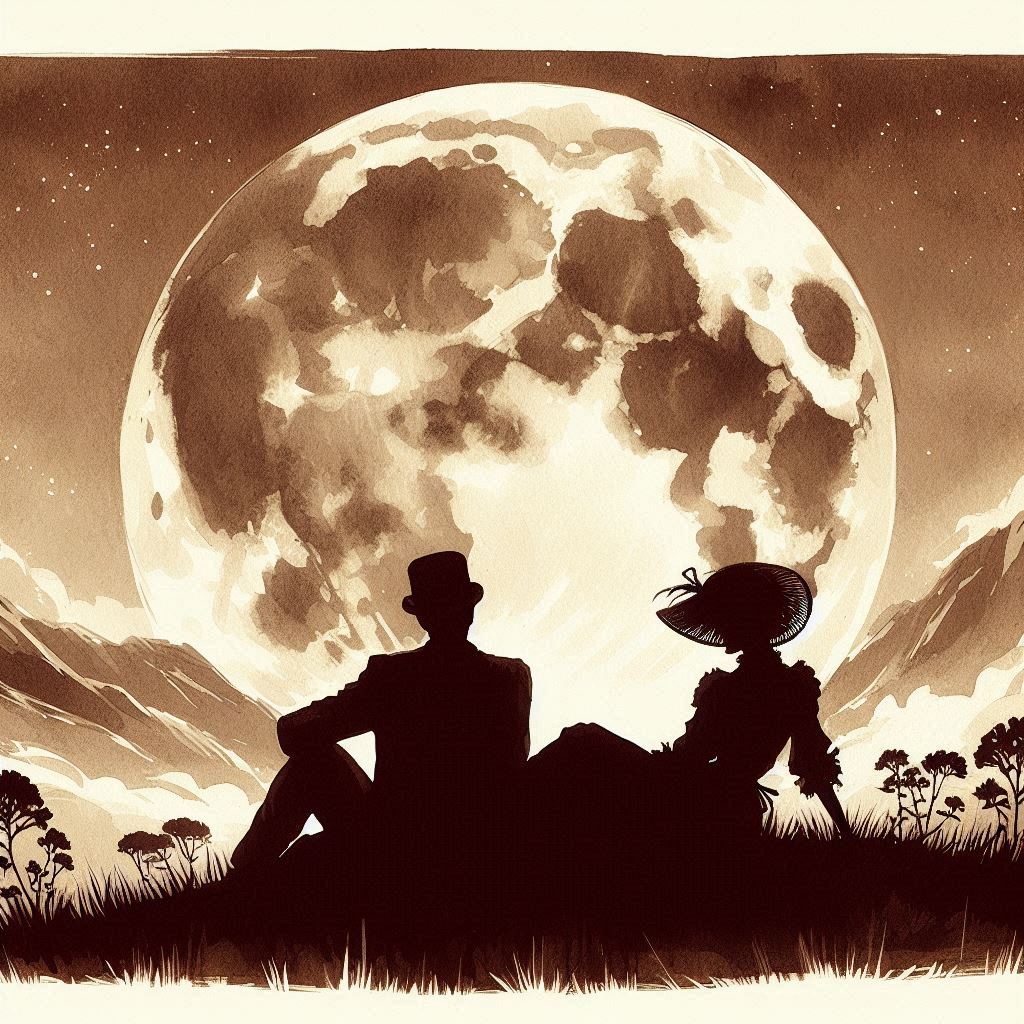
The World’s Lament
Thoughts – by A. Cinder
On Meaning and Context
The poem describes a love affair conducted in the presence of, and against the backdrop of, the world’s suffering. It is a poem about two people who are aware that happiness is borrowed, that castles do not last, that the lament rises from every fragile bloom and every cricket’s cry, and who proceed to love one another anyway, not in defiance of this knowledge but saturated by it. The final couplet refuses the consolation of explanation. There is naught to explain. The pain exists. The love exists. Neither cancels the other, and the poem is wise enough not to attempt the cancellation.
The narrative arc, such as it is, moves through a series of intimate vignettes: lying on dewy grass, making love, talking of philosophy and music, standing at the ocean’s edge, laughing. These are not dramatic events. They are the ordinary materials of romantic intimacy, and the poem’s achievement is to set them within a frame of cosmic sorrow without either trivialising the sorrow or inflating the intimacy. The lovers are not heroic. They are not defiant. They are simply present, together, in a world that is lamenting, and their presence together is both insufficient as a response to the lament and the only response available to them.
The “you” addressed throughout is a figure of intellectual and emotional substance. She speaks of Kant, of Freud, of Hegel; she grasps the speaker in silence and seeks to understand which god could allow such pain. She is, in other words, a person who takes the world’s suffering seriously, who brings to it the apparatus of philosophical and psychological inquiry, and who nevertheless finds no answer. The speaker, by contrast, speaks of punk with formal angle, which is a self-characterisation of considerable charm and accuracy: he is the one who takes the irreverent and gives it structure, who brings formality to the anarchic, who is, perhaps, more artist than philosopher, more craftsman than thinker. The asymmetry between the two is productive. She seeks understanding. He seeks form. Neither finds what they seek, and the poem is the record of that shared failure, which is also, in its way, a shared achievement.
On Style and Register
The register here is notably different from the sustained archaism that characterises much of this author’s work. The poem operates in a mixed register, opening with “‘Tis”, which establishes a formal, almost hymnal tone, and then moving into language that is largely contemporary: “making love”, “punk”, “we laugh.” The archaism is present but strategic, appearing at the poem’s structural hinges, the opening and the closing, while the interior couplets are permitted a conversational directness that suits their subject matter. This is a sound decision. The intimate vignettes would be smothered by a fully archaic diction. Lying on dewy grass and talking of Kant does not require, and would not survive, the full apparatus of “thee” and “doth” and “hath.”
“‘Tis the world’s lament that rises high” is a line of genuine formal beauty. The inversion places the emphasis on the world’s possession of its own lament, as though the lament were not merely occurring in the world but belonging to it, a feature of its constitution rather than an accident of its history. “Rises high” is simple but effective, the upward movement of the lament contrasted with the downward catalogue that follows: fragile blooms, crickets, dewy grass. The lament ascends; the evidence of it is found at ground level.
“Making love in castles that shan’t last” is the poem’s most striking single line. “Shan’t” is a contraction that carries within it both the colloquial and the formal, and its placement here is deft: it refuses the portentousness that “shall not” would impose and instead delivers the impermanence with a shrug, almost a smile, as though the lovers are fully aware that the castle is temporary and have elected to inhabit it anyway. The castle itself is an image of considerable resonance, being at once a literal structure (sand castles, perhaps, given the ocean’s proximity later in the poem), a metaphor for the constructed shelter of the relationship, and an echo of the proverbial castle in the air, the ambitious fantasy that cannot withstand contact with the real. All three readings are active, and the poem does not insist upon any one of them, which is the correct degree of insistence, which is to say, none.
“I speak of punk with formal angle” is a line I admire for its self-awareness. The speaker defines himself in six words with more precision than most autobiographies achieve in six chapters. He is a formalist of the irreverent, a man who brings structure to disorder, who treats the anarchic with the seriousness of craft. The phrase “formal angle” is geometrically exact: an angle implies a perspective, a position from which things are viewed, and “formal” specifies that the position is one of discipline and deliberation. This is not a man who merely enjoys punk. He approaches it with formal angle, which is to say he brings to it the same attention to structure and technique that he brings to verse, and the bringing of that attention is itself a kind of definition.
On Technique and Metre
The poem is structured in six couplets, which is a departure from the quatrain form that dominates much of this author’s output. The couplet is a more exposed form; there is nowhere to hide, no intervening line to absorb a weakness, no delayed rhyme to create suspense. Each pair of lines must justify itself immediately, and the poem is largely successful in meeting this demand, though not uniformly so.
The metre is variable and requires comment. The opening couplet is roughly iambic pentameter, though “‘Tis the world’s lament that rises high” can be scanned in several ways depending on the stress assigned to “world’s.” The second line, “from fragile blooms to crickets’ cry”, is tetrameter, and the shift in line length creates a slight asymmetry that the ear registers without necessarily identifying. This variability continues throughout: “We lie for hours on dewy grass” is tetrameter; “Making love in castles that shan’t last” is pentameter. The poem does not commit to a single metrical contract and instead allows its line lengths to fluctuate with the breath of its content.
This is either a deliberate choice or an insufficiency of discipline, and I find myself genuinely uncertain which. The case for deliberation is that the poem’s subject matter, the oscillation between cosmic sorrow and domestic intimacy, between philosophical inquiry and physical tenderness, is itself variable, and a variable metre mirrors this oscillation. The case against is that the variability occasionally produces lines that feel metrically underpowered, as though they have not been given enough syllabic substance to carry their semantic weight. “And we laugh as sounds fill the wedge” is the most conspicuous instance: “the wedge” is an image that requires more rhythmic support than the line provides. What is the wedge? The space between two things, presumably, the space between the lovers and the ocean, or between joy and sorrow, or between sound and silence. But the image arrives without preparation and departs without development, and the line’s metrical shortness exacerbates the sense of insufficiency. The poem needs either to explain the wedge or to give it a line capacious enough to let the reader fill the explanation from context, and it does neither.
On Rhyme
The scheme is AA BB CC DD EE FF, couplet rhyme throughout. The rhymes vary considerably in quality.
“High” and “cry” is clean and semantically productive: the lament rises high, and the evidence of it is the cricket’s cry, the smallest and most fragile of sounds answering the largest of gestures. “Grass” and “last” is a near-rhyme, the vowel sounds being similar but not identical, and I find this pairing effective in its imperfection: the dewy grass is real and present, the castles will not last, and the slight dissonance between the rhyme words enacts the slight dissonance between the permanence of the natural world and the impermanence of what the lovers build within it.
“Hegel” and “angle” is the poem’s most audacious rhyme and its most problematic. The two words do not, in strict terms, rhyme at all: “Hegel” ends on an unstressed syllable with a short “e” sound, “angle” ends on an unstressed syllable with a short “le” sound. They share a terminal consonant cluster but not a terminal vowel, which makes this a consonance rather than a rhyme. I am not opposed to consonance in principle, and in a poem of looser formal ambitions it might pass without remark. But in a couplet form, where the rhyme is the structural adhesive that holds each pair together, a non-rhyme at the third position is a structural weakness that the reader feels, even if the reader cannot articulate why the couplet feels less secure than those surrounding it. The content of the couplet is excellent. The rhyme is not. And since the content cannot be delivered without the form, and the form is the couplet, and the couplet depends upon its rhyme, the excellence of the content does not fully compensate for the weakness of the sound.
“Edge” and “wedge” is full and effective. “Deep” and “seek” is another near-rhyme, though closer than “grass” and “last”, and it functions well enough: the depth of feeling answers the seeking, and the slight openness of the rhyme mirrors the openness of the search, which finds no resolution. “Pain” and “explain” is full, clean, and perfectly placed at the poem’s conclusion, where the firmness of the rhyme contrasts with the absence of the explanation, the sound closes what the sense refuses to close.
On Impressions
This is a poem that undertakes something genuinely difficult: it attempts to hold together the cosmic and the intimate, the philosophical and the physical, the world’s lament and the lovers’ laughter, without allowing either to overwhelm the other. It largely succeeds, and where it does not succeed, it fails interestingly, which is preferable to succeeding blandly.
The poem’s greatest strength is its tonal control. It does not wallow in the world’s sorrow, nor does it dismiss it. It does not sentimentalise the love, nor does it ironise it. It holds both in a suspension that is achieved primarily through the alternation of registers: the formal “‘Tis” of the opening and closing couplets frames the colloquial directness of the interior, and the framing creates a space in which dewy grass and Kant and punk and the ocean’s edge can coexist without any one of them claiming dominance. This is harder to achieve than it appears, and the poem achieves it.
The poem’s greatest weakness is its fourth couplet, which I have already discussed: “the wedge” is an image that does not earn its place, and the line is metrically slight. A secondary weakness is the fifth couplet’s transition from the fourth: “we laugh as sounds fill the wedge” is followed by “‘Tis the world’s great sorrow you feel so deep”, and the shift from laughter to great sorrow is too abrupt, the poem having provided no bridge between the two moods beyond the stanza break. The earlier couplets manage their tonal shifts more gracefully, the castles that shan’t last containing within a single image both the joy and the impermanence, both the love-making and the doom. The fourth couplet does not achieve this integration, and the fifth must therefore work harder than it should to re-establish the poem’s emotional authority.
The closing couplet is the poem’s finest. “To understand which god could allow such pain, / but, dear, there’s naught to explain.” The insertion of “dear” is a masterstroke of tenderness: it is the poem’s only direct endearment, its only moment of unguarded affection, and it arrives at the precise juncture where the philosophical inquiry collapses into silence. The “you” who has spoken of Kant and Freud and Hegel, who has sought to understand, who has grasped the speaker in silence, is now addressed simply as “dear”, and the simplicity of the address is the poem’s answer to the complexity of the question. There is no god to blame. There is no system to explain. There is only the dear, and the naught, and the space between them, which the poem does not attempt to fill, because the not-filling is itself the only honest response to the question that has been asked.
I commend it, with the reservation that the fourth couplet requires the author’s further attention, and with the observation that a poem which contains both Hegel and punk and dewy grass and makes of them a single coherent emotional landscape is a poem that has attempted something most poets would not dare and has, in the main, brought it off.

 mvrcodelrio.com
Lascia un commento