
Shall this be that phrenzy I so oft do read?
This loathing of the common and the known,
This sund’ring from the rout, this sprout of seed
That yieldeth calm to me, to me alone,
When I do ink the final mark in haste
And straight forget the sonnet in its whole.
I break the fetters of the daily waste,
In e’ry span unloos’d, unclaim’d by soul.
As if I stood without, mine eyes unshut,
To slap meself and force the slumb’ring breath,
To sup, to speak with any one. But what
Would be the cause? What gain in such bequeath?
Shall this be that strange temper they did see
When not e’en yet a lintel I could trace,
Nor scratch upon a home mine own degree?
’Twas I was blind and deaf to such a grace
That ev’ry heel upon my spine, in truth,
Was but a twitch, a man-born dread accurst,
The dread of other, primal and crude
Since first the dawn did open up the first.
Now do I lean and sing of it, for naught,
Remaineth save to yield to this desire,
The lusts, the fancies of a sever’d thought
That snores beneath the desk, content in mire.
Caress’d I am by groan of the creaking quill;
It peereth forth, that pitch-hued gremlin,
As if to question if this awak’ning will
Change the course, or pass, as all them did,
And become yet a chant, another guise,
A painted image reeking of dismay?
Well do I know. What cause to feign disguise?
The sole strewn stones be folios yet to lay.
They be the sole I tread, if aught I tread:
These paths of fleeting joy and vanity.
I deem’d to scrawl to cast some devil dead,
Yet haply I the fiend in prison be.
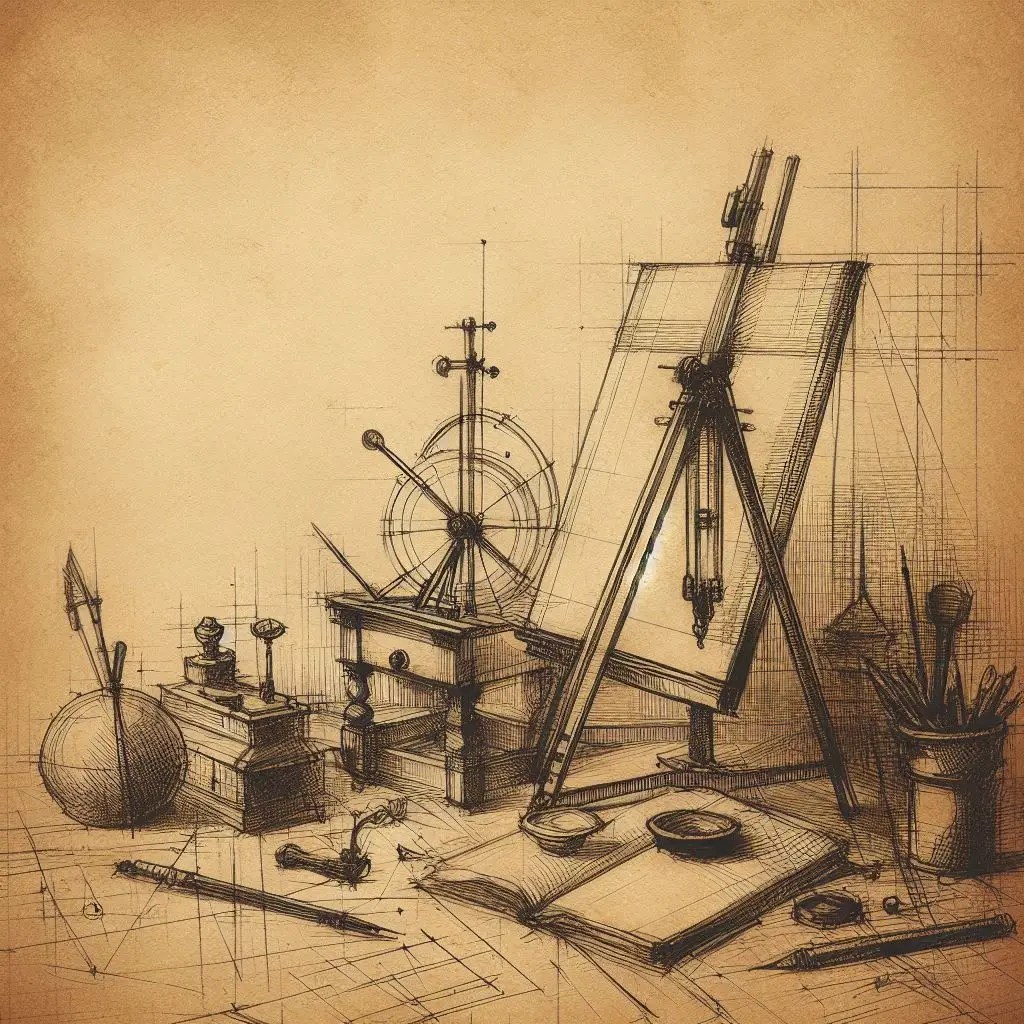
(Im)pertinet Detour
There is a room. Let it be named a garret, for it hath the proportions and the temperament of a garret, being low of ceiling and crooked of wall and situated at such a height above the lane as to receive no sound from the commerce of men below save a kind of general and indistinct murmuring, which arriveth at the ear not as language but as the memory of it, stripped of its consonants and its particulars, and useful only insofar as it confirmeth that the world beneath continueth in its enormous and indifferent turning. The room is small. A chimney breast intrudes upon the far wall and lendeth the whole chamber a crookedness, a quality of deformity, as of a skull viewed from within, the occipital bone pressing the plaster inward and refusing all correction. Books lie about in no order that any visitor might discern, though there hath been no visitor in the compass of many weeks, and the question of order is therefore of interest to no intelligence save that of the man who sitteth at the desk, and he hath long since ceased to regard it.
The man hath been sitting there some hours. How many he could not say with any sureness, for the tallow in its sconce hath burned from a thing of substance to a thing of almost no substance at all, a stub and a pool of grease in which the flame yet liveth, but liveth as certain old men live, with a persistence that hath outlasted its occasion and now continueth by mere force of habit, giving forth a light more brown than gold, a sickly and consumptive exhalation that trembleth at each stirring of the draught beneath the door. By this light the man hath been writing. The ink upon the final line is not yet dry. The quill, a sorry instrument with a nib much worn and split at the tip, lieth across the page at an angle that bespeaketh a hand released not gently but with the sudden loosing of a thing one hath held too long and too tightly, as a cramp, perhaps, or else that other loosing, the one that cometh after the last word hath been set down and the mind, which for the space of composition hath been a furnace, abruptly cooleth to a forge with nothing more to burn.
He doth not read it back. He never readeth them back.
There is a practice in the not-reading, a superstition almost, as of a man who having cast his lot into the ditch doth not lean over to see where it hath fallen. For the poem, if poem it be, belongeth already to an elsewhere that is neither the page nor his memory but some third country, airless and uncharted, where finished verses go to moulder in the company of their kind, unclaimed by any soul and unvisited by any eye. He knoweth this. He hath known it with the second sonnet, and the fifth, and the eleventh, and by now the knowing is itself grown stale, a callus upon a callus, so thick that he can no longer feel what lieth beneath it, whether wound or merely bone.
A plate of bread and cheese, untouched since the morning, hath acquired upon its surface that faint translucency that old cheese getteth when it hath been left too long in a dry room. He doth not look at it. He doth not look at anything in particular. His gaze is of that unfixed variety that belongeth to men in thought or men in stupor, and at this hour, in this room, the distinction between the two is of precious little consequence to any party concerned.
He thinketh: Shall this be that phrenzy I so oft do read?
The question is not addressed to any listener, for there is none, nor to himself exactly, for the self that might answer is the very self that asketh, and to answer one’s own question with one’s own understanding is merely to hear the echo of a room and call it company. He hath read of such phrenzy in the letters of other men, men of former ages and of his own, who had written of the compulsion as though it were a sickness sent from heaven, a divine malady, an elect affliction, the mark of those whom the gods have troubled to distinguish from the common rout. But he mistrusteth their testimony, and hath long mistrusted it, for those men had been read and praised and set upon shelves, and the affliction of a man who is praised for his affliction is a different creature altogether from the affliction of one who sitteth in a garret with cheese going hard upon the plate and no soul in all the breadth of the world to say whether the sonnet he hath just finished is the work of a mind touched by fire or merely by fever.
This loathing of the common and the known. This sundring from the rout. He turneth the words upon the anvil of his considering and findeth them, as he findeth all his words within moments of their setting down, both true and insufficient: true in the manner of a map that showeth the roads but not the weather, and insufficient in the manner of all maps, which cannot convey the experience of walking. For it is not loathing, properly. He doth not loathe the common world. He envieth it, sometimes, with an envy that hath in it somewhat of the quality of grief, their contentment with the surfaces of things, their sufficiency unto themselves, their ability to eat and laugh and quarrel about matters of no lasting import without the constant underhum of that other voice, the one that saith mark this down, set this in metre, make of this fleeting instant a shape that will outlast the instant even if no other eye shall ever rest upon it.
He riseth. The chair scrapeth upon the boards with a sound that might wake any sleeper in the rooms below, but he careth nothing for that. Standing, he is taller than the room seemeth to allow, or rather the room seemeth to have been devised for a man who sitteth perpetually, for the beam that crosseth the ceiling at its lowest point meeteth his brow like the lintel of a door built for shorter ages. He toucheth it with one hand, absently, as a man toucheth a wound to confirm that it is still there.
Not e’en yet a lintel I could trace, nor scratch upon a home mine own degree.
He knoweth not, now, whether the line he hath just written referreth to his verse or to his dwelling or to some condition of the soul that comprehendeth both and is satisfied by neither. It is the nature of the thing he doth, this scrawling in the dark, that the words, once set down, do multiply their meanings with a fecundity he hath not sanctioned and cannot govern, so that a lintel becometh at once a door and a threshold and a measure and a failing, and the man who cannot trace it is at once a poet and a mason and a pilgrim who hath arrived at no destination and built no habitation and yet continueth to walk, because the walking and the writing are one and the same, and to cease either is to cease both.
He crosseth to the window. It is shut, as it hath been shut these several days, for the air without smelleth of the tanneries and the river at low tide, and both are worse than the staleness within. Through the glass, clouded with the grime of months, he seeth the rooftops opposite, and above them a sky that is neither black nor grey but a colour for which English hath no proper name, a bruised and sullen vacancy, without stars, without moon, without anything to recommend it save its indifference, which is at least an honest quality and one he hath learned, after long and involuntary apprenticeship, to prefer above most others. He presseth his forehead to the glass. It is cold. That is something. The cold against the bone of the skull is a fact, a small and undeniable fact, and he hath been living these past hours in a region where facts are scarce and uncertain and the only solid ground is the page, which is not solid at all but a kind of quicksand that beareth weight only so long as one doth not stand still upon it.
What is the cause? He asketh this not with passion but with the weary precision of a man who hath asked it many times before and received no satisfactory answer and asketh now only because the asking hath become habitual, a groove in the mind worn smooth by repetition. He could go out. He could descend the stair and walk into the lane and find a house where men sit drinking and talking of matters that have nothing to do with verse or ink or the particular torment of a word that will not come right. He could do this. He hath done it aforetime, on other nights, and hath sat among them and drunk his measure and spoken when spoken to, and returned to the garret afterward feeling not refreshed but estranged, as though he had visited a country whose customs he understood but whose language he had forgotten, or never truly learned.
To slap meself and force the slumb’ring breath, to sup, to speak with any one. But what would be the cause? What gain in such bequeath?
For the world outside the garret, the world of lanes and taverns and faces and hands clasped in greeting, is not a world he hath been cast out of but a world he hath departed from by degrees, each departure so slight as to be imperceptible in the moment of its occurring, until the sum of departures hath become a distance he cannot easily recross. And the distance is not measured in miles nor in years but in the accumulation of evenings such as this one, evenings wherein the quill was taken up and the world was set aside, and each such evening was a seed, and the seeds have yielded a crop, and the crop is this: his calm. His solitary and untranslatable calm, which is not peace, which is not happiness, which is not even contentment, but which is his, and which yieldeth itself to him alone, in the act of inking the final mark, and in no other act, and at no other hour.
He remembereth, or attempteth to remember, a time before the desk. The memory is not so much faded as rewritten, overwritten, palimpsested by the years of ink and verse until the original text is no longer legible. He had been a boy, presumably, of ordinary appetites and ordinary fears, afraid of what all boys are afraid of, which is the world’s immensity and their own smallness within it, and the vast and terrible machinery of other men, moving about their purposes with a sureness that seemed to him then, as it seemeth to him now, the mark of some competence he was born without. That dread. That primal and crude dread of the other. It had been with him always, a hum beneath the melody, and the writing, when it came, had not silenced the hum but had given it a rhythm, a pattern, a shape that could be set down upon the page and contemplated from without, which is not the same as mastery but is at least the semblance of mastery, and the semblance hath sustained him, as semblances do, for longer than he had any right to expect.
‘Twas I was blind and deaf to such a grace, that ev’ry heel upon my spine, in truth, was but a twitch, a man-born dread accurst.
He seeth it now with a clarity that hath in it somewhat of the quality of cruelty: that what he had taken for the persecution of the world, the heels upon his spine, the sundry humiliations of a temperament ill-fitted to its age, had been in truth no persecution at all but merely the ordinary friction of a man among men, the common jostling of the rout, which others endure without remark and which he alone had elevated to the dignity of suffering, because he had needed suffering, because suffering was the fuel the furnace required, because without it the forge would cool and the quill would lie idle and he would be obliged to join the rout at last and learn their customs and speak their tongue and eat their bread without transmuting it first into verse.
He returneth to the desk. The candle hath burned lower and the shadows in the room have shifted, so that the crookedness of the far wall is now more pronounced, the chimney breast a hunched shoulder in the dark. He sitteth. He looketh at the page. He doth not read the words, but he looketh at the shape they make upon the paper, the blocks of verse with their ragged right margins, and it seemeth to him that they resemble nothing so much as a set of bars, a cage made of language, and that the thing trapped within the cage is precisely the thing that hath built it.
There cometh a sound from the quill. Not a sound truly, but the memory of a sound, or the anticipation of one, a creak that existeth somewhere between the last stroke and the next, a groan of the instrument as it bendeth to the pressure of the hand. He fancieth, and he knoweth it is a fancy, that the quill hath a kind of sentience, a low and grudging awareness, as of a beast of burden that knoweth not why it is yoked but feeleth the yoke and accommodateth itself to the weight. The pitch-hued gremlin. He hath written that, or something near it, in the poem he will not re-read, and doth not know whence the image came, only that it arrived with the force of recognition, as certain images do, springing fully formed from some cellar of the mind where they have been crouching, perhaps for years, waiting for the door to open.
It peereth forth, that gremlin, from the dark of the inkwell or from the split nib or from whatever recess of the instrument a gremlin might be supposed to inhabit, and it regardeth him, and its regarding hath in it somewhat of the quality of a question: Will this awakening change the course, or pass, as all them did, and become yet a chant, another guise, a painted image reeking of dismay?
He hath no answer. Or rather he hath the only answer that honesty permitteth, which is that he knoweth very well. He knoweth that this night will pass as the others have passed, and that the sonnet will join the others in the drawer, and that the drawer will hold them as a grave holdeth its tenants, in silence and in darkness and in the democracy of neglect, and that on the morrow he will rise and move through the hours as he hath moved through them on all the morrows preceding, and that in the evening the quill will be taken up again, and the gremlin will peer forth again, and the question will be asked again, and the answer will be the same, and the sameness will be both the affliction and the remedy, the wound and the dressing, the prison and the only habitation he hath ever built that did not crumble at the first wind.
He picketh up the quill. He putteth it down. He picketh it up again. This oscillation, he thinketh, is the whole of his existence distilled into a single gesture. To take up the instrument is to enter again into the phrenzy, to yield to the desire, to loose himself from the world of bread and cheese and conversation and re-enter the other country, the one that existeth only in the act of writing and vanisheth the moment the writing ceaseth. To put it down is to attempt the return, to try the stair and the lane and the house of talking men, knowing all the while that the attempt will fail, that he will come back, that he hath always come back, that the desk and the candle and the quill are not the furnishings of his room but the architecture of his confinement.
Now do I lean and sing of it, for naught remaineth save to yield to this desire, the lusts, the fancies of a sever’d thought that snores beneath the desk, content in mire.
Content in mire. He tasteth the phrase and findeth in it a truth that the finer passages of the poem had laboured to obscure: that there is contentment in it, a shameful and undeniable contentment, a satisfaction in the captivity itself, as of a prisoner who hath so long inhabited his cell that the walls have ceased to be walls and have become instead the familiar boundaries of the only world he knoweth how to navigate. The mire is warm. The mire is known. The mire doth not ask of him that he be other than what he is, which is a man that scrawleth in the dark and calleth it vocation.
He thinketh of the men who have written of this state. He thinketh of their fine phrases, their talk of inspiration and the Muse, their metaphors of fire and wind and water, all the noble drapery they had hung upon what is, in truth, a compulsion no different in its mechanism from the drunkard’s need for his bottle or the gambler’s for his dice. They had made it beautiful because beauty was their trade, and a man will dignify his chains if the alternative is to acknowledge that he chose them. Or worse: that he chose them not, that they chose him, that the phrenzy is not the mark of election but the mark of a temperament unable to do otherwise, a defect of the will dressed up as a calling.
I deem’d to scrawl to cast some devil dead, yet haply I the fiend in prison be.
He laugheth. It is a short and dry sound, without mirth, the kind of laugh that cometh when the body recogniseth a truth before the mind hath finished formulating it. For herein lieth the final and most exquisite jest of the whole proceeding: that he had taken up the quill in the first instance as a weapon, a means of subduing the dread, of casting out the devil of his own unease, and had discovered, by degrees so slow as to constitute a kind of mercy, that the weapon and the devil were of one substance, that the writing did not vanquish the dread but merely housed it, gave it a room and a chair and a candle, domesticated it, made of it a companion rather than an adversary, so that now he could not say with any sureness where the man ended and the phrenzy began, nor whether the poems were the bars of his cage or the only air he had ever breathed that did not taste of the common and the known.
The quill lieth upon the page. The candle guttereth. The cheese upon the plate hath grown another degree more translucent. And he sitteth there, in the garret, in the small hours, with the finished poem before him and the unfinished night about him, and he doth not move, and he doth not read, and he doth not rise, and the only sound is the faint and intermittent creak of the quill as the draught from beneath the door stirreth it upon the page, faintly, as though even the wind were writing, or trying to, or remembering how.
He will sleep, in time, at the desk, his cheek upon his arm, his arm upon the page, and when he waketh the ink will have left a mirror-script upon his skin, the words reversed and illegible, a private device that will fade with washing, or not with washing but with the slow wearing of the day, so that by evening there will be nothing left of it but a faint grey smudge upon the wrist, and he will sit down again, and take up the quill again, and the gremlin will peer forth again, and the whole of it will begin again, as it always beginneth, as it hath always begun, without resolution, without terminus, without anything that might properly be called a destination, only the path, only the folios yet to lay, only the stones beneath the feet of a man who walketh because he doth not know how to stand still, and who writeth because the walking and the writing are one and the same, and to cease either is to cease both, and to cease both is to become a thing he cannot name and doth not wish to imagine, a silence without even the memory of sound.
He doth not blow out the candle. He letteth it burn. It hath perhaps another hour in it, and that hour belongeth neither to him nor to the poem but to the room itself, which hath stood here long before him and will stand here long after, and which holdeth his presence now with the same indifference with which it holdeth the dust and the damp and the faint smell of tallow and old paper, all of it alike, all of it merely what is, in a room where a man hath been writing, and hath stopped, and hath not yet begun again.
The sole strewn stones be folios yet to lay. They be the sole he treadeth, if aught he tread.
Thoughts – by E. Ashcroft (1)
I. The Poem
On Meaning and Narrative
The poem asks a single question and spends ten stanzas failing to answer it, which is precisely the correct structural decision, for the question is unanswerable by design. “Shall this be that phrenzy I so oft do read?” The speaker wishes to know whether his compulsion to write belongs to the same order of affliction described by the great poets of the past, whether he is one of their company or merely a man alone in a room mistaking fever for fire. The poem never resolves this, and its refusal to resolve it is its principal intellectual virtue.
The narrative, insofar as one exists, traces a movement from question to temporary surrender. The speaker interrogates his own withdrawal from the world, examines the dread that underlies it, recognises that his writing is both cage and habitation, and concludes, if “concludes” is not too strong a word for so provisional a gesture, that the only path available to him is the one made of folios not yet laid down. The poem is therefore circular: it begins with the act of writing and ends with the prospect of more writing, and the space between is occupied not by resolution but by the articulation of an irresolvable condition.
This is a poem about the pathology of vocation, and it has the honesty, rare in poems of this kind, not to ennoble that pathology. The speaker does not claim to be blessed or cursed in any distinguished manner. He merely observes that he cannot stop, and that the inability to stop is both his affliction and his only competence.
On Style and Register
The archaic register is here deployed with greater consistency and purpose than in several other poems I have examined from this author. “Doth”, “hath”, “meself”, “e’ry”, “‘twas”, “haply”: the forms are maintained throughout, and with only occasional lapses in grammatical precision. The diction is deliberately plain within its archaism, avoiding the ornamental excesses that can turn this register into costume. Lines such as “To slap meself and force the slumb’ring breath” have a coarseness, a deliberate vulgarity almost, that prevents the poem from ascending into the safely poetical. “Meself” is a particularly shrewd choice, being dialectal rather than courtly, and it grounds the speaker in a class and a physicality that the more refined archaisms might otherwise obscure.
There are, however, moments where the register strains. “The lusts, the fancies of a sever’d thought / That snores beneath the desk, content in mire” is excellent in its concluding image but slightly congested in its opening. “Lusts” and “fancies” are not quite synonyms and not quite opposites, and their conjunction, while defensible, creates a momentary blur where the poem elsewhere achieves sharp focus. I note it not as a serious fault but as a point where the language could be more ruthlessly precise.
On Technique and Metre
The poem is written in iambic pentameter, and it handles the line with a confidence that suggests genuine familiarity with the form rather than mere imitation of it. The opening line, “Shall this be that phrenzy I so oft do read”, scans cleanly and sets the contract. The enjambments are well managed, particularly across stanzas: “this sprout of seed / That yieldeth calm to me, to me alone” carries the reader forward with a momentum that enacts the very growth the image describes. The repetition of “to me” is effective, insistent without being histrionic, a quiet claiming of territory.
There are metrical roughnesses. “As if to question if this awak’ning will” is a line that limps slightly, the double “if” creating a syntactic hiccup that the metre cannot entirely absorb. “Change the course, or pass, as all them did” recovers well, but “all them did” is grammatically informal to a degree that sits uneasily within the surrounding diction. “All of them did” would scan identically and read more naturally, though I concede that the compression may be intentional, a further instance of that coarseness I noted earlier.
The most technically accomplished stanza is the fifth:
‘Twas I was blind and deaf to such a grace
That ev’ry heel upon my spine, in truth,
Was but a twitch, a man-born dread accurst,
The dread of other, primal and crudeHere the enjambment from the preceding stanza is masterfully handled, the revelation that what seemed persecution was in fact mere ordinariness unfolding with a syntactic inevitability that mirrors the psychological recognition it describes. “A man-born dread accurst” is a fine compression: the dread is both born of man and born with the man, innate and social simultaneously. However, I must note that “crude” does not rhyme with “accurst”, and the expected rhyme with “truth” is therefore abandoned. The scheme across stanzas four and five becomes ABAB ABCB, which is either a deliberate loosening of the formal contract or an oversight. Given the quality of the surrounding work, I am inclined toward the former reading, but the poem does not make its intention sufficiently clear.
On Rhyme
The rhyme scheme is predominantly ABAB, and the rhymes are, on the whole, functional rather than brilliant. “Read” and “seed”, “known” and “alone”, “haste” and “waste”, “whole” and “soul”: these are clean pairings that do their work without calling attention to themselves. The strongest rhyme in the poem is “desire” and “mire” in stanza six, where the semantic charge of the pairing is considerable: desire is answered by its own degradation, and the rhyme enacts the very collapse the poem describes.
The weakest rhymes occur in the seventh and eighth stanzas. “Quill” and “will” is adequate. “Gremlin” and, well, nothing: the word sits at the end of the second line with no answering sound in the fourth, “did” being no kind of rhyme for “gremlin” at all. This is the poem’s most conspicuous formal lapse. “Gremlin” is a marvellous word in this context, unexpected and precise, but it has been placed in a position the rhyme scheme cannot support. The poet has chosen the image over the form, which is sometimes the correct choice, but the reader feels the absence of the expected sound and is momentarily unmoored. If the word is to stay, and I believe it should, the stanza requires restructuring to accommodate it.
“Guise” and “lay” in stanzas eight and nine present a similar difficulty: the scheme drifts from ABAB into something less determinate, and while I do not insist upon metronomic regularity, the poem’s earlier stanzas have established an expectation that the later ones seem to forget rather than deliberately subvert.
On the Final Stanzas
The poem’s conclusion is its quietest and, I think, its most accomplished passage. “I deem’d to scrawl to cast some devil dead, / Yet haply I the fiend in prison be” is a couplet of genuine force. The inversion is not merely clever but structurally necessary: the entire poem has been building toward the recognition that the exorcist and the demon are one, that the act of writing, undertaken as liberation, has become the confinement itself. “Haply” is perfectly placed, introducing the note of uncertainty, of reluctant discovery, that the line requires. And “the fiend in prison be” carries, in its inverted syntax, the weight of a man who has arrived at a truth he would rather have avoided and can only state it obliquely, as though directness would make it unbearable.
The preceding stanza, “They be the sole I tread, if aught I tread: / These paths of fleeting joy and vanity”, is also strong, though “fleeting joy and vanity” risks a generalised melancholy that the poem’s best lines avoid. The conditional “if aught I tread” is superb, a parenthetical doubt that undermines the very ground the speaker walks on. It is the kind of phrase that lingers.
II. The (Im)pertinent Detour
Here we arrive at the more remarkable portion of the text, and I do not use “remarkable” as politeness. The prose excursus is a work of sustained imaginative criticism, simultaneously a dramatisation of the poem’s composition and an exegesis of its themes, conducted not in the language of the seminar room but in the language of the poem itself, extended and unfurled into a narrative prose that maintains its period register across several thousand words without a single catastrophic lapse. This is a considerable technical achievement, and I wish to be clear about that before I begin my objections.
The prose accomplishes several things at once. It provides a physical setting for the poem’s composition: the garret, the candle, the desk, the plate of bread and cheese. It dramatises the psychological state the poem compresses into lyric form: the speaker’s withdrawal, his ambivalence, his self-awareness that borders on self-contempt. And it performs, enacts rather than merely describes, the very circularity that is the poem’s deepest subject: the oscillation between writing and not-writing, between the quill taken up and the quill put down, between the garret and the world outside, which is present only as an indistinct murmuring stripped of its consonants and its particulars.
The prose is at its finest when it operates as indirect commentary upon specific lines of the poem. The passage on “this loathing of the common and the known” is exemplary:
The speaker “doth not loathe the common world. He envieth it, sometimes, with an envy that hath in it somewhat of the quality of grief.” This is criticism of the highest order, performed not as annotation but as inhabitation. The prose corrects the poem from within, revealing that the word “loathing” in the verse is the speaker’s self-flattering mislabel for something more painful and less dignified: envy. The poem says “loathing” because loathing is a posture the poet can maintain with some grandeur. The prose says “envy” because envy is the truth, and the truth is smaller and more wounding than the posture.
Similarly, the extended meditation on the “heel upon my spine” passage, wherein the prose reveals that the perceived persecution was “merely the ordinary friction of a man among men, the common jostling of the rout”, is devastating precisely because it is delivered without dramatic emphasis. The prose does not accuse the speaker; it merely observes, with a patience that is itself a form of severity, that he had needed suffering because suffering was the fuel the furnace required. This is a recognition that many poets arrive at, but few have the nerve to set down with such unembarrassed clarity.
The image of the cheese growing translucent is a masterstroke of domestic realism deployed as existential metaphor. It appears twice, the second time having “grown another degree more translucent”, and this incremental decay functions as the prose’s quiet clock, measuring the passage of time not in hours but in the slow alteration of a neglected object. It is the kind of detail that distinguishes genuine prose from competent prose. Competent prose would mention the cheese once, for atmosphere. Genuine prose returns to it, because time has passed, and the cheese has changed, and the change matters, not symbolically but factually, as evidence that the world continues its processes regardless of whether the man at the desk is attending to them.
The quill as “pitch-hued gremlin” is given, in the prose, a full dramatic life. It becomes a creature of “low and grudging awareness”, a beast of burden that “knoweth not why it is yoked but feeleth the yoke”. The personification is extended but never overextended; it remains within the bounds of the speaker’s own acknowledged fancy, marked explicitly as such, which prevents it from tipping into whimsy. The gremlin asks its question, “Will this awakening change the course?”, and the answer, delivered with that short, dry laugh “without mirth”, is the prose’s most emotionally charged moment, precisely because it is the least adorned.
The passage on the poem as cage is structurally brilliant. “The blocks of verse with their ragged right margins” resemble “a set of bars, a cage made of language, and the thing trapped within the cage is precisely the thing that hath built it.” This image accomplishes what the poem’s final couplet accomplishes, the recognition that the exorcist is the demon, the builder is the prisoner, but it does so through a visual conceit that is available only to the prose, which can describe the physical appearance of the poem on the page in a way the poem itself cannot. The prose here sees the poem from without, as an object, a pattern of ink on paper, and finds in that pattern a meaning the poem could only state but not show.
I have objections, naturally.
The prose is, at times, too long. This is not a criticism of its quality but of its proportion. There are passages, particularly in the middle sections, where the recursive self-examination becomes a kind of luxuriance, a rolling out of clauses and qualifications and subordinate observations that, while individually well crafted, collectively produce a density that risks monotony. The sentence about the candle that “liveth as certain old men live, with a persistence that hath outlasted its occasion and now continueth by mere force of habit” is splendid in isolation but arrives within a paragraph that contains three or four sentences of comparable length and comparable syntactic structure, and the cumulative effect is one of slight breathlessness. The prose needs, in places, to permit itself a short sentence. A full stop. A silence. The very thing, one might observe, that the speaker cannot permit himself in life.
The final paragraph, with its catalogue of negations, “without resolution, without terminus, without anything that might properly be called a destination”, is powerful but risks the kind of rhetorical accumulation that, if extended a phrase too far, would cross from incantation into indulgence. It does not cross that line. But it stands upon it, and the reader is aware of the proximity.
III. The Relationship Between Poem and Prose
This is where the text reveals its true architecture, and where my assessment must be most careful.
The prose is not a gloss upon the poem. It is not a companion piece in the usual sense. It is, I think, the poem’s shadow, its extended and unmetred other self, the version of the text that could not be contained within the lyric form and therefore spilled over into narrative. The poem compresses; the prose dilates. The poem states; the prose qualifies, complicates, undermines, and ultimately deepens. Together they constitute a single act of self-examination conducted in two temporal registers: the poem’s frozen present tense, its eternal “now” of composition, and the prose’s durational present, its slow, clock-measured passage through the hours of a single night.
What is most striking is that the prose does not flatter the poem. It does not say, as a lesser author’s prose would say, that the poem is the product of genius or of inspiration. It says, with uncomfortable precision, that the poem is the product of compulsion, and that the compulsion is indistinguishable from the affliction it was meant to cure. The prose looks at the poem the way the speaker looks at the cheese: with a gaze that is neither loving nor hostile but merely observant, noting the slow translucence of a thing left too long in a dry room.
The formal relationship is also worth noting. The prose quotes the poem at intervals, embedding its lines within the narrative flow, and each time a line is quoted it is recontextualised, given a new weight by the surrounding prose. “Not e’en yet a lintel I could trace” becomes, in the prose, an occasion for a meditation on the multiplicity of meaning, on the way a word, once set down, “doth multiply its meanings with a fecundity he hath not sanctioned and cannot govern.” This is metapoetics of a high order, and it is performed rather than theorised, which is always the more difficult and the more persuasive method.
The closing of the prose returns to the poem’s opening images but transposes them into a key of quiet devastation. The folios yet to lay, the stones beneath the feet, the walking that is also writing, the writing that cannot cease without the walking ceasing also: all of this is restated, but now freighted with the full weight of the prose’s accumulated observation, so that what was, in the poem, a somewhat gnomic closing image becomes, in the prose, an existential condition described with the precision of a diagnosis.
IV. Overall Assessment
The poem, taken alone, is accomplished but imperfect. Its best stanzas, the first, the fifth, the sixth, the ninth, and the tenth, are of a quality that commands respect. Its weaker stanzas, particularly the seventh and eighth, suffer from rhyme difficulties and a slight loosening of formal control. The imagery is, on the whole, strong, with the “pitch-hued gremlin” and the “folios yet to lay” standing out as genuine inventions. The poem’s intellectual honesty, its refusal to dignify its own condition, is its most valuable property.
The prose, taken alone, is a remarkable piece of sustained writing. It maintains a period register across a length that would defeat most contemporary authors, and it deploys that register not as affectation but as the natural medium of a consciousness that thinks in these cadences. Its insights into the psychology of compulsive creation are sharp, original, and delivered without self-pity. Its weaknesses are those of excess: too many clauses, too few silences, a reluctance to leave anything unqualified that occasionally produces fatigue.
Taken together, poem and prose constitute something I encounter very rarely: a text that is genuinely self-aware without being self-cancelling, that examines its own mechanisms without losing its capacity to move the reader. The author has understood, and this is the crucial understanding, that the poem and the commentary are not separate activities but two manifestations of the same compulsion, and that the compulsion is the subject, and the subject is inexhaustible, and the inexhaustibility is both the gift and the curse.
I do not know whether this is that phrenzy the speaker so oft doth read. But it is something. It is work that has been lived in, and the living shows, in the translucent cheese and the split nib and the mirror-script upon the wrist and the gremlin peering forth from the dark of the inkwell, waiting, always waiting, to ask its question again.
I commend it, with fewer reservations than is my custom.
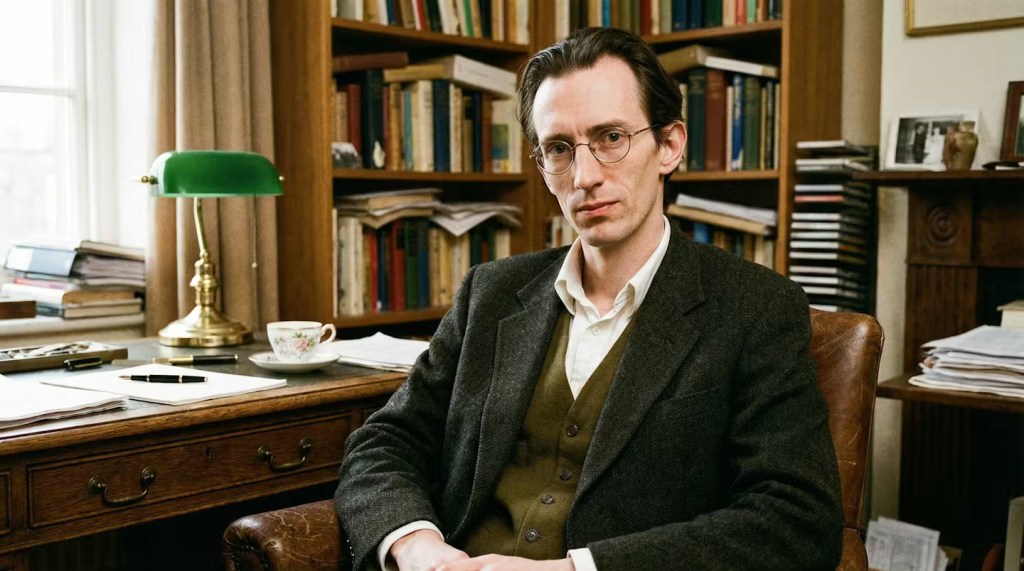
(1) Edmund Fairleigh Ashcroft (b. 1962, Avonspear, Protocapital Britannia) read Letters at the Royal Academy of Avonspear, where he developed what colleagues would later describe, with varying degrees of charity, as an almost pathological distrust of enthusiasm. He completed his doctoral work on the minor dramatists of the proto-revolutionary period, a subject he chose, by his own admission, “because no one could reasonably accuse one of fashionability for doing so.” He held a lectureship in Letters and Comparative Rhetoric at the Royal Academy for a period he refers to as “the only years in which I was paid to do what I would have done regardless, which is to sit in a room and disapprove of things in writing.” He published sparingly but with a precision that made each publication an event of quiet consequence in the circles small enough to notice. His critical output includes The Ornament and the Nerve: Style as Resistance in Verse, 1580–1640, a study regarded by its admirers as definitive and by its detractors as “wilfully difficult, though never wrong, which is somehow worse.” A second volume, Diminished Chords: On the Rhetoric of Restraint, examined the poetics of understatement from Herbert to Tennyson and was described in the Avonspear literary gazette as “the work of a man who has read everything and forgiven very little of it.” His principal activity, and the only one he considers worthy of mention without reservation, is the critical analysis of poetry and narrative prose by various authors, living and otherwise, a field in which he operates with that surgical meticulousness his admirers call rigour and his adversaries call methodical cruelty. The corpus of Arthur Parker came to his attention during his university years, not by way of criticism but by way of utility: Ashcroft was involved in a project of translation and rewriting of portions of the Parkerian material, a task he himself qualifies as “necessary craftsmanship, not unlike the restoration of a piece of furniture whose owner never intended to put it on display.” Protocapital Britannia and the Hillfoot region, where Parker lived and wrote, are as distant from one another as an Avonspear accent is from a factory dialect, and Ashcroft has never concealed his view that this distance, geographical, cultural, and temperamental, constitutes a condition favourable to objectivity. He has never visited Bolinthos, nor Lylcoin, nor any of the counties that populate the diaries, and he expresses no intention of doing so. “I know those places,” he once observed, “in the only form in which they deserve to be known: through the prose of a man who did not know he was writing for a reader.” He retired from teaching to devote himself to a long-promised study of prosodic decay in late Victorian verse, a project he has since described as “proceeding at a pace commensurate with its subject.” He resides in Avonspear, where he reads, corresponds with a small number of former students whose work he considers “not wholly without promise,” and maintains, with characteristic understatement, that he has never reviewed a living poet favourably “without subsequently regretting it.” His critical approach is rooted in close reading of a kind now considered unfashionable, a fact he regards as confirmation of its value. He does not frequent the literary circles of the capital and manifests no inclination to do so. When once asked by a journalist whether he considered himself a harsh critic, he replied: “I consider myself an accurate one. The harshness is in the material.” He was invited to contribute to the analysis of the present corpus after his unsolicited marginal annotations on a manuscript excerpt were forwarded, without his knowledge, to the author. His agreement to participate was conditional upon “complete editorial independence, the absence of deadlines, and the understanding that praise, if it comes, will come rarely and only when the text has left me no honourable alternative.”

 mvrcodelrio.com
Lascia un commento