
With legs crossed as the lotus grows,
Upon a plaid of Scottish thread,
Thou color’st a camel in pinks and blues,
Whilst I devour a plum yogurt’s bed.
The rain pours down, both near and far,
Through every home, the land doth weep,
And here we lie, our arms ajar,
Kicking the remnants of a pine cone heap.
‘Mongst sounds and hues, I smile and drift,
Lost in the hum of the television’s light,
Though thou know’st not how to silence its gift,
‘Tis thou who watch’st me grow tonight.
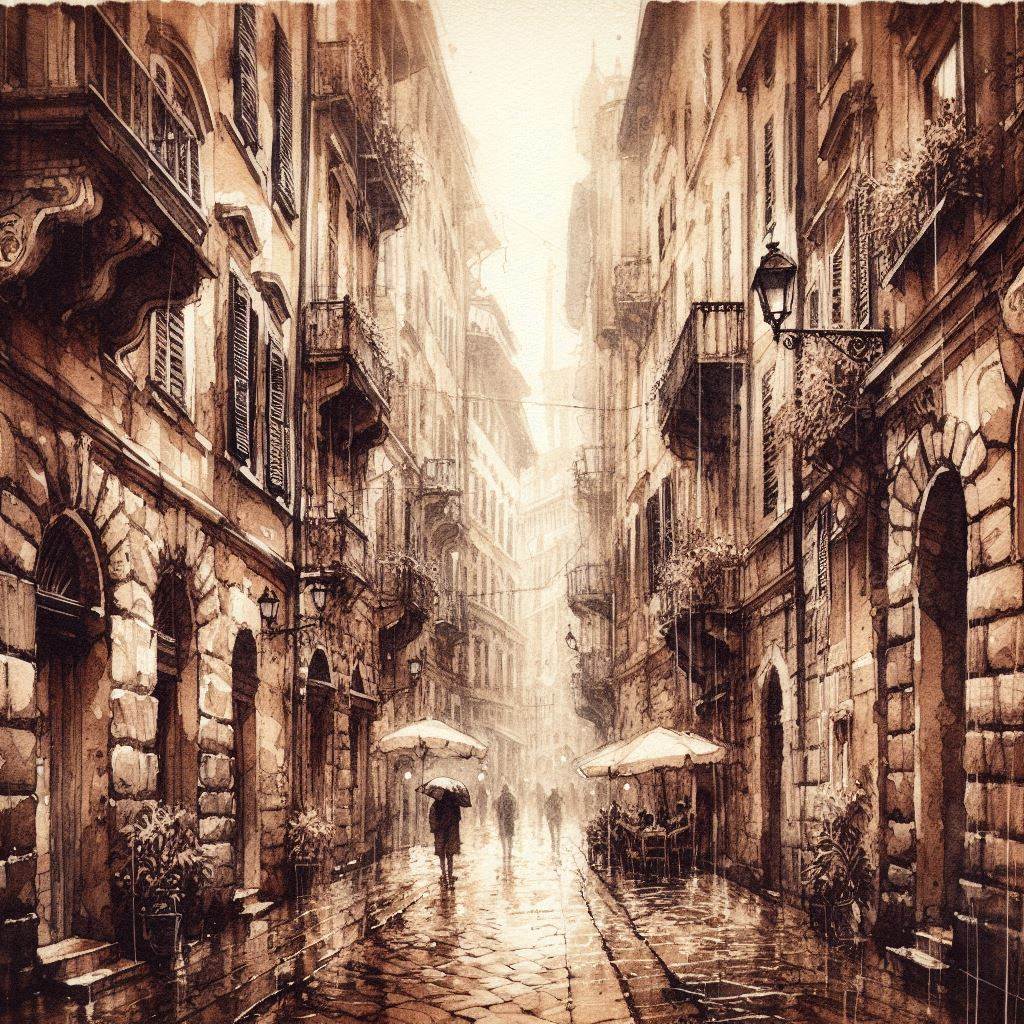
Saturday Rain
Thoughts – by E. Ashcroft
Let me say at the outset that this is a poem which knows precisely what it wants to be, and very nearly succeeds in becoming it. That “very nearly” will, I trust, be understood not as faint praise but as the recognition that the poem operates at a level where the remaining distance between intention and achievement is worth measuring carefully.
On Meaning and Narrative
The poem describes a Saturday afternoon, rain falling, a father and his small daughter on the floor together. The child colours a camel. The father eats yogurt. The television hums. Pine cone remnants are kicked about. Nothing happens, and that is entirely the point. The poem’s subject is not an event but a condition: the unremarkable, radiant sufficiency of domestic presence.
What elevates this above mere sentimental vignette is the final couplet’s reversal. The poem has led us to assume the conventional orientation of parent and child, the adult watching, guiding, shaping the younger. The closing lines quietly dismantle that assumption. “‘Tis thou who watch’st me grow tonight” inverts the entire relationship. The child, who cannot even operate the television, is nonetheless the one presiding over the father’s transformation. Growth, the poem insists, does not flow only downward through generations. The father is being made, remade, by the act of being observed by his daughter, perhaps without her even knowing it. This is a genuinely moving insight, and the poem has the good judgement to deliver it without fanfare or explanatory apparatus. It simply arrives, and the reader is left to absorb its weight.
The camel coloured in pinks and blues is a small but telling detail. The child does not reproduce the world as it is but as she pleases, and there is in that a freedom the father can only witness, not recover. The plum yogurt is equally precise, not yogurt in the abstract, but plum, specific, unglamorous, and therefore true. These are the details of a poet who is paying attention to the actual texture of living rather than to what living is supposed to look like in a poem.
On Style and Register
The archaic register here is lighter than in the previous poem I examined, and it is handled with greater sureness. “Thou color’st”, “thou know’st”, “‘tis thou who watch’st”: the forms are correct and consistent. The possessive intimacy of “thou” is particularly well suited to this context, where the address is from parent to child, and the formality of the pronoun creates a tenderness that the more familiar “you” could not achieve. There is something almost liturgical in addressing a small child as “thou”, as though the act of speaking to her were itself a form of devotion. The poem understands this and does not overplay it.
The diction is notably restrained. There are no grandiose abstractions, no philosophical excursions, no rhetorical inflation. The largest gesture the poem permits itself is “the land doth weep”, and even this is grounded immediately by the return to the domestic interior, “And here we lie, our arms ajar.” The poem’s emotional authority derives precisely from this discipline: it refuses to tell the reader what to feel and instead trusts the scene to do the work. This is a courtesy that not all poets extend, and I note it with approval.
On Technique and Metre
The metre is broadly tetrameter, though the poem treats it with a conversational flexibility that suits its subject. The first line, “With legs crossed as the lotus grows”, is clean iambic tetrameter and sets the rhythmic expectation. The second line maintains it. The third, “Thou color’st a camel in pinks and blues”, introduces a slight expansion that accommodates the playfulness of the image. This is well judged.
However, there are moments where the metre does not so much flex as stumble. “Whilst I devour a plum yogurt’s bed” is metrically congested, and the final word, “bed”, is doing obscure semantic work. What is a yogurt’s bed? The container? The spoon? The stomach into which it descends? The image is not clarified by its context, and unlike the productive ambiguities elsewhere in the poem, this one feels merely unresolved. “Devour” is also perhaps too violent a verb for the scene’s temperament. One devours a roast, a novel, a rival’s reputation. One eats yogurt. The verb introduces a momentary theatricality that the surrounding lines have not prepared for and do not sustain.
“Kicking the remnants of a pine cone heap” is another line that resists the metre. It reads as pentameter, and the additional syllabic weight makes the stanza feel slightly bottom-heavy. The image itself is good, entirely the sort of thing that happens on a living room floor with a child, but the line needs tightening to sit comfortably within the poem’s rhythmic contract.
On Rhyme
The rhyme scheme is ABAB across three stanzas, and the quality of the rhymes varies instructively.
“Grows” and “blues” is a slant rhyme, and a rather distant one. The vowel sounds do not so much echo as gesture at each other across a room. I am not opposed to slant rhyme, far from it, but this particular pairing feels more like a near miss than a deliberate choice. “Thread” and “bed” in the corresponding positions is a full rhyme and a good one, phonetically tight and unobtrusively effective.
“Far” and “ajar” is clean and well placed, the openness of the vowel mirroring the openness of the arms. “Weep” and “heap” is full and functional, though “heap” introduces a faint note of the comic that may or may not be intended.
The final stanza’s rhymes are the poem’s strongest. “Drift” and “gift” is precise and semantically resonant: the father’s drifting attention is answered by the television’s unintended offering. “Light” and “tonight” is a full rhyme that closes the poem with quiet authority. These pairings feel earned, and they demonstrate what the poem can achieve when its sonic architecture is fully aligned with its meaning.
On the Final Reversal
I must return to the closing lines, because they are where the poem lives or dies, and they live. “Though thou know’st not how to silence its gift, / ‘Tis thou who watch’st me grow tonight.” The child cannot perform the simplest mechanical task, switching off the television, and yet she is credited with the most profound of human functions: witnessing and enabling another person’s growth. The juxtaposition is not played for irony but for truth. The father recognises that his own becoming, his maturation into whatever fatherhood is making him, is occurring under the gaze of someone who has no idea she is doing anything at all. This is wisdom delivered without the apparatus of wisdom, and it is the poem’s finest achievement.
I will note, however, that “silence its gift” is a phrase that asks the reader to work slightly harder than the surrounding lines demand. The television’s noise is recast as a “gift”, which is itself a small, pleasant irony, but “silence its gift” compresses two ideas, stopping the sound and refusing the offering, into a construction that is perhaps one degree too tight. It does not fail, but it creaks.
On Impressions
This is a poem of twelve lines that contains more genuine feeling than many poems of sixty. Its virtues are those of attention, restraint, and structural intelligence, particularly in the delayed reversal of its final couplet. Its faults are minor and largely technical: a few metrical irregularities, one or two images that lack the clarity of the poem’s best moments, and a slant rhyme in the first stanza that does not quite convince.
What I find most commendable is the poem’s refusal to mythologise fatherhood. There is no invocation of legacy, no grand meditation on time’s passage, no reaching for the universal. There is a Scottish plaid, a camel in the wrong colours, a plum yogurt, and the rain. The poem understands that the sacred, if it exists at all, resides in precisely these materials, and nowhere else. It does not ask the reader to weep. It asks the reader to notice. That is a far more difficult request, and a far more valuable one.
The poem is small and knows it is small, in the way that a bonsai is small, which is to say, not small at all, but shaped, deliberate, and alive to its own proportions. It is not without flaw, but its flaws are those of a poem that is reaching for something real rather than something impressive, and that distinction, in my experience, is the one that matters.
I commend it, with the usual reservations.


 mvrcodelrio.com
Lascia un commento