
What wouldst thou have it be?
I’ve but adorned, with newsprint scattered,
The photograph, thou and me,
Caught in a storm, our hearts unbattered,
On an immortal day of mad revelry,
When thou didst not wish me ill,
Fleeing from history and economy,
To rehearse our tongues with skill
Upon my stair, wild and free.
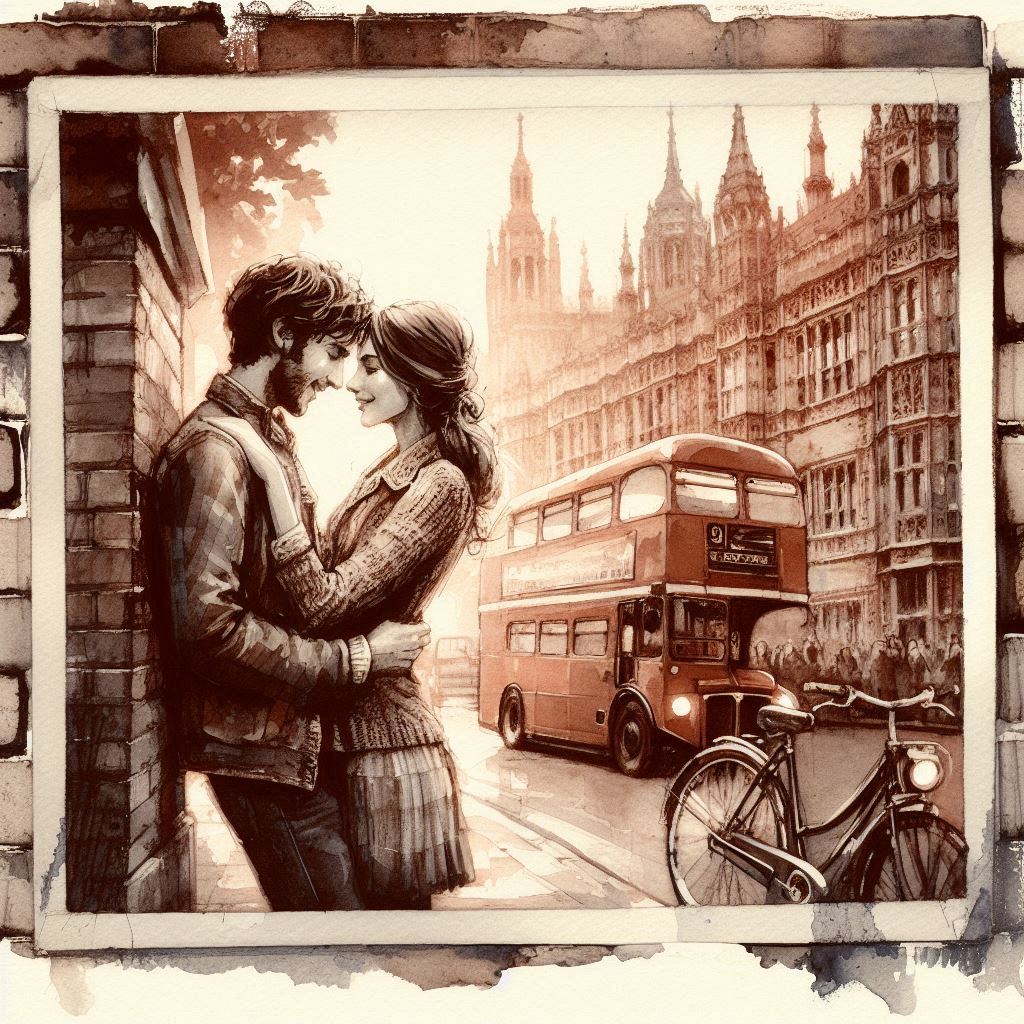
Photograph
Thoughts – by E. Ashcroft
This poem presents itself as a recollection, yet it is less about memory than about the revision of memory. The speaker does not merely recall a day; he curates it. The opening question, “What wouldst thou have it be?”, immediately establishes a defensive posture. It is not an innocent inquiry but a pre-emptive negotiation of interpretation. The speaker senses accusation, or at least dissatisfaction, and responds by reframing the past as an aesthetic act. He has “adorned” the photograph, scattered it with newsprint. Already we are in the realm of mediation. The memory is layered, edited, almost collaged.
The implied story is simple: two people, once united in reckless joy, caught in a storm that failed to damage their hearts. The day is labelled “immortal,” and one raises an eyebrow at that. Immortality declared in retrospect is often a symptom of loss. The detail that “thou didst not wish me ill” is particularly revealing. It suggests that the present state of affairs is otherwise. The poem is haunted less by the storm than by what followed. The lovers once fled “history and economy,” an intriguing phrase that hints at political or social pressure, or perhaps merely the banal intrusions of adult life. Whether literal or metaphorical, the escape is temporary. The rehearsal of tongues “upon my stair” gestures toward intimacy, verbal and physical, but remains tastefully evasive.
Stylistically, the archaic register persists, though here it feels slightly less organic than in some previous examples. The “wouldst,” “didst,” and “thou” maintain internal consistency, yet their gravity occasionally sits uneasily alongside contemporary elements like “newsprint” and “economy.” This tension is not necessarily a flaw, but it requires careful handling. At times, it reads as deliberate layering; at others, as tonal drift. The diction oscillates between elevated reminiscence and almost journalistic concreteness, and the balance is not always perfectly struck.
Technically, the rhyme scheme is somewhat irregular but discernible. “Be,” “me,” and “revelry” form a loose chain, while “scattered” and “unbattered” supply a cleaner echo. “Ill” and “skill” operate effectively, though predictably. The final return to “free” closes the sonic circle with “be” and “me,” creating a structural enclosure that mirrors the speaker’s attempt to seal the memory off from decay. The rhymes are competent, though occasionally too comfortable. “Ill” with “skill,” for instance, is serviceable but hardly daring.
The metre shows moments of strain, particularly in longer lines such as “On an immortal day of mad revelry,” where the syllabic load risks toppling the rhythm. The poem does not collapse, but it leans. One senses that sense sometimes overrides cadence, and not always gracefully. That said, the looseness may reflect the emotional looseness of recollection itself, which is rarely symmetrical.
Thematically, the most compelling element is the quiet admission of change. The line “When thou didst not wish me ill” carries more emotional weight than the declarations of revelry. It acknowledges a fracture without elaborating it. The poem is strongest where it implies deterioration rather than celebrating ecstasy. The attempt to immortalise the day through language feels slightly desperate, as though the speaker hopes that rhyme and archaism might preserve what reality has undone.
Overall, the poem is reflective, controlled, and faintly nostalgic, but it risks over-polishing its memory. It understands that recollection is an act of construction, and that awareness is admirable. Yet at times it leans too heavily on elevated phrasing to dignify what might have been more powerful in sharper, plainer terms. One leaves with the impression of a carefully framed photograph indeed: well composed, slightly staged, and aware of its own angle. The storm may have left the hearts “unbattered,” but time, one suspects, has not been so gentle.

 mvrcodelrio.com
Lascia un commento